Rodent Removal in Fort Pierce, FL
Droppings in the pantry, scratching that travels the length of a bungalow wall, oranges hollowed on the ground out back. Fort Pierce roof rats are old residents in an old housing stock. Tell us where the sign is showing and we will trace the route.
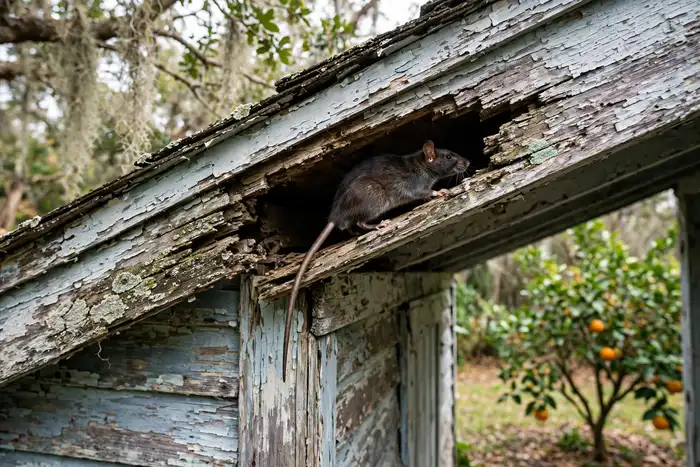
Rodents in your Fort Pierce home
Here the roof rat's oldest local name is the honest one: fruit rat. The same animal answers to palm rat and citrus rat across the Treasure Coast, but Fort Pierce earned the fruit name in the groves — generations of rats have lived in citrus canopy west of town and treated the nearest houses as an extension of the grove. They climb, they travel rooflines and fences, and they enter high: through a softened wood soffit, a gable vent, a gap where a porch roof meets the wall of a 1920s house.
The house mouse plays a small supporting role indoors here, and the Norway rat is a rarity this far south — when a Fort Pierce rodent call comes in, it is a roof rat until the sign says otherwise. Our answer is built for that animal: trap the attic population out, then seal the structure in materials a rat cannot gnaw, with the exterior routes — palms, citrus, wires, fence lines to the grove — walked and dealt with in the same plan. Poison is deliberately absent from that plan.
Wood soffits: the bungalow front door
Newer subdivisions fail at vent screens; Fort Pierce fails at carpentry. A wood soffit that has taken twenty wet summers rots at the corners and around nail lines until a roof rat can push through a section that still looks painted from the street. Painters have caulked over soft wood on half the older blocks in this city. Our inspection probes the soffit line physically, and the seal list for an old house routinely includes replacing rotted sections — sealing over sponge is not sealing.
The grove commute and the ripening calendar
West-side streets in White City and beyond sit with citrus behind them, and the rat traffic follows the fruit. From September into March, as oranges and grapefruit ripen, grove rats range wider and attic sign spikes in grove-edge homes; fallen fruit under a backyard tree is both evidence and invitation. Picking up drops and harvesting on time will not clear an infested attic, but a yard that holds fermenting fruit all winter will keep re-stocking one — grove-edge prevention is partly gardening, and we say which parts.
Waterfront blocks and the working port
Near the lagoon and the port, rats hold the rocks, docks and older commercial edges and work outward into the residential streets behind the waterfront. Palms along those blocks carry the same frond-skirt housing they do anywhere — a dead skirt is a rat apartment with a lagoon view — and pool-cage rooflines and boat-house roofs give them dry travel lines. Waterfront sealing has to assume a standing population at the seawall and harden the house accordingly, rather than treating each rat as a stray.
Crawlspaces, piers and the low route in
Half of Fort Pierce's older homes stand on piers with a crawlspace beneath, and rats use it as a staging floor: in through a broken vent, up through the plumbing and wiring penetrations in the floor, and into the wall voids from below. Sign shows differently down there — runways in the dust, droppings under the kitchen and bath, gnawed pipe insulation. A rodent plan for a pier house that only looks at the roofline solves the top half of the problem and leaves the bottom half breeding.
Winter rentals and dry drains
Fort Pierce has many houses that work only in winter — rentals and second homes that sit shut through the summer. A shut house stops flushing, its drain traps evaporate, and the sewer connection becomes an open rat route into the building; the state's extension research documents this in vacant Florida homes. Returning owners find droppings in a house with every above-ground entry sound. Our vacant-house rodent check runs the plumbing as well as the roofline, and leaves owners a simple trap-topping routine for whoever watches the house.
Why trapping without sealing fails on old houses
On a street where every third house has rats, trapping alone is a harvest, not a solution — the grove and the lagoon refill the vacancy. Sealing alone, done while rats are inside, walls them into the voids to die, which trades the problem for a worse-smelling one. The order is fixed: confirm the animal, trap the residents out on a checked schedule, then close every route at rat scale — soffit, vent, floor penetration and cage line — so the refilled vacancy never happens.
Common rodent questions in Fort Pierce
Are these really rats, or could they be squirrels?+
My soffits look fine from the ground. Why does the crew want to replace sections?+
The grove behind us was just cleared. Should we expect trouble?+
Do you use bait boxes around the house?+
What does roof rat work cost in Fort Pierce?+
Other Fort Pierce problems that come with rodents
Our wildlife crew handles these closely related problems — the ones that most often turn up with a rodent issue.
Got more than rodents in Fort Pierce?
Rodents are rarely the only thing using an attic or yard in Fort Pierce. See everything we handle locally on the Fort Pierce wildlife removal hub, or jump to Florida wildlife removal.
Serving all of St. Lucie County
Fort Pierce is one part of St. Lucie County. See wildlife removal in St. Lucie County, FL for the county-wide picture — the animals we get called about most, and the other towns we cover.
One call to your Fort Pierce rodent crew
The longer rodents stay in the attic, the more they chew and the bigger the cleanup. Call us and tell us about the job — we will confirm the local crew for your county before any work starts.
- Local to St. Lucie County. FWC-compliant handling — call to ask about licensing and insurance.
- Humane exclusion. One-way doors and steel sealing, not poison.
- Done right. Removal, exclusion and cleanup.