Dead Animal Removal in Fort Pierce, FL
The house smells like a problem with no visible author — strongest by the fireplace, or in the back bedroom, or rising through the floorboards. In a century-old house the hiding places are endless, but odor obeys rules. Tell us where it reads strongest and we will start the map there.
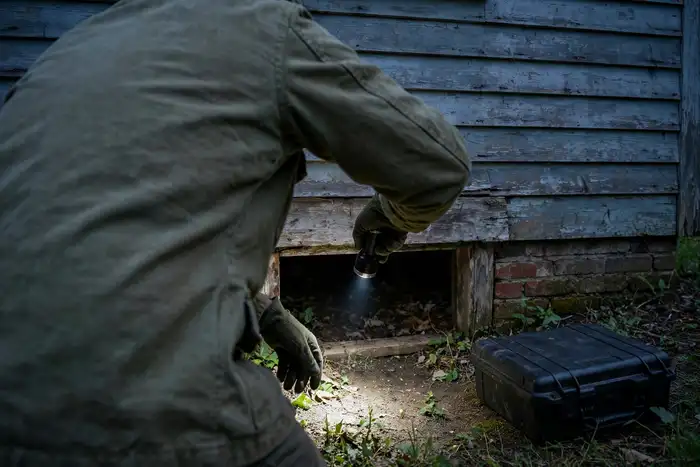
Dead Animals in your Fort Pierce home
Fort Pierce's dead-animal calls have a flavor newer cities cannot match, because its houses hide things so well. A raccoon kit that never left a chimney flue. A squirrel in the wall over a fireplace. An opossum that spent its last winter in a crawlspace under a pier-foundation cottage. A roof rat in the void behind a kitchen that has been remodeled three times. Florida's heat and humidity move every one of these cases quickly — the interval between 'something is off' and 'the house is unlivable' is measured in days here, not weeks.
Our sequence does not change with the address: locate the animal precisely, remove it, sanitize what it has touched, and seal the way it got in. Skipping the last step is how a household buys this service twice. Winter adds the local variation — houses that sat closed through the summer greet returning owners and tenants with a fully matured version of the problem, and those calls are treated as the whole-house investigations they are.
Chimney cases: Fort Pierce’s specialty
Masonry flues collect the saddest files: a young raccoon down from the smoke shelf, a squirrel past the damper, birds trapped in a flue capped just carelessly enough. The signature is an odor that serves every room the chimney passes and sharpens whenever the house warms. Retrieval works from wherever the animal lies — cleanout, damper, or the top — and the same visit answers the forward question: a proper cap, fitted over a verified-empty flue, retires this exact story for this exact house.
Reading odor in an old floor plan
Smell concentrates near its source, climbs heat currents, and pools in the still rooms. We grade it room by room and floor by floor, then lay that map over what an old Fort Pierce house actually contains — flues behind plaster, chases beside the chimney breast, additions whose framing nobody alive remembers. The strongest-reading wall at the lowest point of the smell's daily cycle is a more honest witness than any guess, and it is where access, if access must be cut, gets discussed.
Crawlspaces and the under-house ending
Beneath a raised house, an opossum or an ailing raccoon that denned for the winter can die in the far corner, directly under the bedroom, unnoticed until a warm week carries the evidence up through the floor. Retrieval down there is close, unpleasant work — low headroom, old insulation, plumbing everywhere — and it finishes with the sanitizing of the site and the repair of the vent or access door that admitted the animal. An under-house left open is simply the same appointment booked for next season.
Wall voids in much-remodeled houses
Animals fall into wall cavities from attics and cannot climb smooth framing back out; in houses remodeled in layers, those cavities can be sealed boxes with no top or bottom access at all. When the odor map fixes a carcass in such a void, the remedy is a small, deliberate opening at the mapped spot — measured, discussed with you first, and placed where the patch afterward is easiest. Exploratory demolition is not part of the method; evidence is.
Sanitizing: treatment, not fragrance
Once the source is out, fluids that migrated into insulation, wood and plaster keep the smell on reduced power for weeks if left alone. Fouled material within reach comes out, the void's surfaces are treated with sanitizing agents, and the space is aired. We scope the treated area from what we find rather than from a package — a single rat over a ceiling joist and a summer-long crawlspace case sit at opposite ends of that scale, and the estimate should reflect your end of it.
The winter-return discovery
Owners and tenants arriving in October through January meet the accumulated version: an animal that entered through a storm-loosened soffit in August and died in September has had the whole humid autumn to announce itself. First moves matter — air the house, resist flooding it with scent, and note the strongest room before the air conditioning homogenizes the evidence. We then run the full sequence on the whole structure, because a house that admitted one animal while empty rarely stopped at one entry.
Common dead animal questions in Fort Pierce
Why is the smell worst around the fireplace?+
Will walls have to be opened?+
Could the odor be a plumbing problem instead?+
How long does the smell persist if we do nothing?+
What does dead animal removal cost in Fort Pierce?+
Other Fort Pierce problems that come with dead animals
Our wildlife crew handles these closely related problems — the ones that most often turn up with a dead animal issue.
Got more than dead animals in Fort Pierce?
Dead Animals are rarely the only thing using an attic or yard in Fort Pierce. See everything we handle locally on the Fort Pierce wildlife removal hub, or jump to Florida wildlife removal.
Serving all of St. Lucie County
Fort Pierce is one part of St. Lucie County. See wildlife removal in St. Lucie County, FL for the county-wide picture — the animals we get called about most, and the other towns we cover.
One call to your Fort Pierce dead animal crew
The longer dead animals stay in the attic, the more they chew and the bigger the cleanup. Call us and tell us about the job — we will confirm the local crew for your county before any work starts.
- Local to St. Lucie County. FWC-compliant handling — call to ask about licensing and insurance.
- Humane exclusion. One-way doors and steel sealing, not poison.
- Done right. Removal, exclusion and cleanup.