Bat Removal in Fort Pierce, FL
A decade of droppings in the attic insulation, a papery stirring in the chimney at dusk, bats slipping out of a soffit corner over the porch. Old houses collect bat colonies quietly. Tell us what you have found — and know that the calendar governs what happens next.
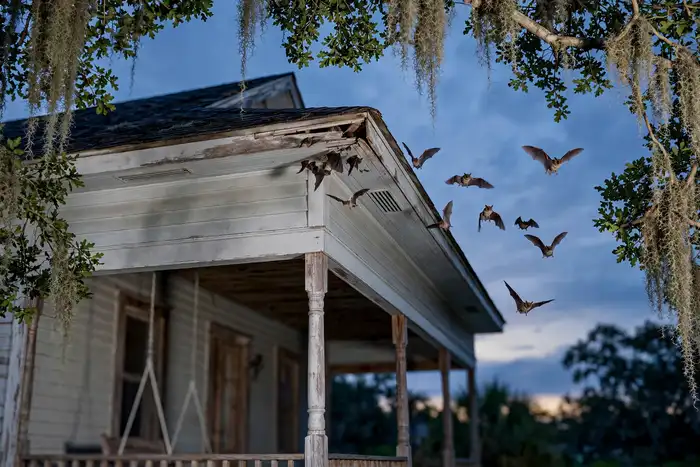
Bats in your Fort Pierce home
Fort Pierce's bats are connoisseurs of old construction. The evening bat takes the small roosts — a family group behind a bungalow's soffit or in a warm wall top. The Brazilian free-tailed bat, the state's commonest bat, builds the big colonies in the broad, hot attics of older homes and around chimney masonry, then pours out at dusk to work the lagoon and the inlet, where insects over the water are thickest. Between them they account for nearly every roost in the city, and both species are creatures of habit: a good roost is used for years.
Florida protects its bats completely. They may not be harmed or killed at any time, and the single legal tool is exclusion — one-way devices at the exits, everything else sealed — permitted only from August 15 to April 15. The closed season, mid-April through mid-August, is maternity time, when the roost holds pups that cannot fly. Because that closed season overlaps the storm months, Fort Pierce bat work is a planning exercise as much as a roofing one.
Chimneys and attics: roosts in the historic stock
The generous attics of 1920s housing — high, vented, undisturbed for months at a time — are premium bat habitat, and the masonry chimney adds warm crevices at exactly the height bats prefer. Guano concentrates under the roost seam rather than scattering, so the evidence in an old Fort Pierce attic is often a single telling ridge of droppings below one gable or flue. Reading that evidence tells us the roost's size, age and exit before we ever schedule a dusk watch to confirm it.
The dusk watch on a lagoon-side street
Bats file out at dusk in ones and twos, then in a stream if the colony is large, and an old house may have a dozen candidate gaps between chimney flashing, soffit returns and gable vents. Watching which seam actually produces bats — rather than sealing the obvious holes and hoping — is the difference between exclusion and expensive guesswork. Fort Pierce watches are pleasant work, at least: the colony leaves over the lagoon, and the count we take that evening sizes the whole job.
What exclusion looks like on an old house
The working exits receive one-way fittings sized to the species; every other gap the inspection mapped is sealed, which on a century-old house means a carpentry list as much as a bat list — re-screened gable vents, pointed mortar at the chimney shoulder, soffit corners rebuilt where they have gone soft. Over the following nights the colony leaves to feed and cannot re-enter, and once the dusk count reads zero for a proper stretch, the fittings come off and their exits are closed like the rest.
Why June and July discoveries wait — and why that is not neglect
A colony found in early summer contains flightless young. Excluding then would strand them in the attic, which is why Florida forbids it outright. The useful summer work is everything around the devices: species identified, exits counted, carpentry and sealing completed where it traps no one, and the exclusion booked for the first days after August 15. Homeowners who call in June get August dates; homeowners who call in late August join a queue behind the storm season's damage — the arithmetic favors the early call.
Old guano in old attics
Years of roosting leave their deposit, and in a house where the attic also stores a family's overflow, that deposit needs respectful handling: protective equipment, containment, and removal of the fouled insulation section rather than stirring it through the house. Dried droppings can carry a fungus best not breathed as dust. Scope follows the roost's history — a two-season evening bat corner is an hour's cleanup; a free-tailed colony of a decade is a project, and the estimate will say which one you have.
Bats and the storm season in a waterfront town
Hurricanes rearrange bat geography. A storm that strips tiles and soffits on the historic blocks creates new roosts the same week it destroys tree roosts, and colonies displaced from damaged houses prospect the survivors. If your roof takes damage in a September storm, an attic check belongs on the repair list before the new soffits go on — sealing a storm-made opening in October, inside the legal window, can prevent a colony rather than evict one.
Common bat questions in Fort Pierce
I found bats in my attic in May. Why can nothing be done until August?+
Are the bats in Fort Pierce houses dangerous?+
One bat got into the living room. Is that the colony?+
My chimney sweep found droppings in the flue. Same problem?+
What does bat exclusion cost in Fort Pierce?+
Other Fort Pierce problems that come with bats
Our wildlife crew handles these closely related problems — the ones that most often turn up with a bat issue.
Got more than bats in Fort Pierce?
Bats are rarely the only thing using an attic or yard in Fort Pierce. See everything we handle locally on the Fort Pierce wildlife removal hub, or jump to Florida wildlife removal.
Serving all of St. Lucie County
Fort Pierce is one part of St. Lucie County. See wildlife removal in St. Lucie County, FL for the county-wide picture — the animals we get called about most, and the other towns we cover.
One call to your Fort Pierce bat crew
The longer bats stay in the attic, the more they chew and the bigger the cleanup. Call us and tell us about the job — we will confirm the local crew for your county before any work starts.
- Local to St. Lucie County. FWC-compliant handling — call to ask about licensing and insurance.
- Humane exclusion. One-way doors and steel sealing, not poison.
- Done right. Removal, exclusion and cleanup.