Snake Removal in Fort Pierce, FL
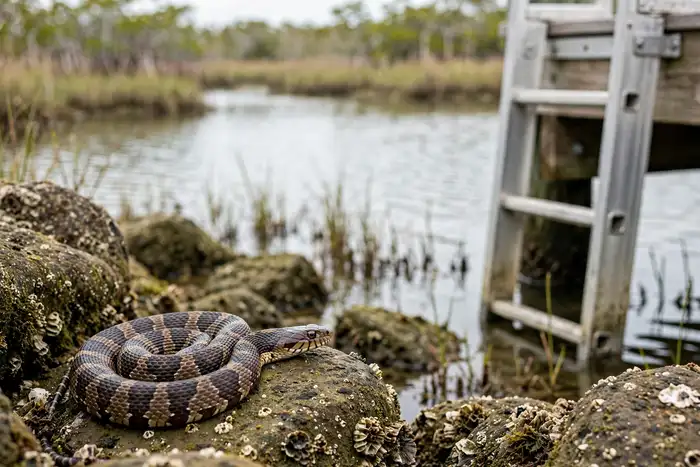
It is coiled by the dock ladder, stretched along the jetty rocks, or moving through the garden mulch with the dog at full volume. Keep your distance and your eyes on it if you safely can, then call — in snake work, a name comes before a hand, every time.
Snakes in your Fort Pierce home
Fort Pierce gives a snake watcher every habitat in one small city. At the docks and along the inlet, the heavy swimmer is usually the Florida banded water snake — harmless, fish-eating, and cursed with a strong resemblance to the cottonmouth it is always mistaken for. In gardens and rock edges, southern black racers hunt lizards by day, and corn snakes — red rat snakes — and eastern rat snakes climb after the roof rats this town grows so well.
The venomous roster here is exact: the cottonmouth where fresh water meets marsh and canal, the eastern diamondback rattlesnake in the dry scrub and grove margins west of town, the small dusky pygmy rattlesnake in wet prairie edges and low ground, and the banded, burrowing eastern coral snake in leaf litter. Four species justify real caution — and the dozens of harmless encounters justify identification before alarm. That ordering is the service.
The dockside dilemma: water snake or cottonmouth
No identification in Fort Pierce matters more, and none is harder from six feet up a dock. The banded water snake flattens its head, strikes readily when cornered and performs menace convincingly. The cottonmouth is heavier through the body, carries a strongly angular head with a dark band through the eye, and tends to hold position and gape rather than flee. Even experienced eyes want a photograph and a minute. Send both when you call; if the snake must be treated as unidentified, it is treated as venomous — that is the standing rule, not a judgment on your photography.
Jetty rocks, seawalls and racer country
The inlet's rock — jetties, riprap, seawall rubble — warms in the sun and shelters lizards, which makes it racer territory. A long, matte-black snake pouring itself across the rocks at midday is a southern black racer doing pest control; it is fast, nervous and entirely harmless, and it will vacate given a moment and an escape line. Callers fear it because it does not fear the open. Knowing that one fact converts most jetty calls from removals into identifications, and we are content when they end that way.
West of town: diamondbacks and pygmies
The two rattlesnakes divide the western ground by moisture. Diamondbacks take the dry side — sandhill patches, grove margins, palmetto scrub along the undeveloped parcels — a heavy, honest snake that rattles a warning and wants only distance. Pygmies take the wet side: ditch edges, low prairie, the soggy corners of grove-edge lots, small and thick with a rusty stripe and a rattle too tiny to carry. A pygmy in a garden bed is the encounter we most want called in rather than handled, precisely because its size invites underestimation.
Coral snakes in bungalow gardens
The eastern coral snake lives underground and in leaf litter, surfacing after rain and during garden work, which is how Fort Pierce meets it: a slender, brightly banded snake uncovered by a rake in a shaded bed. It is venomous and, in the same breath, one of the shyest animals in the county — it does not chase, posture or defend a territory. The protocol is simple: step back, keep the dog back, and let us move it. The garden lesson afterward is about litter depth against the house and gloves on hands that work in it.
The protected snake, and two referrals
One local snake is off the table entirely: the eastern indigo snake, Florida's great blue-black constrictor, is protected, and we do not handle it — a sighting earns admiration from a distance and, if it is in harm's way, a call to FWC. The same referral logic covers a gopher tortoise at its burrow, which is state-protected and permit-only, and any alligator of concern, which belongs to FWC's statewide nuisance alligator program rather than to a private crew. Knowing whose job a species is forms part of this one.
A yard snakes pass through, not one they keep
Snakes settle where food and cover overlap. Cut the cover back from paths and dock steps, keep lagoon-edge plantings trimmed off the ground, clear leaf litter from against the foundation, and address the roof rats and frogs that stock the pantry — a rat snake in the attic is a symptom, and sealing the rats' entries treats it. On lagoon and grove-edge lots, zero is not an available outcome; a yard arranged so snakes hunt the far margin instead of the doorstep is.
Common snake questions in Fort Pierce
A snake is on my dock right now. What do I do first?+
Can you tell a cottonmouth from a water snake over the phone?+
Are rattlesnakes common in Fort Pierce yards?+
A black snake lives under my steps and eats lizards. Must it go?+
What does snake help cost in Fort Pierce?+
Other Fort Pierce problems that come with snakes
Our wildlife crew handles these closely related problems — the ones that most often turn up with a snake issue.
Got more than snakes in Fort Pierce?
Snakes are rarely the only thing using an attic or yard in Fort Pierce. See everything we handle locally on the Fort Pierce wildlife removal hub, or jump to Florida wildlife removal.
Serving all of St. Lucie County
Fort Pierce is one part of St. Lucie County. See wildlife removal in St. Lucie County, FL for the county-wide picture — the animals we get called about most, and the other towns we cover.
One call to your Fort Pierce snake crew
The longer snakes stay in the attic, the more they chew and the bigger the cleanup. Call us and tell us about the job — we will confirm the local crew for your county before any work starts.
- Local to St. Lucie County. FWC-compliant handling — call to ask about licensing and insurance.
- Humane exclusion. One-way doors and steel sealing, not poison.
- Done right. Removal, exclusion and cleanup.