Armadillo Removal in Fort Pierce, FL
By morning the big lot looks worked over — shallow holes everywhere, mulch scattered, a burrow mouth gaping under the porch where none was last week. On Fort Pierce's sandy ground, that is an armadillo with a route and a home base. Show us both and we will deal with both.
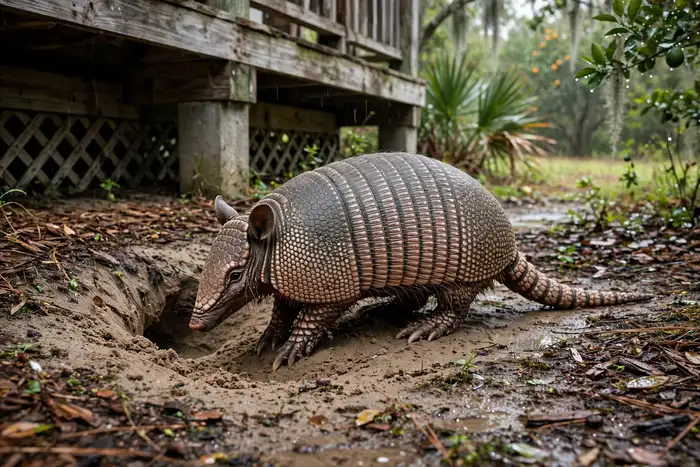
Armadillos in your Fort Pierce home
The nine-banded armadillo suits Fort Pierce's outer neighborhoods precisely. In White City and Fort Pierce South, lots run large, soil runs sandy, and groves and undeveloped parcels stand a street away — an armadillo can burrow in a quiet bank, feed across three lawns after rain, and trouble nobody's attic while it rearranges everybody's landscaping. It digs with its nose down and its claws busy, hunting grubs, worms and insects a few inches under the surface.
Before any plan, one fact about this animal has to be on the table: the armadillo is nonnative in Florida, and a captured one cannot be relocated or released — not at a grove, not at a preserve, not anywhere in the state. Companies that hint at catching yours and letting it go out in the country are describing something the law forecloses. Our armadillo work is lawful removal under FWC Rule 68A-9.010 with the property owner's authorisation, finished with burrow closure.
Night feeding versus a home burrow
Two different problems share one animal. Feeding sign is the scattered, shallow digging across open lawn — dozens of neat holes after a wet night, worst where grubs are thick. A burrow is an address: a round entrance, commonly under a porch, a slab edge, a shed or a bank, with the excavated sand fanned out front. Feeding visits from a burrow two streets away call for one response; a chamber dug beneath your own porch calls for removal and closure together, because the hole — not just the animal — is what the next tenant inherits.
Porches and slabs on sandy soil
Fort Pierce's sand digs like a beach and holds a burrow's shape just well enough to be dangerous to what stands over it. An armadillo chamber beneath a porch slab or at a pool deck's edge removes support grain by grain; the visible bill arrives later as a settled corner, a cracked step, pavers gone uneven. Older homes with shallow footings feel it first. When we map a burrow, the first question is always what it runs under, and that answer orders the job's urgency more than the lawn damage does.
Grove margins keep the supply coming
At the western edge, armadillos live the agricultural year: grove floors and ditch banks for burrows, irrigated ground for feeding, and the big residential lots of the outer neighborhoods as an extension of both. A grove-edge homeowner who removes one animal and closes nothing may meet its replacement within the season. We will tell you plainly when your lot sits on that kind of thoroughfare — the closure work and edge barriers then matter more than any single removal, and expectations deserve to be set accordingly.
What actually discourages the digging
Grub treatment lowers a lawn's reward and is worth doing, but an armadillo's diet runs well beyond grubs, so treated lawns still get sampled. Granular repellents, in our experience on these streets, scent the holes without stopping them. Barriers work where they are built like barriers — a fence or porch skirt with a buried, outward-bent apron an animal cannot dig past. Half-measures fail against a digger this single-minded; the honest menu is removal, closure, and real edging on the sides that matter.
Burrow closure: finishing the excavation story
Once the system is confirmed empty, entrances are closed down and the runs beneath structures are dealt with so voids do not keep settling. An open, abandoned burrow is premium housing for opossums and other diggers, and on grove-edge lots it will not stay vacant a full season. Closure is also the moment to protect the porch and slab edges the animal preferred — those exact lines are where the next prospector will test first.
Timing: rain, dusk and the warm months
Armadillos surface at dusk and work deepest after rain softens the ground and brings food up. The warm months are their busiest — which is also when Fort Pierce lawns are being watered into perfect digging condition. Calls cluster accordingly. If your damage appears only after storms, say so: that pattern usually means a feeding visitor rather than a resident burrow, and the plan — and its price — differ accordingly.
Common armadillo questions in Fort Pierce
Can you trap our armadillo and release it in the groves?+
How do I know it is an armadillo and not a raccoon digging?+
The burrow goes under our porch. How serious is that?+
Will removing one animal end it?+
What does armadillo removal cost in Fort Pierce?+
Other Fort Pierce problems that come with armadillos
Our wildlife crew handles these closely related problems — the ones that most often turn up with a armadillo issue.
Got more than armadillos in Fort Pierce?
Armadillos are rarely the only thing using an attic or yard in Fort Pierce. See everything we handle locally on the Fort Pierce wildlife removal hub, or jump to Florida wildlife removal.
Serving all of St. Lucie County
Fort Pierce is one part of St. Lucie County. See wildlife removal in St. Lucie County, FL for the county-wide picture — the animals we get called about most, and the other towns we cover.
One call to your Fort Pierce armadillo crew
The longer armadillos stay in the attic, the more they chew and the bigger the cleanup. Call us and tell us about the job — we will confirm the local crew for your county before any work starts.
- Local to St. Lucie County. FWC-compliant handling — call to ask about licensing and insurance.
- Humane exclusion. One-way doors and steel sealing, not poison.
- Done right. Removal, exclusion and cleanup.