Wildlife Removal in Parma, OH
Parma is block after block of postwar ranches and Cape Cods packed close together, almost every lot with its own detached garage, shed and low deck out back. That density is exactly what wildlife likes — cover, food and a warm structure are never more than a few feet apart. Call us and tell us about the job — we will confirm the local crew for your county before any work starts.
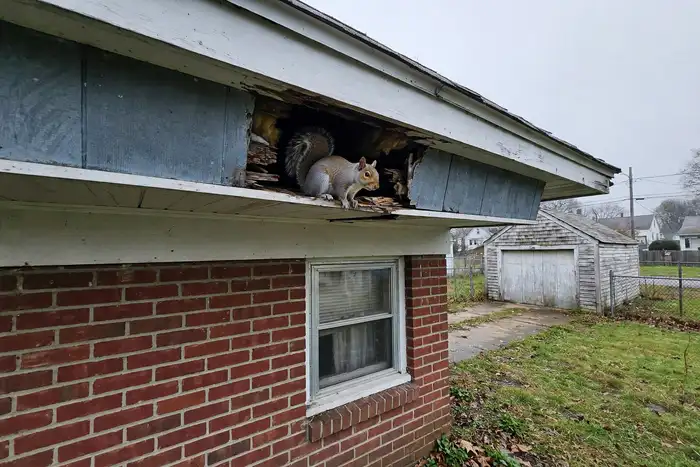
Why Parma homes see the wildlife they do
Parma grew fast after the war, and it shows in the housing. Street after street is lined with small ranches and Cape Cods from the 1950s and 1960s, set on narrow lots with short setbacks, a driveway running back to a detached garage and often a shed behind that. For a homeowner that layout is practical. For wildlife it is a connected system: a groundhog under the shed, a skunk under the deck, squirrels in the garage roof and mice in the basement can all be working the same small yard at the same time.
The age of the stock is the other half of the story. Roofs, soffits and fascia on houses this old have been through decades of lake-effect snow, ice and freeze-thaw cycles that pry seams open a little more each winter. A gap that starts as a lifted soffit corner in March is a squirrel entry by fall, when animals push hardest to get inside before the cold. Down low, older foundations, basement windows and worn garage door seals give mice and chipmunks their own way in.
Our wildlife crew works Parma the way the housing demands: start with a full look at the house, the garage and the structures out back, identify each animal and its entry, remove it the way Ohio rules require, and then close the openings with metal so the next animal on the block cannot simply move into the same hole. On lots this close together, sealing is not the finishing touch — it is the job.
One small lot, four structures for animals to use
A typical Parma parcel holds more wildlife shelter than lots twice its size elsewhere. The house itself has an attic and a basement. The detached garage has its own roof void, often with stored boxes, birdseed or pet food inside. The shed sits low, sometimes right on the ground, with a dark gap underneath. And the deck or concrete stoop against the back of the house creates a covered, dry cavity that stays hidden from view.
Animals divide that space up. Groundhogs and skunks take the ground-level cavities because they are poor climbers and want to dig or shelter at grade. Squirrels take the garage and house rooflines. Chipmunks take the voids inside stoops and retaining walls. Mice take the basement. Treating only the structure where you first noticed a problem usually just moves activity to the next one over, which is why a Parma inspection covers the whole lot.
It also explains why a neighbor can have the same problem in the same month. When one yard is sealed properly and the next is not, the animals concentrate where the openings remain.
Aging roofs and soffits on 1950s and 1960s houses
Most Parma houses are at the age where the roofline needs watching even if the shingles look fine from the street. Wooden soffits and fascia have been repainted many times, and paint can bridge over a soft or separated board without restoring it. Cape Cods add their own weak points: the short eaves, the junctions where dormers meet the main roof, and knee-wall spaces behind upstairs rooms that connect straight into the attic.
Freeze-thaw does the quiet damage. Water gets into a seam, freezes, widens it, melts and gets in deeper next time. By the time a homeowner hears scratching overhead in October, the opening has often been growing since spring. Gray squirrels only need a gap they can get their head through to start chewing, and once one squirrel has enlarged a soffit corner, the hole advertises itself to the next one.
A careful exclusion on this housing stock means checking every dormer junction, every soffit corner and every vent — not just the hole with droppings under it — and closing each one in metal that freeze-thaw cannot work loose the way caulk and foam can.
Under decks, sheds and stoops: the ground-level city
If Parma attics belong to squirrels, the ground belongs to skunks and groundhogs. Low decks built close to grade are the single most common den site in the city: the space underneath is dry, dark, protected from dogs and weather, and usually impossible for a homeowner to see into. Concrete stoops are often hollow underneath, and once an animal digs in at the edge, it has a solid-roofed burrow that can last for years. Sheds set on skids or a gravel pad offer the same cover.
The signs are ground-level too: a fan of fresh soil at a deck edge, a burrow entrance about the width of a dinner plate for a groundhog, the faint skunk smell on a still evening, or a dog that suddenly cares intensely about one corner of the yard. In late winter and spring these dens hold young as well as adults, which changes how removal has to be timed and handled.
Closing these spaces off takes more than a board laid over a hole. Buried hardware cloth, fitted so an animal cannot dig under or pry it up, is what keeps a cleared deck or shed cleared.
Ohio seasons and Ohio rules shape every job here
Parma wildlife work runs on a northern calendar. Fall is the peak season: squirrels, raccoons and house mice all push indoors at the first hard frosts, and a house that was quiet in August can have three problems by November. Winter slows some animals — groundhogs are true hibernators and vanish from roughly late October to February, and skunks den up through the coldest weeks — while big brown bats may be hibernating quietly inside the attic itself. Spring brings emergence, mating and litters, and a fresh round of digging.
The law is Ohio-specific too. Nuisance wildlife work for hire requires an ODNR Commercial Nuisance Wild Animal Control Operator license under ORC §1531.40. Under Ohio Administrative Code 1501:31-15-03(E)(3), captured raccoons, skunks and opossums cannot be relocated — they must be released on site or handled as the rule requires — so honest Ohio work is built on exclusion first: one-way doors, on-site release where the law allows, and sealing, rather than promises to haul animals away. Raccoons, skunks, foxes and bats are also Ohio's main rabies vectors, with bats the most frequently confirmed species, which is why none of these animals should ever be handled bare-handed.
Bats carry an extra calendar of their own: exclusion is closed from May 16 to July 31 for maternity colonies and from October 15 to March 31 for hibernation, without written ODNR permission. The open windows are April 1 to May 15 and August 1 to October 15 — timing a bat job right is a large part of doing it legally.
Wildlife we remove in Parma
From attic to basement to the shed at the back of the lot, our wildlife crew handles the full Parma list. These are the calls homeowners here make most.
🐿️ Squirrels
The top attic call in Parma. Aging soffits, dormer junctions and garage rooflines on postwar houses give gray squirrels an opening, and fall is when they push in hardest. Night noise points to flying squirrels instead. See our full Parma squirrel removal guide →
🦝 Raccoons
Strong climbers that tear at worn fascia, enter chimneys and raid garages. A rabies-vector species in Ohio, and one that cannot legally be relocated — exclusion and on-site handling under Ohio rules, with kits accounted for before any sealing.
🦇 Bats
Big brown bats roost behind gable vents and fascia gaps and may hibernate right in a Parma attic. Exclusion is only legal April 1–May 15 and August 1–October 15 without written ODNR permission, so inspections should happen before a window closes.
🦨 Skunks
The animal under Parma decks and stoops. Skunks den at ground level all over the city, spray when cornered by dogs, and are a rabies-vector species that Ohio law does not allow to be relocated. Exclusion and screened-off dens are the fix.
🦫 Groundhogs
Burrow systems under sheds, decks and foundations, with entrances that undermine slabs and stoops. True hibernators — gone from late fall to February, then back digging at spring emergence with young to follow.
🐾 Opossums
Quiet tenants of garages, sheds and the space under decks, often found when a dog corners one at night. Ohio law bars relocating opossums, so the work is removal from the structure and sealing the shelter they were using.
🐿️ Chipmunks
Burrows inside retaining walls, hollow stoops and sidewalk edges all over Parma, with soil and undermined pavers as the visible damage. Small animals, surprisingly large tunnel systems.
🐀 Rodents
House mice pour into Parma basements every fall through gaps around pipes and worn door seals; Norway rats work older garages and foundations; voles carve surface trails through lawns that show up at snowmelt. Sealing beats bait, every time.
🐍 Snakes
Almost always a harmless garter snake or rat snake in a basement, garage or garden bed. Northeast Ohio snakes are overwhelmingly nonvenomous — the job is identification and calm removal, not fear.
🕯️ Dead animals
A smell that builds in one room through winter usually means an animal died in a wall or attic — often a mouse or squirrel that got in during fall. A pro locates it, removes it tastefully and finds the opening it used.
Animal-specific help in Parma
Deep, local guides for the problems we get called about most — with our wildlife crew behind every one.
How to get help in Parma
Tell us what you're hearing
Scratching in the attic, a snake by the porch, holes in the yard — call with your problem and your Parma address.
We connect you locally
Call us and tell us about the job — we will confirm the local crew for your county before any work starts.
They solve it — for good
Inspection, humane removal, full exclusion and cleanup — handled by our wildlife crew, following Ohio rules.
Common wildlife removal questions in Parma
Who do I call for wildlife removal in Parma?+
Why do Parma houses seem to get so many different animals?+
When is Parma wildlife season at its worst?+
Can a raccoon or skunk in Parma just be trapped and released somewhere else?+
There is a smell under my deck but I never see an animal — what is it likely to be?+
How much does wildlife removal cost in Parma?+
Serving all of Cuyahoga County
Parma is one part of Cuyahoga County. See wildlife removal in Cuyahoga County, OH for the county-wide picture — the animals we get called about most, and the other towns we cover.
One call to your Parma wildlife crew
Whether it's squirrels in an older in-town attic or a raccoon in a new subdivision crawlspace, the fastest fix is our wildlife crew, who knows Cuyahoga County wildlife. Call us and tell us about the job — we will confirm the local crew for your county before any work starts.
- Local to Cuyahoga County. ODNR-compliant handling — call to ask about licensing and insurance.
- One company, one call. Call us and tell us about the job.
- Done right. Removal, exclusion and cleanup.