Chipmunk Removal in Parma, OH
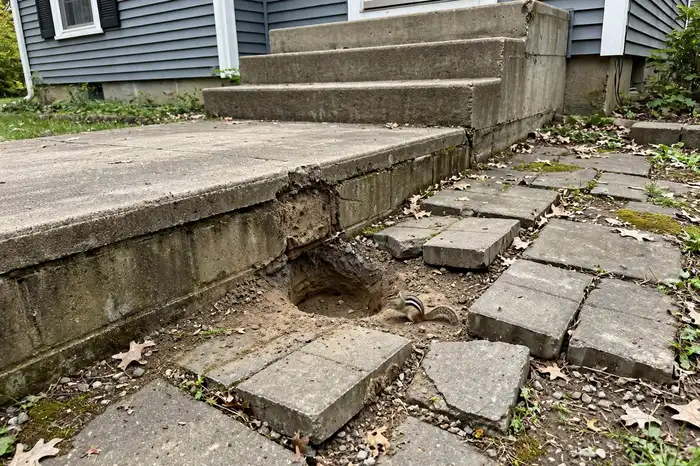
A neat little hole at the base of the retaining wall, pavers that have started to tilt, and a striped blur diving under the stoop every time you open the door? Chipmunks look harmless — the tunneling underneath Parma hardscaping is not. Call us and tell us about the job — we will confirm the local crew for your county before any work starts.
Chipmunks in your Parma home
Parma is full of chipmunk architecture. The city is built on retaining walls, raised planting beds, concrete stoops, paver patios and sidewalk slabs, and every one of those structures has exactly what a chipmunk wants: a protected void with soil behind it. A chipmunk burrow is far bigger than the animal — a tunnel system with a nest chamber, food storage and multiple exits — and unlike a groundhog's, its entrances are kept clean, with no dirt mound to announce them.
One chipmunk is a curiosity. Parma lots usually host several, drawn by bird feeders and foundation plantings, and their combined digging quietly undermines the hardscaping homeowners paid the most for. When a stoop starts to rock or a retaining wall bulges, chipmunks are very often the engineers.
How chipmunk burrows damage walls and stoops
A chipmunk removes soil a cheek-pouch at a time and hides the spoil, so the first sign of trouble is structural, not visual: a paver that sinks when stepped on, a stoop that develops a hollow sound, a retaining wall that starts to lean or shed soil through its joints after rain. Behind that wall, tunnels have replaced the compacted base the wall depends on. The burrow entrance itself is a clean round hole about two inches across, typically at the wall base, beside a stoop, or under a downspout splash block. Tunnels also channel rainwater into the disturbed soil, speeding the washout — freeze-thaw then heaves the loosened pavers further each winter.
Seasons: two litters and a winter slowdown
Ohio chipmunks are busy from spring through fall, raising litters in spring and again in mid-to-late summer, and spending autumn hauling seeds into the burrow's storage chamber. They do not truly hibernate; they drop into the burrow for long torpor stretches in winter, waking periodically to eat from storage. That means a burrow quiet in January is still occupied, and fall is when new systems get dug as young animals disperse and set up their own tunnels before the cold. Parma calls peak when the damage shows — spring wall repairs and fall paver problems.
The feeder connection
Almost every heavy chipmunk yard in Parma has a bird feeder at its center. Sunflower seed spilled on the ground is a guaranteed, year-round food supply steps from foundation cover, and chipmunks will build their whole territory around it. Feeders do not have to go, but seed on the ground is the population driver; a pro will tell you honestly that removal without changing the food picture means new chipmunks — and Parma has plenty — will refill the tunnels. Seed trays, cleaning up spill and moving feeders away from walls and stoops take pressure off the structures you are trying to protect.
What removal and exclusion look like for a two-ounce digger
Chipmunks are small enough that generic fixes miss them. Live trapping at active entrances removes the residents; Ohio lists chipmunks among the species that may be released or handled under the nuisance rules, and our crew works under the ODNR operator license. Then the voids have to be dealt with: entrances are closed with hardware cloth and backfill packed in stages, and vulnerable wall bases and stoop edges can be screened so the next animal cannot re-enter the same cavity. Simply collapsing the visible hole does nothing — the system has other exits, and a resident chipmunk digs a new doorway in a day.
Chipmunk, young groundhog or vole?
Homeowners mix these up constantly, and the fix differs. A chipmunk hole is small and clean, near a structure, and you'll usually see the animal itself during the day. A groundhog entrance is dinner-plate wide with a dirt fan. Vole damage is surface-level — shallow runways through grass and gnawed bark, no deep burrow at a wall. If you are seeing holes at a retaining wall and a quick striped animal in daylight, chipmunk identification is nearly certain; a pro confirms it in minutes on site and can tell you whether the wall's base is already undermined.
Common chipmunk questions in Parma
Chipmunks are under my Parma retaining wall — how serious is it?+
How do I get chipmunks out of my stoop or sidewalk?+
Will chipmunks come back after removal?+
Do chipmunks get into Parma houses like mice do?+
How much does chipmunk removal cost in Parma?+
Other Parma problems that come with chipmunks
Our wildlife crew handles these closely related problems — the ones that most often turn up with a chipmunk issue.
Got more than chipmunks in Parma?
Chipmunks are rarely the only thing using an attic or yard in Parma. See everything we handle locally on the Parma wildlife removal hub, or jump to Ohio wildlife removal.
Serving all of Cuyahoga County
Parma is one part of Cuyahoga County. See wildlife removal in Cuyahoga County, OH for the county-wide picture — the animals we get called about most, and the other towns we cover.
One call to your Parma chipmunk crew
The longer chipmunks stay in the attic, the more they chew and the bigger the cleanup. Call us and tell us about the job — we will confirm the local crew for your county before any work starts.
- Local to Cuyahoga County. ODNR-compliant handling — call to ask about licensing and insurance.
- Humane exclusion. One-way doors and steel sealing, not poison.
- Done right. Removal, exclusion and cleanup.