Groundhog Removal in Parma, OH
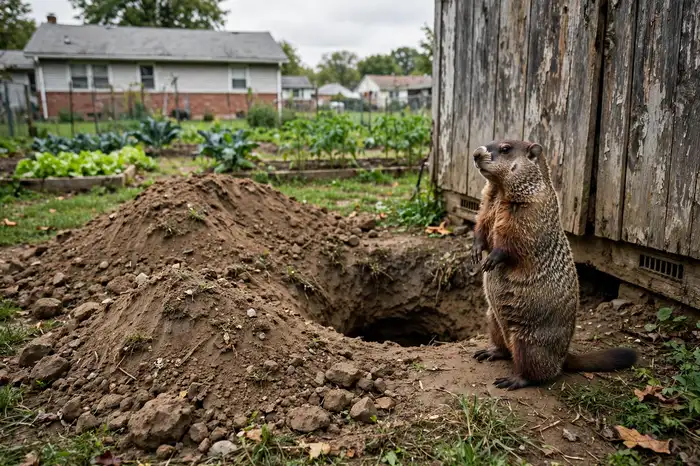
A hole the width of a dinner plate at the edge of the shed, a fan of fresh dirt, and the vegetable garden trimmed like someone took shears to it? That is a groundhog, and in Parma it is almost always living under a structure on your own lot. Call us and tell us about the job — we will confirm the local crew for your county before any work starts.
Groundhogs in your Parma home
The groundhog — the same animal as the woodchuck — is a digger first and everything else second. A single burrow system can run many feet with several entrances and chambers, and groundhogs strongly prefer to dig that system where the soil is sheltered: under Parma's sheds, decks, garage slabs, stoops and foundation edges. The main entrance gets a mound of excavated soil; a second, cleaner plunge hole nearby is the escape route most homeowners never notice.
Parma's tight lots make a groundhog a shared problem. One burrow system can start under your shed and surface at the neighbor's fence, and the garden damage — beans, peas, melon rinds, flowers — spreads across both yards. The animal is also working on a strict Ohio calendar: above ground and digging from spring to fall, then completely gone into true hibernation for the winter.
The hibernation calendar runs the whole job
Groundhogs are among the few true hibernators in Ohio. In Cuyahoga County they typically disappear into the burrow from about late October to February, living off stored body fat, and emerge thin and hungry in late winter to early spring. Mating follows emergence, and pups are born in spring and come above ground weeks later. Practically, that means fall is the season to screen a vacated burrow so spring does not start with a tenant, spring work must account for pups underground, and a burrow that is silent in January is not solved — it is asleep.
What a burrow does to slabs, stoops and foundations
The lawn holes are the least of it. A burrow tunneled under a concrete stoop, an AC pad, a shed base or a driveway edge removes the soil those structures rest on. Over a season or two the slab can crack, tilt or settle, and a burrow against a foundation wall gives rainwater a direct channel down to the basement — a real concern in Parma houses where the basement is finished or used for storage. The longer a system runs under a structure, the more soil it moves, so an active burrow at a foundation is a this-season job, not a someday one.
Finding every entrance, not just the obvious one
Homeowners usually find the main entrance because of its dirt mound. Groundhog systems almost always have at least one more opening — a plunge hole with no mound, often hidden in mulch, under a deck or at a fence line — and young groundhogs disperse in summer to dig satellite burrows nearby. Sealing or trapping at only the visible hole fails. A pro walks the whole lot and the fence lines, maps every entrance, and plans removal and screening around the full system. Ohio rules devote a specific subsection to woodchucks (OAC 1501:31-15-03(H)(6)), including how traps may be placed at burrows, and our crew works under the ODNR operator license Ohio requires.
How removal and screening work
Removal is timed to when the animal is active and, in spring, to the pups' development, so nothing is left underground. Once the system is confirmed empty, the openings are closed and the structure is protected with buried hardware cloth trenched down and bent outward along the shed, deck or foundation edge — a barrier a digging animal meets head-on and cannot get past. Filling a hole with loose dirt alone does nothing; a groundhog treats that as soft digging and reopens it, sometimes the same week, and an unoccupied but open burrow also invites a skunk or opossum to move in.
Gardens, fences and living with the lot you have
A Parma garden next to an active burrow will be eaten — groundhogs are bold daytime feeders and climb better than people expect, so a low fence alone rarely stops one at a fence line it can push under. The durable order is: remove the animal, screen the structure, then protect the garden. Keeping brush piles and tall weeds cleared from fence corners also removes the cover groundhogs like around a burrow entrance, making your lot less attractive to the next dispersing youngster in summer.
Common groundhog questions in Parma
A groundhog is under my Parma shed — how is it removed?+
The burrow went quiet in winter — did the groundhog leave?+
Can a groundhog really damage my foundation or stoop?+
I filled the hole and it was dug out again the next day — why?+
How much does groundhog removal cost in Parma?+
Other Parma problems that come with groundhogs
Our wildlife crew handles these closely related problems — the ones that most often turn up with a groundhog issue.
Got more than groundhogs in Parma?
Groundhogs are rarely the only thing using an attic or yard in Parma. See everything we handle locally on the Parma wildlife removal hub, or jump to Ohio wildlife removal.
Serving all of Cuyahoga County
Parma is one part of Cuyahoga County. See wildlife removal in Cuyahoga County, OH for the county-wide picture — the animals we get called about most, and the other towns we cover.
One call to your Parma groundhog crew
The longer groundhogs stay in the attic, the more they chew and the bigger the cleanup. Call us and tell us about the job — we will confirm the local crew for your county before any work starts.
- Local to Cuyahoga County. ODNR-compliant handling — call to ask about licensing and insurance.
- Humane exclusion. One-way doors and steel sealing, not poison.
- Done right. Removal, exclusion and cleanup.