Bat Removal & Exclusion in Parma, OH
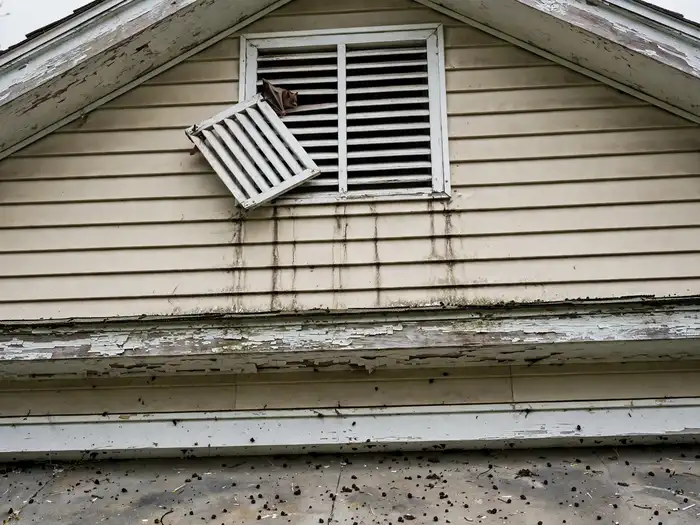
A scatter of small dark droppings on the siding or the driveway under a gable, or a bat circling a Parma bedroom at 2 a.m.? Timing decides what can legally be done about bats in Ohio — and the windows are narrower than most people expect. Call us and tell us about the job — we will confirm the local crew for your county before any work starts.
Bats in your Parma home
Parma's attic bats are overwhelmingly big brown bats, a species that has adapted to houses so completely that buildings are now its main roost habitat. A big brown needs a gap only about the width of a finger — behind a gable vent, under loose fascia, at a chimney flashing — and postwar Parma houses, with decades of freeze-thaw working at every seam, offer plenty. Colonies are usually found by their droppings, called guano, piling up below the entry or in the attic under the roost.
What surprises homeowners is that Ohio treats bats very differently from every other attic animal. Bats are protected, exclusion is the only legal removal method, and the state closes exclusion entirely during two long stretches of the year. Big brown bats also hibernate inside Ohio attics — a winter colony may be hanging silently in your roof right now. Getting the calendar right is not a detail; it is the job.
The two Ohio blackout windows
Under OAC 1501:31-15-03(H)(5), bat exclusion is prohibited from May 16 through July 31 when a maternity colony of five or more bats is present, because the pups cannot fly and would be trapped inside — and from October 15 through March 31 for any bats, because colonies are hibernating. Work inside either window requires prior written permission from the ODNR Division of Wildlife. The open windows are April 1 to May 15 and August 1 to October 15. If you find bats in June, the legal plan is an inspection now and an exclusion booked for August; anyone offering to seal a Parma colony out in June without ODNR permission is offering unlawful work.
Where bats enter a Parma ranch or Cape Cod
The classic Parma entries are gable-end vents with no screen behind the louvers, fascia boards that have pulled slightly away from the roof edge, gaps at chimney flashing, and the corners of dormers on Cape Cods where old trim has shrunk. Because the gap needed is so small, a house can look well kept from the street and still be open to bats in four places. An inspection at dusk, watching where bats emerge, is often the fastest way to find the active entry; the rest of the roofline still has to be checked and sealed, or the colony simply switches doors.
Guano, and a bat in the living space
Guano accumulates under a roost season after season. Dried guano can carry the fungus that causes histoplasmosis, a lung infection whose spores become airborne when the material is disturbed, so attic cleanup belongs to someone with proper protective equipment. Full insulation replacement is suggested more often than it is needed; ask what actually has to come out. A bat found in a bedroom or a room where someone was sleeping is a separate, urgent matter: bats are the most frequently confirmed rabies species in Ohio, so do not release it or handle it — close the room door and call, and contact your doctor or the health department about possible exposure.
How a legal exclusion actually works
Only a licensed Commercial Nuisance Wild Animal Control Operator may do bat exclusion for hire in Ohio. Within a legal window, the pro seals every gap on the house except the active entries, then fits those with a one-way bat valve that lets bats drop out at dusk to feed but not re-enter. Once emergence counts confirm the colony is fully out — which can take several nights of watching — the valves come down and the last openings are sealed permanently. The colony relocates itself to another roost; no bats are handled or harmed in a standard exclusion.
What not to do while you wait for a window
Do not caulk the entry shut. Sealing at the wrong time traps flightless pups in summer or torpid, hibernating bats in winter, and turns a clean exclusion into dead animals in the walls. Mothballs, bright lights and ultrasonic gadgets do not move an established colony. What does help while you wait: keep attic access closed, note where droppings appear and where bats emerge at dusk, and get the inspection done early so the exclusion is first in line when the window opens.
Common bat questions in Parma
I found bats in my Parma attic in July — can they come out now?+
When are the legal bat exclusion windows in Ohio?+
Do bats hibernate in Parma attics over winter?+
A bat got into my house — what should I do?+
How much does bat removal cost in Parma?+
Other Parma problems that come with bats
Our wildlife crew handles these closely related problems — the ones that most often turn up with a bat issue.
Got more than bats in Parma?
Bats are rarely the only thing using an attic or yard in Parma. See everything we handle locally on the Parma wildlife removal hub, or jump to Ohio wildlife removal.
Serving all of Cuyahoga County
Parma is one part of Cuyahoga County. See wildlife removal in Cuyahoga County, OH for the county-wide picture — the animals we get called about most, and the other towns we cover.
One call to your Parma bat crew
The longer bats stay in the attic, the more they chew and the bigger the cleanup. Call us and tell us about the job — we will confirm the local crew for your county before any work starts.
- Local to Cuyahoga County. ODNR-compliant handling — call to ask about licensing and insurance.
- Humane exclusion. One-way doors and steel sealing, not poison.
- Done right. Removal, exclusion and cleanup.