Dead Animal Removal in Parma, OH
A smell in one corner of the house that was faint on Monday and unmistakable by Thursday, with a few flies at the nearest window? In a Parma winter especially, that usually means an animal has died somewhere inside the house's structure. Call us and tell us about the job — we will confirm the local crew for your county before any work starts.
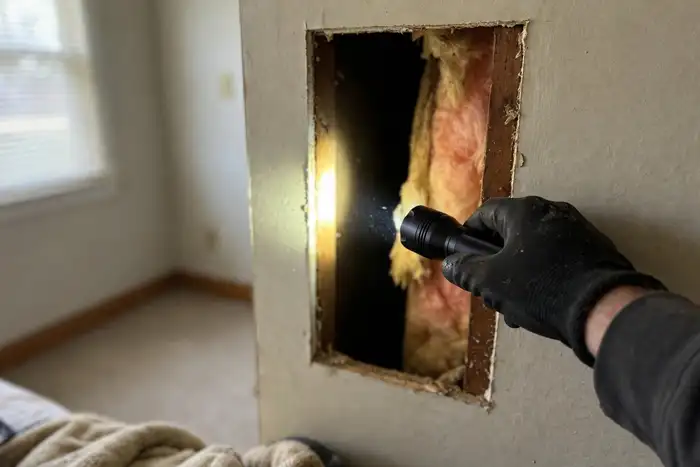
A dead animal in your Parma walls or attic
Parma dead-animal calls follow the seasons of entry. Mice and squirrels that moved into basements, walls and attics during the fall push sometimes die there over the winter — from poison set out in a previous attempt, from getting trapped in a wall void, or simply from age and cold in a hidden corner. A house can be quiet for months before the smell announces what happened. The other common story is a den animal — a young raccoon or opossum — left behind when an opening was sealed too quickly in spring.
However it happened, two things are true: the odor will not improve quickly on its own, and there is an opening in the house that a live animal used first. A proper job handles both halves — locate and remove the source, clean the area, and then find and close the way in, so this is not repeated with the next fall's arrivals.
How the search works in a postwar house
There is no scanner for this; a pro works by pattern. Odor is checked room by room and floor by floor, strongest near the source; flies gathering at a particular window or light confirm the neighborhood of the problem. In a Parma ranch or Cape Cod the likely locations are predictable: the bottom of a wall void, the insulation over a bedroom, a basement ceiling cavity along a pipe run, or the knee-wall space behind an upstairs room. Balloon-era framing is less common here than in older cities, but pipe chases and duct runs still let an animal die a long way from where it entered — and let the smell surface in a room it never entered alive.
The winter spike and the poison connection
Winter is dead-animal season in Parma for two reasons. Animals that came in during fall are sealed inside a closed-up house, and rodent poison does much of its work then: a poisoned mouse heads back to its hidden nest to die, usually inside a wall. If you set out bait in November and a smell starts in December, the connection is very likely, and mentioning the bait when you call saves real searching time. Heat matters too — a carcass near a duct or over a warm ceiling announces itself faster and stronger than one in a cold exterior wall.
Removal, cleanup and the question of cutting
Once located, the carcass is removed along with the insulation or debris immediately around it, and the area is cleaned and treated at the source — masking sprays do not fix a smell whose cause is still in the wall. Sometimes the only route to the animal is a small, careful opening in drywall or a ceiling. A good technician locates thoroughly first so any cut is small and in the right place, and you should ask up front about patching: most wildlife crews remove and sanitize but do not do drywall repair, so that finish work may be yours or a handyman's.
What to expect if you wait it out
Left alone, the smell follows a curve — building for days, peaking, then slowly fading as the remains dry out, often over roughly two weeks, longer in cold weather when everything slows down. Flies can persist after the worst of the odor, and a carcass in an attic can stain a ceiling below. Waiting is an option some people choose for a faint case, but a strong smell in living space, or any case where you cannot locate the source, is worth professional removal; the other thing waiting never does is close the opening the animal used.
Closing the story: find the entry
Every dead animal inside a Parma house is evidence — a mouse route through the foundation, a squirrel gap at the soffit, a den under the garage slab. After removal, the inspection turns to those routes: foundation and pipe gaps sealed for mice, roofline openings closed in metal for squirrels, den cavities screened. That final step is the difference between a one-time unpleasant job and an annual winter ritual, and on Parma's older housing there is almost always at least one opening to find.
Common dead animal questions in Parma
There is a dead-animal smell in my Parma wall — what do I do?+
How long will the smell last if I do nothing?+
I put out mouse poison and now something smells — is that connected?+
Why are there flies at one window all of a sudden?+
How much does dead animal removal cost in Parma?+
Other Parma problems that come with dead animals
Our wildlife crew handles these closely related problems — the ones that most often turn up with a dead animal issue.
Got more than dead animals in Parma?
Dead Animals are rarely the only thing using an attic or yard in Parma. See everything we handle locally on the Parma wildlife removal hub, or jump to Ohio wildlife removal.
Serving all of Cuyahoga County
Parma is one part of Cuyahoga County. See wildlife removal in Cuyahoga County, OH for the county-wide picture — the animals we get called about most, and the other towns we cover.
One call to your Parma dead animal crew
The longer dead animals stay in the attic, the more they chew and the bigger the cleanup. Call us and tell us about the job — we will confirm the local crew for your county before any work starts.
- Local to Cuyahoga County. ODNR-compliant handling — call to ask about licensing and insurance.
- Humane exclusion. One-way doors and steel sealing, not poison.
- Done right. Removal, exclusion and cleanup.