Wildlife Removal in Kent, OH
Kent housing turns over with the school year, and wildlife keeps its own calendar underneath that one: attics opened by hard winters, porches and crawlspaces left unsealed between tenants, and a river corridor that delivers animals to the door. Owners and landlords both end up making this call. Call us and tell us about the job — we will confirm the local crew for your county before any work starts.
Why Kent homes see the wildlife they do
The streets near Kent State and downtown hold a housing stock unlike a purely residential city: older houses converted to rentals, duplexes, and small multi-unit buildings standing beside owner-occupied homes of the same vintage. The buildings share the same risks — old rooflines, uncapped chimneys, porch voids and tired vent covers — but a rental carries an extra one. Small openings go unnoticed or unreported for a semester at a time, and an animal that moves in during a quiet break can be well established before anyone with authority over the building hears about it.
Turnover sharpens the pattern. Houses sit briefly empty between leases, students come and go, and upkeep that an owner living on site would catch in a week can wait a season in a property managed from a distance. Squirrels find the soffit gap, bats find the gable vent, mice find the utility entry, and the first clear report often comes from a new tenant hearing noises in the first cold week of the term.
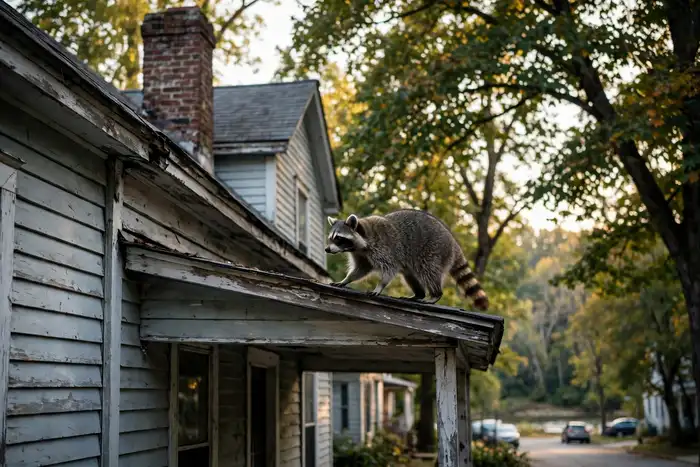
Through all of it runs the Cuyahoga River, with its wooded banks and low ground — a travel route that keeps raccoons, skunks, opossums and snakes moving through Kent neighborhoods regardless of who owns the house. Our crew works Kent properties as the connected systems they are: inspect the whole envelope, remove the animal as Ohio law requires, seal the entries in metal so the fix outlasts the next turnover, and clean the space. For a landlord, that durability is the point; for a homeowner, it is the same job done once instead of yearly.
Rental houses and duplexes: small gaps, long delays
A converted rental house accumulates openings differently from an owner-occupied one. Each conversion, repair and cable or pipe run can leave a penetration that was never properly sealed. Duplexes add shared walls, shared attics and a shared roofline, so an entry over one unit can mean animals traveling above both. Porches get enclosed, vents get painted shut or broken, and nobody walks the roofline in fall because nobody who lives there owns the roofline.
The delay is the expensive part. A tenant may hear scratching and mention it weeks later, or assume someone else reported it, or simply leave at the end of the lease. By the time a landlord gets the call, a squirrel den may hold a litter, a bat colony may be deep into a season when exclusion is closed, and droppings or latrine damage may be months old.
The practical answer for Kent landlords is a clear reporting path for tenants plus an inspection rhythm that does not depend on reports: a walk of the envelope at turnover, when the house is empty and every room, attic hatch and crawlspace can actually be seen. Our crew can tell an owner plainly what was found, what was sealed and what to watch — in terms a property owner can act on from a distance.
Older housing near downtown and the turnover season
Kent was built long before it was a college town, and the older stock near downtown shows its age in the places animals test. Chimneys on houses that burn little wood make raccoon dens. Tall, subdivided interiors create wall voids and chases where mice travel and where a dead animal can be remarkably hard to place. Freeze and thaw work the rooflines every winter, prying at flashing and soffits, so a house can pass one autumn quietly and admit squirrels the next without anything dramatic happening to it.
Turnover season and wildlife season collide in an awkward way. Houses change hands and tenants in late spring and summer — exactly when raccoon and skunk litters are in dens, when groundhogs are digging hardest, and when the bat maternity closure means a colony found in June usually cannot be excluded until August. A landlord who schedules a turnover inspection early learns about a bat colony while an April or May exclusion is still possible, not after students have moved in beneath it.
For owner-occupants on the same streets, the lesson is simpler: the fall check matters. Sealing before the first frost, while the attic is empty and the work is straightforward, beats every version of the winter call.
The Cuyahoga River corridor running through town
The river is not scenery in Kent; it is infrastructure for wildlife. The Cuyahoga and its wooded banks, low areas and connected green spaces give raccoons, skunks, opossums, groundhogs and snakes a sheltered route through the middle of the city, with food and water along the way. Streets near the river and the parks feel that pressure first, but animals following the corridor fan out into neighborhoods well beyond the banks.
River-adjacent properties tend to see a broader cast: waterside snakes that are harmless and often misidentified, raccoons traveling at night, skunks working the lawns, and in the lower ground, burrowing animals where banks and retaining edges give them cover. Garbage left near the river-facing side of a rental, grills on back decks and pet food outdoors all raise the odds that a passing animal stops to investigate the house itself.
Sealing still decides the outcome. A house a raccoon cannot enter is a house it passes on its way along the river; a porch void left open three streets from the bank is as inviting as one on the bank itself.
Ohio rules that shape the work: licensing, bats and rabies
Wildlife removal for hire in Ohio requires an ODNR Commercial Nuisance Wild Animal Control Operator license under Ohio Revised Code section 1531.40 — ask us about licensing and insurance when you call. Bats follow a strict state calendar: exclusion is not allowed from May 16 through July 31 when five or more bats are present, because pups cannot fly, or from October 15 through March 31, when big brown bats may be hibernating in the attic, without prior written ODNR permission. The open windows are April 1 to May 15 and August 1 to October 15 — dates worth knowing if a rental turns over in summer with a colony in the attic.
Raccoons, skunks, foxes and bats are Ohio's main rabies vectors, so a bat in a sleeping room or an animal behaving strangely calls for distance and advice, not handling. Under Ohio Administrative Code 1501:31-15-03(E)(3), a captured raccoon, skunk or opossum cannot be carried away for release elsewhere: the lawful outcomes are release on the same property or humane euthanasia. Our crew leads with exclusion — one-way doors that let an animal leave a structure on its own where that can work — and handles the rest exactly as Ohio rules require.
Wildlife we remove in Kent
From squirrels in a duplex attic to skunks under a rental porch, these are the calls Kent homeowners and landlords make most.
🐿️ Squirrels
Shared attics over duplexes and converted houses give Kent squirrels room to spread, and a gap reported late can mean a whole winter of chewing above the tenants. Fall is the main entry season, when cooling nights send gray squirrels testing rooflines across town. See our full Kent squirrel removal guide →
🦝 Raccoons
The river corridor keeps raccoons moving through Kent, and uncapped chimneys on older rentals give a mother the den she wants in spring. Ohio law bars taking a captured raccoon away for release, so the work is exclusion, kits accounted for, and cleanup. See our full Kent raccoon removal guide →
🦇 Bats
Big brown bats colonize the tall attics of older Kent houses and hibernate inside some Ohio attics through winter. Exclusion is lawful only April 1–May 15 and August 1–October 15 without written ODNR permission — timing that matters when a house turns over in summer. See our full Kent bat removal guide →
🦨 Skunks
A skunk under the porch of a rental house announces itself to every tenant at once, usually in spring. Skunks are an Ohio rabies vector and a captured skunk cannot lawfully be moved off the property, so patient exclusion and buried screening do the lasting work. See our full Kent skunk removal guide →
🦫 Groundhogs
Groundhogs burrow under porches, sheds and foundation edges where Kent yards meet the green ground along the river and the parks. They sleep through winter, emerge in late winter, and dig through spring with a litter in the burrow. See our full Kent groundhog removal guide →
🐾 Opossums
Opossums follow the river at night and bed down in Kent garages, crawlspaces and porch voids by day. Ohio law does not allow a captured opossum to be taken away for release, so removal pairs with closing the shelter it found. See our full Kent opossum removal guide →
🐿️ Chipmunks
Chipmunks tunnel against foundations, stoops and retaining walls on the wooded streets away from downtown, undermining soil in small, tidy increments that add up over seasons. A rental can host a mature system before anyone maps it. See our full Kent chipmunk removal guide →
🐀 Rats, mice & voles
House mice invade Kent houses at first frost and travel the shared walls of duplexes with ease, Norway rats work the older housing and river-adjacent ground, and voles mark up lawns under snow until melt. The entry points are usually old and simple. See our full Kent rodent removal guide →
🐍 Snakes
Near the Cuyahoga, Kent snake calls often involve harmless watersnakes and garter snakes, and in basements, rat snakes that followed mice inside. The useful service is a calm identification and removal, not alarm. See our full Kent snake removal guide →
🪰 Dead animals
A smell in a rental that surfaces at spring turnover often means an animal died in a wall or attic over the winter. Our crew locates and removes it, cleans the area, and seals the entry before the next tenant moves in. See our full Kent dead animal removal guide →
Animal-specific help in Kent
Deep, local guides for the problems we get called about most — with our wildlife crew behind every one.
How to get help in Kent
Tell us what you're hearing
Scratching in the attic, a snake by the porch, holes in the yard — call with your problem and your Kent address.
We connect you locally
Call us and tell us about the job — we will confirm the local crew for your county before any work starts.
They solve it — for good
Inspection, humane removal, full exclusion and cleanup — handled by our wildlife crew, following Ohio rules.
Common wildlife removal questions in Kent
Who do I call for wildlife removal in Kent?+
I own a rental house in Kent — when should it be inspected for wildlife?+
Does living near the Cuyahoga River mean more wildlife problems?+
A tenant reported bats in a Kent rental in June — can they be removed right away?+
Can a raccoon or skunk at my Kent property be taken out to the country?+
How much does wildlife removal cost in Kent?+
Serving all of Portage County
Kent is one part of Portage County. See wildlife removal in Portage County, OH for the county-wide picture — the animals we get called about most, and the other towns we cover.
One call to your Kent wildlife crew
Whether it's squirrels in an older in-town attic or a raccoon in a new subdivision crawlspace, the fastest fix is our wildlife crew, who knows Portage County wildlife. Call us and tell us about the job — we will confirm the local crew for your county before any work starts.
- Local to Portage County. ODNR-compliant handling — call to ask about licensing and insurance.
- One company, one call. Call us and tell us about the job.
- Done right. Removal, exclusion and cleanup.