Skunk Removal in Kent, OH
Every tenant in the house smelling the same thing on the same still night? A skunk has likely denned under the porch or deck of your Kent home, close to the river routes it travels. Call us and tell us about the job — we will confirm the local crew for your county before any work starts.
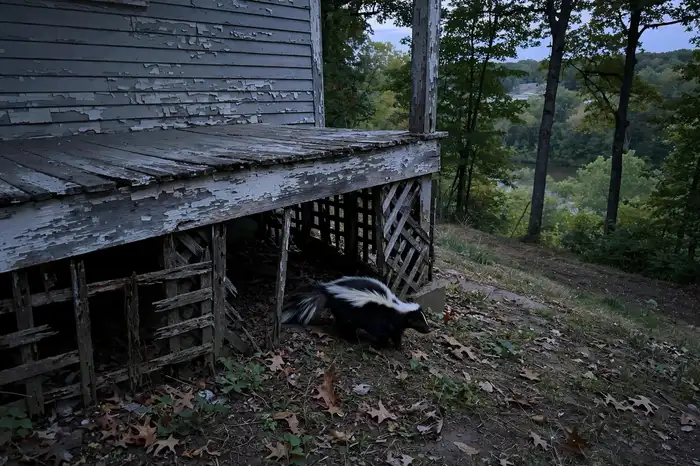
Skunks in your Kent home
The Kent skunk address is usually under something: the raised front porch of an older rental, a low deck behind a duplex, a shed in a yard that slopes toward the river's green edges. The void underneath is dry, dark and undisturbed — everything a striped skunk asks of a den — and the lawns around it supply grubs for the nightly rounds.
Skunks are slow, mild animals, which makes exclusion-led work practical. The constraints are legal and olfactory: a skunk is one of Ohio's main rabies vectors and cannot lawfully be carried away for release once captured, and one panicked spray under a porch can scent a multi-unit house for weeks. Patient work, done in the right order, avoids both problems.
Porch voids, deck voids and the crawlspace behind them
On older Kent houses, a porch void often connects to a crawlspace or a basement area through gaps in the foundation wall, which is why the smell can be strongest indoors. Duplex decks and rental-house porches multiply the hiding places. The inspection establishes where the animal digs in, whether it can reach into the building, and whether a litter is in the den before any exclusion is planned.
Winter denning, spring odor season
Skunks sleep through the coldest stretches and emerge on milder nights. They breed in late winter, and spring is when Kent complaints spike: roaming males, mothers settling under porches with litters on the way, and dogs making first contact at the den mouth. A known den is best addressed before litters arrive, while the job is still one animal and one opening.
Ohio law: a captured skunk stays on site or is not released
Under Ohio Administrative Code 1501:31-15-03(E)(3), a captured skunk must be released on the same property or humanely euthanized; moving one elsewhere for release is unlawful. The working plan is therefore exclusion: a one-way arrangement at the den entry lets the skunk out at night to feed and bars its return, and the crew verifies the void is empty before closing it. Where direct handling is required, a licensed operator does it with spray-aware care and follows the same rule.
Keeping a multi-tenant house spray-free
Skunks warn before they spray — stamping, turning, tail up — and prefer to leave quietly. Sprays happen when a dog charges or a person corners the animal at its only exit. In a rental house the stakes are communal: odor under one porch reaches every unit. Calm, well-timed exclusion work, with pets kept in during the process, keeps that risk low.
Screening the void so the den stays closed
An emptied porch or deck void is an advertisement to the next skunk working the river corridor, and to opossums and groundhogs besides. The closure that lasts is buried metal screening around the perimeter — mesh set into a trench and bent outward below ground, so a digger meets metal at every attempt. For a landlord, it is the difference between one skunk job and a skunk job every spring.
Food signals around Kent houses
Small cone-shaped holes in the lawn are a skunk grub-hunting. Trash stored loosely by a back door, pet food on a porch and seed spilled under a feeder reward the nightly visit. None of it creates a den alone, but a yard that feeds a skunk reliably is a yard it will consider denning in once a void is available. Secure the food when the den is closed.
Common skunk questions in Kent
A skunk is under the porch of my Kent rental — how is it removed?+
Can a skunk be let go somewhere outside Kent?+
Will the removal make it spray under the house?+
Why is the skunk smell strong inside when nobody has seen a skunk?+
How much does skunk removal cost in Kent?+
Other Kent problems that come with skunks
Our wildlife crew handles these closely related problems — the ones that most often turn up with a skunk issue.
Got more than skunks in Kent?
Skunks are rarely the only thing using an attic or yard in Kent. See everything we handle locally on the Kent wildlife removal hub, or jump to Ohio wildlife removal.
Serving all of Portage County
Kent is one part of Portage County. See wildlife removal in Portage County, OH for the county-wide picture — the animals we get called about most, and the other towns we cover.
One call to your Kent skunk crew
The longer skunks stay in the attic, the more they chew and the bigger the cleanup. Call us and tell us about the job — we will confirm the local crew for your county before any work starts.
- Local to Portage County. ODNR-compliant handling — call to ask about licensing and insurance.
- Humane exclusion. One-way doors and steel sealing, not poison.
- Done right. Removal, exclusion and cleanup.