Dead Animal Removal in Kent, OH
A smell discovered when a rental opened up for turnover, strongest in one room with no source in sight? Something likely died inside the structure of your Kent home over the winter. Call us and tell us about the job — we will confirm the local crew for your county before any work starts.
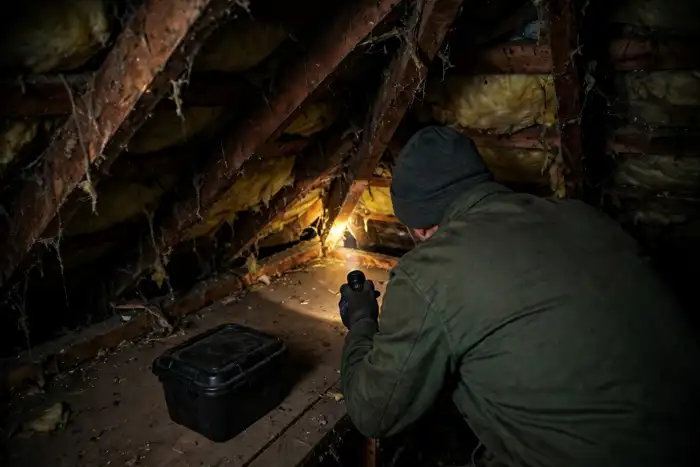
A dead animal in your Kent walls, attic or porch void
Kent dead-animal calls have a local timing: a house opened for cleaning between leases, a faint sour smell in one room that strengthens daily, perhaps flies at a window — and no tenant in residence who can say when the noises stopped. The animal is hidden in a wall cavity, under attic insulation, down a chimney or in a porch den, and the work is to locate it with as little disturbance as possible, remove it, and clean the area so the odor ends at its source.
Winter produces most of these cases. Animals den in Kent attics, chimneys, porches and crawlspaces through the cold months, and some die there; the cold muffles the evidence until thaw, or until the house is opened and heated for the next occupants. Divided older houses complicate the search, because deep cavities and shared chases can carry a smell into a unit far from where the animal lies.
Where animals die in a Kent house
The likely places match how each animal lives here. Mice and rats die in wall cavities and beneath floors, frequently after eating bait set somewhere in the building. Squirrels die in attics and in the wall voids they traveled between units. Raccoons die in chimneys and large attics. Opossums and skunks die in dens under porches and in crawlspaces. Matching the season and the strongest-smelling room to that list is how a whole divided house narrows to one section of wall.
Why turnover reveals a winter death
Cold slows decomposition to a crawl, so a January death in a wall can stay nearly silent until mild weather — or until a vacant house is cleaned, heated and closed up again for showing. Landlords then face a powerful odor with no recent report to explain it. The crew works from the evidence at hand: the odor map, fly activity, entry points, and any noises earlier tenants mentioned in passing.
The bait connection in multi-unit buildings
A large share of in-wall deaths follow rodent baiting — by an occupant, a prior tenant, or an earlier service in another unit. A poisoned mouse or rat retreats to where it lives and dies there, which in a converted house is inside a shared wall. Mention any known baiting when you call; it points to the species and to the probable scale of the space being searched.
Locating and removing it, methodically
The search is patient rather than dramatic: odor compared room by room and unit by unit, flies watched for where they gather, and the framing of the house — its cavities, chases and porch voids — used to triangulate. Once located, the carcass and the most contaminated material are removed and the area cleaned and treated. Most jobs require no cutting; where a small opening is the only access, it is kept small and placed where patching will be simplest.
Ask about patching before work begins
If an opening does prove necessary, know that most wildlife crews do not repair drywall or plaster — worth settling up front in older Kent houses with original plaster, and in rentals where a landlord needs to know whether a separate patch is part of the turnover plan. Ask what is included before the crew starts.
Closing the entry before the next lease
The animal entered alive, through a foundation gap, a broken vent, a roofline opening or an unscreened porch that remains open today. After removal, that entry is found and sealed in metal, or the next denning season risks a repeat in the same void. Removal, cleanup and sealing together are the complete job — and at turnover, the natural moment to do all three.
Common dead animal questions in Kent
There is a dead-animal smell in my Kent rental at turnover — what now?+
How long will the smell last if nothing is done?+
Why did the odor appear in spring with no animal noises all winter?+
A previous tenant used mouse poison — could that explain the smell?+
How much does dead animal removal cost in Kent?+
Other Kent problems that come with dead animals
Our wildlife crew handles these closely related problems — the ones that most often turn up with a dead animal issue.
Got a live animal problem in Kent too?
Whatever died inside entered alive through an opening that is still open — finding and sealing it is part of finishing the job before the next lease. See everything we handle locally on the Kent wildlife removal hub, or jump to Ohio wildlife removal.
Serving all of Portage County
Kent is one part of Portage County. See wildlife removal in Portage County, OH for the county-wide picture — the animals we get called about most, and the other towns we cover.
One call to your Kent dead animal crew
Left alone the odor can run for weeks — an awkward inheritance for incoming tenants and a preventable one with a turnover inspection. Call us and tell us about the job — we will confirm the local crew for your county before any work starts.
- Local to Portage County. ODNR-compliant handling — call to ask about licensing and insurance.
- Find it, remove it, clean it. Working from the odor pattern and fly activity to the source, removing the carcass and treating the area instead of masking it.
- Done right. Removal, exclusion and cleanup.