Groundhog Removal in Kent, OH
A mound of fresh earth beside the porch and tunnels reaching under the shed? A groundhog has built its burrow against your Kent house, and spring is when the system expands. Call us and tell us about the job — we will confirm the local crew for your county before any work starts.
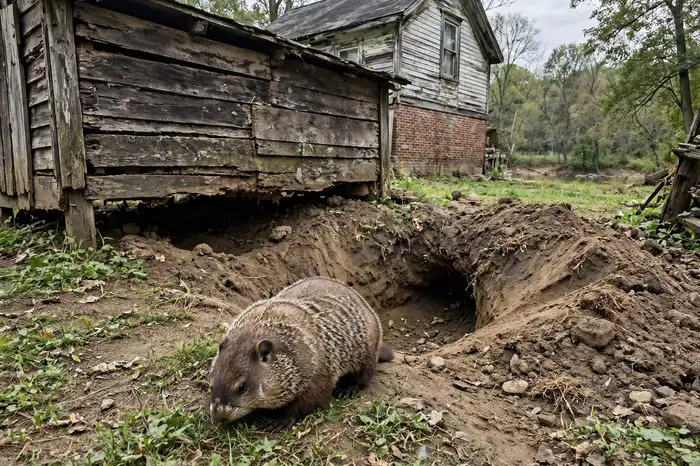
Groundhogs in your Kent home
A groundhog — a woodchuck by its other name — wants workable soil and a solid roof, and Kent supplies both along the river's green edges, around the parks, and under the porches, sheds and foundation edges of the older neighborhoods. A yard that backs onto open or wooded ground is rarely short of a tenant for its burrow.
The species keeps a strict calendar. Groundhogs hibernate from late fall into late winter, so a burrow can stand silent for months with its owner asleep inside it. Emergence restarts everything: fresh digging, a spring litter, and a season of excavation that removes soil from precisely where porches and slabs need it most.
What a burrow system takes from a structure
The visible mound is the spoil from an architecture of multiple entrances, chambers and runs that can extend well under a porch, deck, shed or slab edge. Over a season or two that void can leave a slab unsupported, a porch footing undermined, or soil against a foundation wall opened into a route other animals use. The clipped garden is what tenants and owners notice; the missing support is what should concern them.
Emergence, litters and the honest winter question
Males emerge first in late winter, and litters are born in spring within the burrow. A female with young will dig and defend around the system all summer. Humane timing follows that biology: a burrow is assessed for young before any trapping or exclusion plan is set, and a quiet winter burrow is inspected instead of assumed empty — its resident may be hibernating at the bottom.
Reading the signs of an active system
A groundhog entrance is large and well used, typically with a conspicuous fan of soil; a secondary entrance often hides mound-free beneath a porch or shed edge. Daytime sightings of a stocky brown animal grazing at the yard's edge and whistling as it bolts confirm the identification. Skunks and opossums adopt vacant groundhog burrows readily, so a cleared system is closed and screened rather than left as an invitation.
Removal and exclusion under Ohio woodchuck provisions
Ohio's nuisance rules give woodchucks their own provisions, including where traps may be set, and a licensed operator works within them. Depending on the burrow's position against the structure, the plan is trapping at the active entrances or a one-way arrangement that lets the animal leave and bars re-entry. Once the system is confirmed empty, entrances are closed and the perimeter receives buried screening, so the next digger — groundhog or otherwise — strikes metal.
Fences, flooding and fill: the usual disappointments
Groundhogs climb low fences and excavate under high ones; garden fencing works only buried and bent outward at the base, the same principle as the house screening. Flooding misses chambers, repellents wash off, and fill dirt in an active entrance is re-dug within days. Filling a burrow in winter is the genuinely harmful version — it can trap a hibernating animal inside to die beneath the structure.
Common groundhog questions in Kent
A groundhog is digging under my Kent porch — what should I do?+
The burrow looks abandoned in winter — can I fill it?+
When do Kent groundhogs emerge for the year?+
Can a groundhog burrow hurt my foundation or porch?+
How much does groundhog removal cost in Kent?+
Other Kent problems that come with groundhogs
Our wildlife crew handles these closely related problems — the ones that most often turn up with a groundhog issue.
Got more than groundhogs in Kent?
Groundhogs are rarely the only thing using an attic or yard in Kent. See everything we handle locally on the Kent wildlife removal hub, or jump to Ohio wildlife removal.
Serving all of Portage County
Kent is one part of Portage County. See wildlife removal in Portage County, OH for the county-wide picture — the animals we get called about most, and the other towns we cover.
One call to your Kent groundhog crew
The longer groundhogs stay in the attic, the more they chew and the bigger the cleanup. Call us and tell us about the job — we will confirm the local crew for your county before any work starts.
- Local to Portage County. ODNR-compliant handling — call to ask about licensing and insurance.
- Humane exclusion. One-way doors and steel sealing, not poison.
- Done right. Removal, exclusion and cleanup.