Raccoon Removal in Hudson, OH
Chattering from the fireplace of a house that has heard a century of winters? A mother raccoon has likely claimed the tall, uncapped chimney Hudson's historic homes are known for. Call us and tell us about the job — we will confirm the local crew for your county before any work starts.
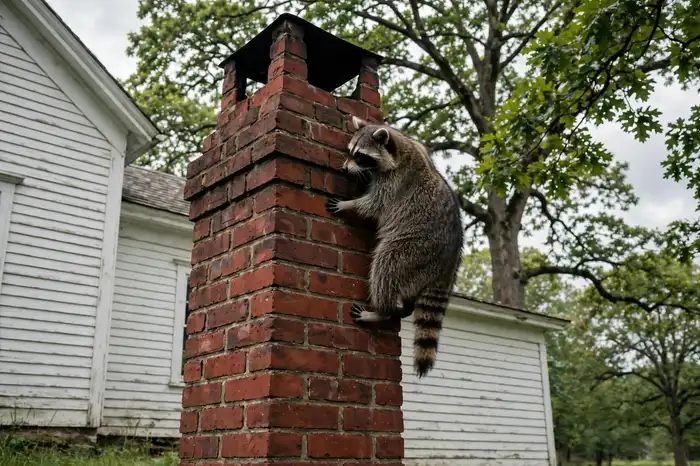
Raccoons in your Hudson home
Every spring, Hudson's chimneys are auditioned. The town's historic homes carry tall masonry stacks — some serving working fireplaces, many serving hearths lit rarely or not in decades — and a female raccoon traveling the wooded corridors is looking for precisely what an open flue offers: a vertical, dry, predator-proof nursery with a shelf inside it made to hold a litter. The attic next door, reached through a lifted cornice or a tired vent cover, is her second choice.
The response is governed by two constraints that arrive together. Kits cannot climb or follow their mother out for their first weeks, so they must be found and accounted for before any door is fitted or cap is set. And Ohio law does not permit a raccoon to be carried away and released on other land, which means the job is built on exclusion and permanent sealing from the first conversation.
Ohio law: raccoons are handled on site
Ohio Administrative Code 1501:31-15-03(E)(3) requires a captured raccoon to be released on the same property or humanely euthanized. Driving one out to parkland or a farm is unlawful, and the rule exists because raccoons are a leading rabies vector in a region covered by the oral rabies vaccine baiting effort. Our crew's first approach is exclusion — a one-way door that lets a raccoon leave the chimney or attic under its own power, combined with sealing — and any raccoon that must be handled directly is handled exactly as the rule requires.
The tall chimney as a nursery
A raccoon litter in Hudson usually means a flue. The mother descends the inner wall and beds the kits on the smoke shelf above the damper, where the household hears them as chattering and scratching from the fireplace, sometimes with soot-marked prints around the damper or debris in the firebox. Two mistakes must be avoided: lighting a fire, which can kill the family in the flue, and fitting a cap, which traps them inside. The cap is the satisfying last step of the job, once the stack is confirmed empty.
Multiple stacks, attics and outbuildings
Historic Hudson homes complicate the survey in useful ways: a house may carry two or three stacks of different ages, a sealed flue nobody remembers, an attic that connects over an addition, and a carriage house or barn behind it with its own loft. A raccoon excluded from the main attic will test all of it. The crew's inspection therefore runs the full property — every flue, every attic section, the outbuildings — and the sealing plan is written for the whole, not for the one opening the animal used first.
Kits first, and the latrine afterward
Locating the litter comes before any hardware. If a mother is excluded while kits remain, they die inside the structure — in a flue or attic, the hardest places in a historic house to reach, and the household trades a raccoon for an odor emergency. Once the family is out, the attic corner used as a latrine is cleaned: raccoon droppings can carry roundworm, so contaminated material in that area is removed and the surface treated. In most attics only the affected section is involved, and the crew will say which case yours is.
Caps and metal that suit a masonry stack
Prevention on a Hudson chimney is a properly fitted cap, sized to the flue and set to shed weather without harming the crown; where the crown itself is cracked, that repair belongs in the conversation too, since water in a stack undoes brickwork slowly and surely. Attic entries close with heavy-gauge metal — reinforced vent covers, flashing at cornice and porch-roof junctions — because a raccoon that has opened a house once will test the repair with strong hands.
Feeding pressure from a wooded town
Hudson's raccoons eat well without help — mast, crayfish in the creeks, gardens — but a household can still lower its own profile: trash in latching cans rather than bags at the curb the night before, pet food indoors, and bird seed spills kept away from the house. On a corridor lot the visits will continue regardless; the cap and the sealing decide whether a visit becomes a tenancy.
Common raccoon questions in Hudson
There is a raccoon in my Hudson chimney — what should I do?+
Can the raccoon be released in the parkland nearby?+
I have three chimneys — do all of them need caps?+
A raccoon is out in my yard at midday — should I be worried?+
How much does raccoon removal cost in Hudson?+
Other Hudson problems that come with raccoons
Our wildlife crew handles these closely related problems — the ones that most often turn up with a raccoon issue.
Got more than raccoons in Hudson?
Raccoons are rarely the only thing using an attic or yard in Hudson. See everything we handle locally on the Hudson wildlife removal hub, or jump to Ohio wildlife removal.
Serving all of Summit County
Hudson is one part of Summit County. See wildlife removal in Summit County, OH for the county-wide picture — the animals we get called about most, and the other towns we cover.
One call to your Hudson raccoon crew
The longer raccoons stay in the attic, the more they chew and the bigger the cleanup. Call us and tell us about the job — we will confirm the local crew for your county before any work starts.
- Local to Summit County. ODNR-compliant handling — call to ask about licensing and insurance.
- Humane exclusion. One-way doors and steel sealing, not poison.
- Done right. Removal, exclusion and cleanup.