Bat Removal & Exclusion in Hudson, OH
Droppings along the foundation below a cornice, in a house whose attic has sheltered generations of everything? Hudson's big brown bats may be among its longest-standing residents — and Ohio law sets the dates they can leave. Call us and tell us about the job — we will confirm the local crew for your county before any work starts.
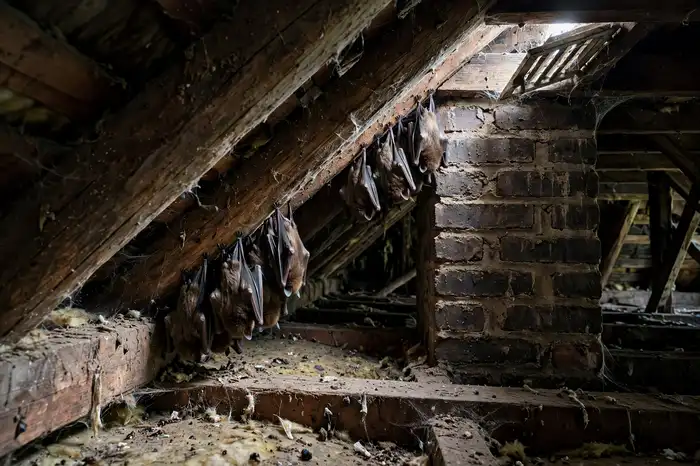
Bats in your Hudson home
If any Ohio houses were built, unintentionally, to bat specifications, they are Hudson's historic ones. The big brown bat wants a warm, quiet, undisturbed roof space with entries the width of a finger, and a preserved Hudson home supplies all of it: broad attics over old framing, cornices and trim with a century of shrinkage, chimney flashing worked by freeze and thaw, and owners who, quite reasonably, rarely disturb the attic at all. Droppings below an entry or staining at a vent are usually how the tenancy surfaces.
The colony may be a year-round one. Big brown bats commonly hibernate inside Ohio buildings, spending winter tucked into attic corners and wall voids of the same house they roosted in all summer. Ohio's rules are written around that double tenancy, and they fix — narrowly — when an exclusion may take place.
The closed seasons and the open windows
Ohio Administrative Code 1501:31-15-03(H)(5) bars bat exclusion from May 16 through July 31 when five or more bats are present, because that is maternity season and the pups cannot fly — and from October 15 through March 31, because bats may be hibernating inside the structure itself. Either closure can be lifted only by prior written permission from the Chief of the ODNR Division of Wildlife. The open windows are April 1 to May 15 and August 1 to October 15. A discovery in June or January still warrants the call: a historic house's entry survey is the longest part of the work, and it can be finished and booked before the window opens.
Where bats enter a historic house
The evidence gathers directly below the entries colonies actually use — droppings on a porch floor, a walk or the ground along the foundation, and staining at vent edges. The entries follow the house's age: gable vents with failed screening, cornices opened at their joints, trim shrunk back from brick, flashing lifted at chimneys, and the seams where additions and porches of different eras meet the original walls. A colony may keep one main dusk exit and several secondary gaps, and in a house this size the survey has to find all of them.
Hibernating bats in a Hudson winter
A winter inspection here is a search for residents, not just roosts. Big browns overwinter singly or in small clusters in quiet attic corners, silent and easily missed among old framing — and sealing a house around them would entomb them, which is the precise harm the October-to-March closure exists to prevent. If hibernating bats are found, the plan is patience: exclude in the April window as they become active, unless ODNR authorizes other action in writing.
Guano with a long history, and the bedroom rule
A colony left for years leaves years of droppings, and dried guano can carry the fungus associated with histoplasmosis, so cleanup belongs to a crew with proper protection — a consideration that grows with the depth of accumulation in an old, undisturbed attic. Bats are also Ohio's most frequently confirmed rabies species. A bat found in a room where someone slept should not be handled or waved out a window: close the room and contact your doctor or local health department, because the bat may need testing.
How a timed exclusion runs on an old house
Inside an open window, our crew seals every gap except the active entries, then fits those entries with one-way bat valves. The colony streams out at dusk toward the creeks and canopy, finds its way back barred, and moves on to natural roosts. Exit checks confirm the attic is empty before the valves come off and the last openings are sealed — on a historic house, with metal and placement chosen to sit quietly against old trim and to fasten to sound material rather than tired wood.
Why a tube of caulk is the worst tool here
Sealing the gap you spotted, the day you spot it, is the classic Hudson mistake precisely because the house is old: behind that gap may sit pups in summer, hibernating adults in winter, and wall voids that carry a trapped colony deeper into the framing in any season. Sprays, mothballs and ultrasonic devices do not disperse bats. The legal sequence is also the kind one for the house: survey, wait for the window if the calendar requires, exclude one-way, then seal.
Common bat questions in Hudson
How are bats removed from a Hudson attic?+
Why can't the bats be taken out in July or midwinter?+
A bat was flying in my house last night — what should I do?+
Will bat sealing alter my home's historic appearance?+
How much does bat removal cost in Hudson?+
Other Hudson problems that come with bats
Our wildlife crew handles these closely related problems — the ones that most often turn up with a bat issue.
Got more than bats in Hudson?
On a historic Hudson roofline, the opening a bat colony uses is rarely the only cornice joint or flashing the years have loosened. See everything we handle locally on the Hudson wildlife removal hub, or jump to Ohio wildlife removal.
Serving all of Summit County
Hudson is one part of Summit County. See wildlife removal in Summit County, OH for the county-wide picture — the animals we get called about most, and the other towns we cover.
One call to your Hudson bat crew
Guano in a Hudson attic may represent decades of summers, and sealing on the wrong date traps pups or hibernating bats inside old walls that are hard to open and harder to repair. Call us and tell us about the job — we will confirm the local crew for your county before any work starts.
- Local to Summit County. ODNR-compliant handling — call to ask about licensing and insurance.
- Timed, one-way exclusion. Bat valves in the April 1–May 15 or August 1–October 15 windows, then careful permanent sealing once every bat is confirmed out.
- Done right. Removal, exclusion and cleanup.