Dead Animal Removal in Hudson, OH
An odor in a restored bedroom with no business being there, growing stronger on mild days? In a Hudson house of this age, something has likely died in a wall void, the attic or a flue. Call us and tell us about the job — we will confirm the local crew for your county before any work starts.
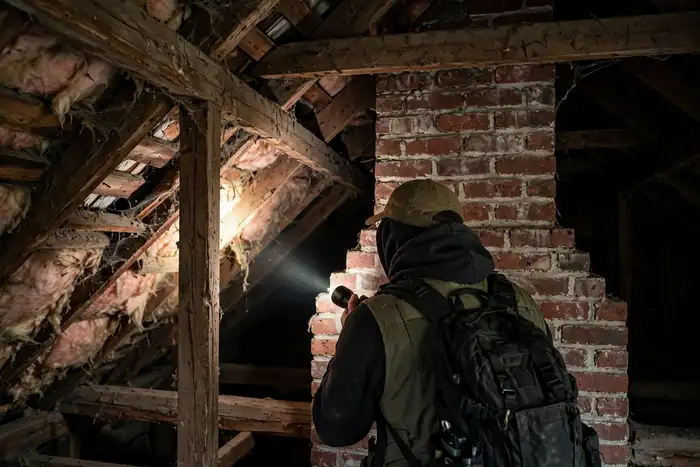
A dead animal in your Hudson walls, attic or chimney
A dead-animal call in Hudson carries an extra sensitivity: the houses are often restored, the walls are often original plaster, and nobody wants a search conducted with a wrecking bar. It does not have to be. The work is a patient location — odor compared room by room, fly activity read like a map, the framing of the old house reasoned through — followed by removal through the smallest sufficient opening, cleaning of the area, and closure of the entry the animal used in life.
The cases themselves follow the Ohio seasons. Animals winter close in Hudson: squirrels and mice in attics and wall voids, raccoons in the tall chimneys, skunks and opossums under porches and in outbuildings. Some die there, and the cold conceals it until a thaw carries the odor through the connected voids of an old house — sometimes rooms away from where the animal actually lies.
Where they die in a historic Hudson house
The likely addresses follow the animals' habits. Mice and rats die in wall voids and beneath basement floors, frequently after eating poison somewhere. Squirrels die in attics and in the vertical channels old framing gives them. Raccoons die in chimneys — a Hudson specialty, given the number and height of the stacks — and opossums and skunks die in their dens beneath porches and outbuildings. Season, the room where the smell is strongest and any noises the household remembers from winter together narrow the house to a section of wall, a flue or an attic corner.
Chimney deaths and the spring discovery
A raccoon or squirrel that dies in a flue announces itself at the fireplace below it, often in the first mild spell, sometimes with flies at the nearest window. The instinct to light a fire and burn the problem away makes everything worse — the carcass remains, and the house gains smoke and a deeper odor for its trouble. Proper removal from a chimney is done from the appropriate end with the flue's condition in mind, and it ends with the cap the stack should have had, fitted once the flue is clear.
Why winter deaths surface at thaw
Cold does not stop decomposition in a wall; it slows it and mutes its evidence. An animal that died in January can be a rumor in February and an emergency in April, as warmth lets the odor build and travel the wall channels and chases an old house is full of. Households then face a strong smell with no recent noise attached to it, and the crew works backward — odor pattern, flies, entries, the winter's history — rather than expecting the animal where it was once heard.
The poison connection
A large share of in-wall deaths began with rodent bait. A poisoned mouse or rat retreats to where it lives — inside a wall, under a floor, deep in insulation — and dies there. Mention any recent baiting when you call, by your household or a service; it identifies the likely species and therefore the size of the space being searched, and it opens the better conversation about sealing and trapping so that bait, and this call, are not repeated next winter.
Locating and removing with a light hand
The search is comparative and unhurried: smell mapped room by room and floor by floor, fly concentrations noted, the house's cavities and chases followed on paper before anything is opened. Once the animal is located, the carcass and the heavily contaminated material around it are removed and the area cleaned and treated, so the source is eliminated rather than scented over. Most Hudson jobs require no opening at all; where one is unavoidable, it is kept small, placed where it will patch most discreetly, and agreed with you in advance.
Plaster, patching and an honest word beforehand
Know before work starts that most wildlife crews do not repair drywall or plaster, and in a Hudson house with original plaster that distinction matters. Ask what is included, and consider whether your own plasterer should make any visible repair — a small, well-placed opening patched properly will disappear; the same opening patched carelessly will announce itself for years. After removal, the entry the animal used is found and sealed in metal, so the wall void does not take its next tenant.
Common dead animal questions in Hudson
There is a dead-animal smell in my Hudson home — what do I do?+
Why did this begin in spring when nothing was heard all winter?+
I used mouse poison and now there is a terrible smell — connected?+
Will you have to cut into my plaster wall?+
How much does dead animal removal cost in Hudson?+
Other Hudson problems that come with dead animals
Our wildlife crew handles these closely related problems — the ones that most often turn up with a dead animal issue.
Got a live animal problem in Hudson too?
An animal that died inside entered alive through an opening that remains — sealing it is part of finishing the job in an old house. See everything we handle locally on the Hudson wildlife removal hub, or jump to Ohio wildlife removal.
Serving all of Summit County
Hudson is one part of Summit County. See wildlife removal in Summit County, OH for the county-wide picture — the animals we get called about most, and the other towns we cover.
One call to your Hudson dead animal crew
Untreated, the odor can run for weeks, and a thaw can make a quiet winter death in a flue suddenly dominate the house. Call us and tell us about the job — we will confirm the local crew for your county before any work starts.
- Local to Summit County. ODNR-compliant handling — call to ask about licensing and insurance.
- Find it, remove it, clean it. Tracing odor and fly activity to the source, removing the carcass and treating the area rather than masking the smell.
- Done right. Removal, exclusion and cleanup.