Wildlife Removal in Hudson, OH
Hudson's houses carry their history above the roofline — tall brick chimneys, steep roofs and mature trees over streets laid out in the Western Reserve. Animals read that same history as opportunity: old framing, generous attics and outbuildings that have stood for a century and a half. Call us and tell us about the job — we will confirm the local crew for your county before any work starts.
Why Hudson homes see the wildlife they do
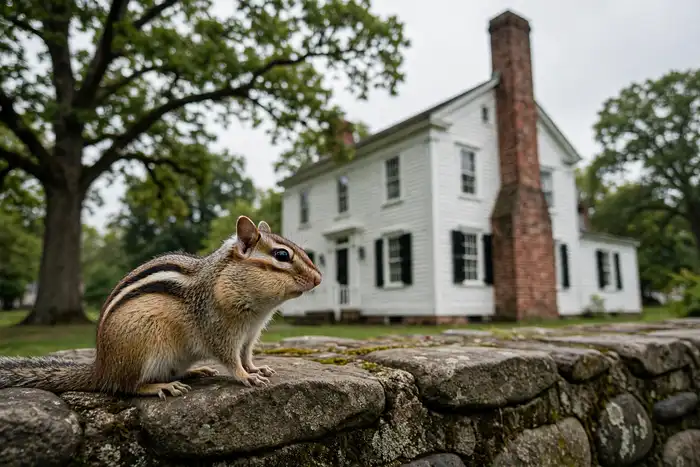
Hudson is a preserved town, and its wildlife problems are preserved-house problems. The older homes near the village green and along the historic streets were framed in an era of tall chimneys, deep eaves, wood siding and hand-built junctions — beautiful, durable in the ways that matter, and full of the small voids and seams that animals exploit. A house that has stood through 150 Ohio winters has been opened by freeze and thaw in more places than its owner will ever see from the ground.
The setting adds pressure rather than relieving it. Hudson's lots are wooded and generous, its trees are large and old, and the ground falls away in places to creek corridors and parkland. Squirrels live in those trees at density, raccoons travel the corridors, groundhogs dig at the edges of lawns and outbuildings, and bats have been roosting in the town's attics, in all likelihood, since the attics were new.
Our crew works a Hudson house with respect for what it is: find how animals are entering without tearing at original fabric, remove them the way Ohio law requires, and seal with materials and placements that protect the house and sit quietly on it. The goal is a house that stays both historic and animal-free — those two aims agree far more often than they conflict, when the work is planned rather than improvised.
Tall chimneys, steep roofs and old framing
Start at the chimney, because in Hudson the chimney is often the story. Historic homes here carry tall masonry stacks, frequently more than one, serving fireplaces that may be decorative, occasional or long sealed. An uncapped flue is a ready raccoon den; a cracked crown or failed flashing is a bat and squirrel entry at the highest, least-inspected point of the house. Chimney work — caps, crown and flashing checks — earns its place at the top of a Hudson inspection list.
The framing below tells the same story at smaller scale. Old houses were built with voids modern construction avoids: balloon-frame wall channels, chases around chimneys and plumbing, eaves and cornices assembled from boards that have shrunk a fraction over a century. Animals travel those channels between basement, walls and attic, which is why a Hudson noise can seem to move through the whole house — and why sealing is planned as a whole-house exercise, not a patch at the loudest wall.
Additions and carriage-era outbuildings — barns, carriage houses, detached garages converted over generations — complete the picture, with their own rooflines, junctions and stored attractions.
Big trees, wooded lots and steady animal pressure
Hudson's canopy is old, and old trees are squirrel infrastructure. A mature oak at the corner of a lot can hold a neighborhood's worth of gray squirrels, drop mast that feeds chipmunks and groundhogs at the foundation line, and lean limbs toward rooflines that were lower than the tree is now. Fox squirrels favor the more open, park-like ground; red squirrels appear among conifers; flying squirrels work the woods at night and the attics after it.
Beyond the lot lines, the town's green framework — creek corridors, parkland and the wooded ravines toward the Cuyahoga valley — keeps raccoon, skunk and opossum populations moving past these houses nightly. A Hudson lot cannot be fenced off from that framework, and attempts to do so mostly move animals to the weakest seam rather than off the property.
The practical answer is the house itself: a capped chimney, a sealed cornice, screened outbuilding vents and a foundation line closed in metal. A tight historic house on a wooded lot stays quiet even while the woods stay busy.
Sealing a historic house without harming it
Owners of Hudson's older homes are right to ask how exclusion work will treat the house. The honest answer is that good wildlife sealing is mostly discreet work: metal flashing tucked at joints animals actually use, steel mesh behind existing vent openings, chimney caps chosen to suit a masonry stack, and repairs at cornices, eave returns and foundation vents done to sound material. Done well, it is visible mainly to the next squirrel.
Where a house sits under historic-district expectations, exterior changes may be subject to local review, and a homeowner should check what applies before altering anything conspicuous — a cap or a vent cover is ordinarily a modest item, but asking first is cheaper than undoing. Our crew will tell you plainly what each repair will look like before it is made, and which items, if any, are worth a question to the village before work day.
What sealing should never be on an old house is foam smeared at a cornice, thin wood nailed over rotted trim, or a patch that hides a gap while the decay behind it continues. Old houses reward sound material and punish shortcuts on a delay.
Ohio rules that shape the work: bats, rabies and relocation
Wildlife removal for hire in Ohio requires an ODNR Commercial Nuisance Wild Animal Control Operator license under Ohio Revised Code section 1531.40, and Hudson is under the same state rules as the rest of Ohio. Bats run on a fixed calendar: exclusion is barred from May 16 through July 31 when five or more bats are present, because the pups cannot fly yet, and from October 15 through March 31, when big brown bats may be hibernating in the attic itself — either window only with prior written ODNR permission. The open windows are April 1 to May 15 and August 1 to October 15.
Rabies shapes the rest. Raccoons, skunks, foxes and bats are Ohio's main rabies vectors, and northeast Ohio lies within the oral rabies vaccine baiting area aimed at raccoon-variant rabies. Under Ohio Administrative Code 1501:31-15-03(E)(3), a captured raccoon, skunk or opossum cannot be taken off the property: the lawful outcomes are release on the same property or humane euthanasia. Our crew leads with exclusion — one-way doors and careful sealing that let an animal leave a structure on its own where that is possible — and handles the rest exactly as Ohio rules require.
Wildlife we remove in Hudson
From bats in a tall attic off the green to groundhogs at an outbuilding on a wooded lot, these are the calls Hudson homeowners make most.
🐿️ Squirrels
Hudson's old oaks feed and house gray squirrels above historic rooflines, and shrunk cornices and eave boards give them their entries each fall. Flying squirrels use the smaller gaps at night. Chewed wiring in an old attic is the urgent concern. See our full Hudson squirrel removal guide →
🦝 Raccoons
Tall, uncapped chimneys are Hudson's classic raccoon nursery, with wooded corridors keeping the mothers supplied. A rabies-vector species Ohio law does not allow to be moved off the property — exclusion first, kits accounted for. See our full Hudson raccoon removal guide →
🦇 Bats
Big brown bats have the run of Hudson's generous old attics — roosting in summer and, in many houses, hibernating through winter. Exclusion is legal only April 1–May 15 and August 1–October 15 without written ODNR permission. See our full Hudson bat removal guide →
🦨 Skunks
Skunks den under porches, low additions and outbuildings on Hudson's wooded lots, close to the gardens they dig in. A rabies vector that cannot be moved off the property under Ohio law, handled with calm exclusion and buried screening. See our full Hudson skunk removal guide →
🦫 Groundhogs
Groundhogs burrow under barns, sheds, retaining walls and porch edges where big lawns meet the woods, then sleep from late fall to late winter. A system under an old outbuilding can undermine ground nothing else has touched in decades. See our full Hudson groundhog removal guide →
🐾 Opossums
Opossums wander in from the wooded corridors at night and bed down in carriage houses, garages and under porches. Ohio law does not allow them to be moved off the property, so removal comes with closing the shelter they chose. See our full Hudson opossum removal guide →
🐿️ Chipmunks
Chipmunks tunnel along stone and block foundations, front walks and garden walls on Hudson's wooded lots, thriving on the oak mast overhead. Their systems move soil away from old footings season after season. See our full Hudson chipmunk removal guide →
🐀 Rats, mice & voles
House mice flood into old framing at first frost and travel its voids all winter; Norway rats appear near outbuildings and water; voles work lawns and beds under the snow. In Hudson the rodent job begins in the basement and the outbuildings. See our full Hudson rodent removal guide →
🐍 Snakes
Almost always harmless — garter snakes in the gardens, rat snakes after mice in basements and carriage houses, watersnakes near the creeks. The Hudson snake call is identification and calm removal, not alarm. See our full Hudson snake removal guide →
🪰 Dead animals
A smell in a restored bedroom, often surfacing at thaw, usually means something died in a wall void, the attic or a chimney over winter. Our crew locates it with as little disturbance as possible, removes it and closes the entry. See our full Hudson dead animal removal guide →
Animal-specific help in Hudson
Deep, local guides for the problems we get called about most — with our wildlife crew behind every one.
How to get help in Hudson
Tell us what you're hearing
Scratching in the attic, a snake by the porch, holes in the yard — call with your problem and your Hudson address.
We connect you locally
Call us and tell us about the job — we will confirm the local crew for your county before any work starts.
They solve it — for good
Inspection, humane removal, full exclusion and cleanup — handled by our wildlife crew, following Ohio rules.
Common wildlife removal questions in Hudson
Who do I call for wildlife removal in Hudson?+
Does owning a historic Hudson home change how wildlife work is done?+
When do animals move into Hudson houses for the season?+
Can bats be removed from my Hudson attic in summer or winter?+
Will you relocate a raccoon or skunk to the parkland outside town?+
How much does wildlife removal cost in Hudson?+
Serving all of Summit County
Hudson is one part of Summit County. See wildlife removal in Summit County, OH for the county-wide picture — the animals we get called about most, and the other towns we cover.
One call to your Hudson wildlife crew
Whether it's squirrels in an older in-town attic or a raccoon in a new subdivision crawlspace, the fastest fix is our wildlife crew, who knows Summit County wildlife. Call us and tell us about the job — we will confirm the local crew for your county before any work starts.
- Local to Summit County. ODNR-compliant handling — call to ask about licensing and insurance.
- One company, one call. Call us and tell us about the job.
- Done right. Removal, exclusion and cleanup.