Squirrel Removal in Hudson, OH
Running in the ceiling of a house older than the state highway system? Hudson squirrels step from century-old oaks onto roofs whose boards have been quietly shrinking since before the Civil War era ended. Call us and tell us about the job — we will confirm the local crew for your county before any work starts.
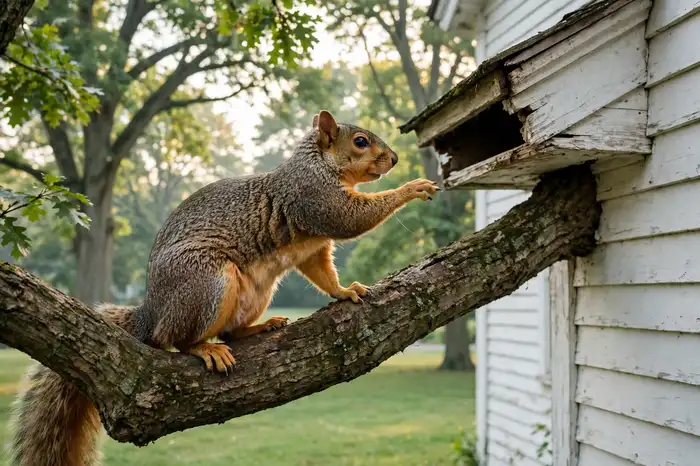
Squirrels in your Hudson home
Hudson's squirrels live in a canopy that predates the houses beneath it in spirit if not in fact: oaks and maples of great size, over lots where a squirrel can travel a whole street without descending. When fall turns, those squirrels test the rooflines below them, and a historic Hudson roof offers tested material — cornice boards shrunk from their joints, eave returns opened by generations of freeze and thaw, vent openings whose screening was fitted long ago.
Once in, a squirrel finds an attic built to older dimensions: generous, quiet and connected to wall voids that run the full height of the house. It nests in the insulation, travels the framing, and chews as its teeth require — wood, ductwork and, most concerning in a house that may carry wiring of several vintages, electrical cable.
Fall entry under a mature canopy
The calls arrive with the first cold, because a fall squirrel is choosing a winter den and a Hudson attic is a distinguished one. Houses near the corridors and the larger wooded lots feel the pressure first, but no street under canopy is exempt. Sealing in early fall, before the choice is made, is the least expensive squirrel work of the year in this town; sealing in December is eviction.
Grays, fox squirrels, reds — and the night shift
Hudson's mix is broader than most suburbs. Gray squirrels dominate the canopy, larger fox squirrels work the open, park-like ground near the green and the lawns, and red squirrels appear where conifers stand. After dark the sounds change: lighter, quicker, in bursts — flying squirrels, social and nocturnal, slipping through gaps a gray cannot use. The species matters because it sets how fine the final sealing must be, and the crew confirms it before anything closes.
Cornices, eaves and chimney flashing
Entries on a historic Hudson home follow its joinery. Cornice and eave boards shrink and open at their ends; the junction where a porch roof meets the main wall works loose; chimney flashing, bent and fitted generations ago, lifts as mortar and metal age at different rates. Outbuildings add their own list — barn and carriage house eaves, loft vents, doors that no longer meet their frames. The survey covers house and outbuildings together, since a squirrel excluded from one will test the other the same week.
Litters, and wiring in an old attic
Squirrels raise young in late winter and again in late summer, and an attic litter governs the sequence: seal a mother out and she will chew her way back, often through a more damaging place than the original entry, while the young left inside cannot survive alone. Nests are checked before doors are fitted. The second urgency is wiring — a squirrel's teeth never stop growing, and gnawed cable in dry old insulation is a fire risk no historic house should carry into winter.
Exclusion that respects the house
The method is a one-way door at the active entry, time for the squirrels to depart and be confirmed gone, then permanent closure of every opening using metal placed at the joint the animal used — flashing at the cornice, steel mesh behind vents, sound repairs at eave returns. On a preserved house the crew works to sound material rather than covering tired trim, and will say plainly where a carpentry repair should precede the sealing so the metal is fastening to something that will hold.
Trees and feeders on a generous lot
On Hudson's big lots, limb work can genuinely help: a tree pruned back from the roof removes the easiest bridge, though determined squirrels still climb siding, chimneys and downspouts, so sealing remains the protection. Feeders are the other dial — seed served at the house holds squirrels at the walls all day, while a feeder stationed out in the lot feeds the same animals at a distance from the cornice.
Common squirrel questions in Hudson
I hear scratching in my Hudson attic in the morning — is it squirrels?+
Will squirrel sealing damage my historic home's exterior?+
Can I just close the cornice gap where they enter?+
My carriage house has squirrels too — is that a separate job?+
How much does squirrel removal cost in Hudson?+
Other Hudson problems that come with squirrels
Our wildlife crew handles these closely related problems — the ones that most often turn up with a squirrel issue.
Got more than squirrels in Hudson?
Squirrels are rarely the only thing using an attic or yard in Hudson. See everything we handle locally on the Hudson wildlife removal hub, or jump to Ohio wildlife removal.
Serving all of Summit County
Hudson is one part of Summit County. See wildlife removal in Summit County, OH for the county-wide picture — the animals we get called about most, and the other towns we cover.
One call to your Hudson squirrel crew
The longer squirrels stay in the attic, the more they chew and the bigger the cleanup. Call us and tell us about the job — we will confirm the local crew for your county before any work starts.
- Local to Summit County. ODNR-compliant handling — call to ask about licensing and insurance.
- Humane exclusion. One-way doors and steel sealing, not poison.
- Done right. Removal, exclusion and cleanup.