Wildlife Removal in Aurora, OH
Aurora homes sit in the landscape rather than on top of it — big newer houses on wooded lots, with ponds, wetlands and careful planting built right into the plan. That beauty comes with constant wildlife pressure at the roofline, the pond bank and the garden edge. Call us and tell us about the job — we will confirm the local crew for your county before any work starts.
Why Aurora homes see the wildlife they do
Aurora does not have a wildlife edge so much as wildlife woven through it. A typical lot backs onto woods, drains toward a pond or a protected wetland, and carries the kind of layered landscaping — ornamental trees, stone edging, mulched beds, water features — that animals experience as food and cover. The houses themselves are large and newer, which changes the work rather than eliminating it: instead of one simple roof, there are multiple gables, dormers, roof-to-wall junctions and long soffit runs, each one a place where a gap can open and stay hidden.
The water is the second half of the story. Retention ponds, private lakes and low wet ground hold frogs, fish and insects, and that food web draws raccoons to the banks at night, groundhogs to the soft pond-edge soil, and watersnakes along the rocks and docks all summer. Homeowners here rarely have a single animal problem. A bat colony in a high gable, a groundhog undermining a patio and a snake at the pond are often three parts of the same property doing exactly what it was landscaped to do — attract life.
Our wildlife crew works an Aurora property as a whole: the complex roofline at the top, the finished living space and utility runs in the middle, and the pond bank, retaining walls and garden edges at ground level. We remove what is inside the way Ohio law requires, seal with metal that disappears into good construction rather than fighting it, and deal honestly with the landscaping features that keep inviting the next animal in.
Big newer homes, complex rooflines, hidden entries
Newer does not mean sealed. A large Aurora home can have a dozen roof planes meeting at valleys, dormers and turret-like features, plus vent stacks, bath fans and fireplace chases exiting in places nobody can see from the ground. Builders seal those junctions well, but houses move: freeze and thaw work at flashing through Portage County winters, trim shrinks, and a vent screen that was tight at closing can be open at one corner five years later. Squirrels and bats do not need a neglected house — they need one overlooked junction.
The size of these homes also hides problems longer. Attic space above a garage wing or a bonus room may go unvisited for a season while a bat colony or a family of squirrels settles in overhead. By the time droppings appear at a vent or scratching is heard through a bedroom ceiling, the entry has often been in use for months. Our crew maps the whole roofline with that in mind, because sealing the one obvious gap on a many-gabled house rarely ends the job.
Inside, finished basements and walk-out lower levels add their own entries at grade — around utility penetrations, under walk-out doors, and where a patio or deck meets the foundation. Mice and chipmunks test those first in fall, and a careful inspection covers the bottom of the house with the same attention as the top.
Ponds, wetlands and the wildlife they bring to the lot line
Water is Aurora's defining wildlife feature. Community retention ponds, private lakes and preserved wetlands sit within a short walk of most homes here, and many lots include a pond edge, a drainage swale or low wet woods of their own. That habitat supports a working food chain — and the middle of that chain visits houses. Raccoons hunt the banks nightly. Muskrats and groundhogs work the soft soil at the waterline. Snakes, especially northern watersnakes, bask on riprap and dock edges where frogs and minnows are plentiful.
None of that is a reason to drain or clear a pond, and our crew will not suggest it. The practical work is separation: keeping dens out from under decks and patios near the water, screening the openings that let pond-side animals into the house, and giving homeowners a clear, calm identification when a watersnake appears at the dock — because in Aurora, that snake is almost always a harmless fish-eater doing its job, not a threat to remove at any cost.
Landscaping carries the same logic. Dense groundcover against the foundation, stacked stone with voids in it, and bird feeders over mulched beds all place food and shelter directly at the walls. Small adjustments — feeders moved out over lawn, stonework pointed up, planting pulled back a foot from the siding — lower the pressure on the house without giving up the look that makes these lots what they are.
Landscaping animals undermine: burrows, beds and retaining walls
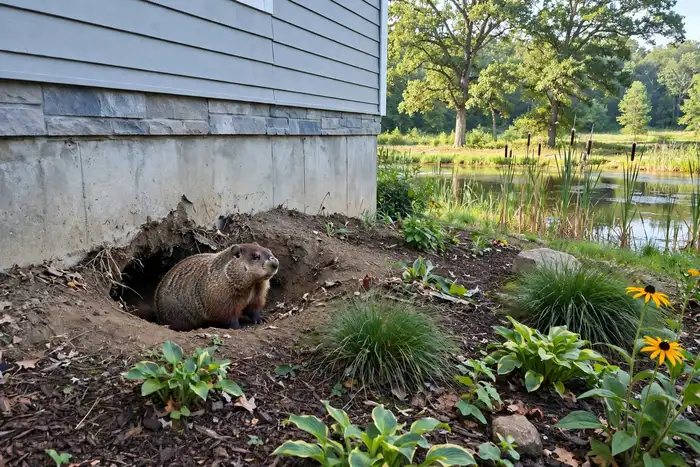
Aurora homeowners invest seriously in their grounds, and burrowing animals spend that investment. Groundhogs tunnel under patios, pool decks and outbuildings, and their excavated soil has to come from somewhere — usually from directly beneath the hardscape. Chipmunks work the same edges at a smaller scale, hollowing soil behind retaining walls and under front walks until a section settles or tips. Voles carve the lawn itself, and in mulched beds their runs stay hidden until a prized planting is girdled at the base.
The pattern to notice is that the damage is structural before it is cosmetic. A groundhog burrow under a slab edge, chipmunk voids behind a wall, and tunneling along a foundation all move the soil that other things rest on. Filling a hole with the dirt beside it feels productive and accomplishes almost nothing; an active animal reopens it within days, and a burrow system is far larger than its one visible entrance.
Our approach pairs removal with buried metal screening set along the vulnerable edge — under a deck skirt, behind a retaining wall's base, along a patio perimeter — so the soil stays where it belongs and the next digger meets a barrier it cannot pass. It is quiet, permanent work that protects the landscaping instead of repeatedly repairing it.
Ohio rules that shape the work: licensing, bats and relocation
Wildlife removal for hire in Ohio is licensed work. It requires an ODNR Commercial Nuisance Wild Animal Control Operator license under Ohio Revised Code section 1531.40, and Aurora homeowners should expect any crew doing this work to operate under that license. Bats follow a strict state calendar: exclusion is barred from May 16 through July 31 when five or more bats are present, because that is maternity season and the pups cannot fly, and from October 15 through March 31, when big brown bats may be hibernating inside the structure itself — in either period only with prior written ODNR permission. The open windows are April 1 to May 15 and August 1 to October 15.
Rabies and relocation rules shape the ground-animal work. Raccoons, skunks, foxes and bats are Ohio's main rabies vectors, and Portage County sits within the state's long-running effort to hold raccoon-variant rabies back with oral vaccine baiting to the east. Under Ohio Administrative Code 1501:31-15-03(E)(3), a captured raccoon, skunk or opossum cannot be taken away and released elsewhere: the lawful outcomes are release on the same property or humane euthanasia. That is why our crew leads with exclusion — one-way doors and thorough sealing that let an animal leave a structure on its own where possible — and handles anything captured exactly as Ohio rules require.
Wildlife we remove in Aurora
From a bat colony in a high gable to a watersnake at the pond dock, these are the calls Aurora homeowners make most.
🐿️ Squirrels
Complex rooflines give squirrels options. Gray squirrels test dormer junctions, soffit corners and vent screens across Aurora's larger homes each fall, looking for a winter den in a quiet attic wing. See our full Aurora squirrel removal guide →
🦝 Raccoons
Pond banks feed them and big attics house them. Raccoons work Aurora's water edges at night and den in chimneys and roof voids by day — a rabies-vector species Ohio law does not allow to be taken away and released elsewhere. See our full Aurora raccoon removal guide →
🦇 Bats
Big brown bats favor the high, warm gables of larger Aurora homes — and may hibernate in the attic through winter. Exclusion is legal only April 1–May 15 and August 1–October 15 without written ODNR permission. See our full Aurora bat removal guide →
🦨 Skunks
Skunks den under decks, pool houses and low porches near Aurora's wooded lot edges, and grub-hunt the lawns between. A rabies vector that cannot be moved off the property under Ohio law, so exclusion and screening do the real work. See our full Aurora skunk removal guide →
🦫 Groundhogs
Soft pond-edge soil and big yards suit groundhogs perfectly. Burrows under patios, decks and outbuildings are the structural worry; spring emergence, after months of hibernation, is when fresh mounds announce an occupied system. See our full Aurora groundhog removal guide →
🐾 Opossums
Opossums wander in from the wetlands and woods at night and bed down in garages, under decks and in window wells. Ohio law does not allow them to be carried off and released, so the shelter gets closed after the animal is out. See our full Aurora opossum removal guide →
🐿️ Chipmunks
Chipmunks hollow the soil behind retaining walls, under front walks and along foundation planting beds — small tunnels that settle pavers and tip stonework on carefully built Aurora lots. See our full Aurora chipmunk removal guide →
🐀 Rats, mice & voles
House mice pour into walk-out basements at first frost, voles run the mulched beds and lawns under snow, and Norway rats appear near pond outflows and outbuildings. Each one is a different job. See our full Aurora rodent removal guide →
🐍 Snakes
Aurora's signature snake is the northern watersnake at pond edges and docks — heavy-bodied, defensive if cornered, and completely nonvenomous. Rat snakes and garter snakes cover the yards and garages. See our full Aurora snake removal guide →
🪰 Dead animals
A smell rising in one wing of a large house, with no clear source, usually means an animal died in a wall, an attic bay or under a deck. Our crew finds it, removes it and closes the opening it used to get in. See our full Aurora dead animal removal guide →
Animal-specific help in Aurora
Deep, local guides for the problems we get called about most — with our wildlife crew behind every one.
How to get help in Aurora
Tell us what you're hearing
Scratching in the attic, a snake by the porch, holes in the yard — call with your problem and your Aurora address.
We connect you locally
Call us and tell us about the job — we will confirm the local crew for your county before any work starts.
They solve it — for good
Inspection, humane removal, full exclusion and cleanup — handled by our wildlife crew, following Ohio rules.
Common wildlife removal questions in Aurora
Who do I call for wildlife removal in Aurora?+
My Aurora home is newer — how are animals getting in at all?+
I keep seeing a big snake at our pond — should I be worried?+
Can bats be taken out of my attic in July or in midwinter?+
Will you trap a raccoon and release it in a park or out in the country?+
How much does wildlife removal cost in Aurora?+
Serving all of Portage County
Aurora is one part of Portage County. See wildlife removal in Portage County, OH for the county-wide picture — the animals we get called about most, and the other towns we cover.
One call to your Aurora wildlife crew
Whether it's squirrels in an older in-town attic or a raccoon in a new subdivision crawlspace, the fastest fix is our wildlife crew, who knows Portage County wildlife. Call us and tell us about the job — we will confirm the local crew for your county before any work starts.
- Local to Portage County. ODNR-compliant handling — call to ask about licensing and insurance.
- One company, one call. Call us and tell us about the job.
- Done right. Removal, exclusion and cleanup.