Skunk Removal in Aurora, OH
A musky smell near the deck on a calm evening, and shallow dig marks scattered across the lawn? A striped skunk has likely denned in the dry shelter under an Aurora deck or outbuilding at the woods edge. Call us and tell us about the job — we will confirm the local crew for your county before any work starts.
Skunks in your Aurora home
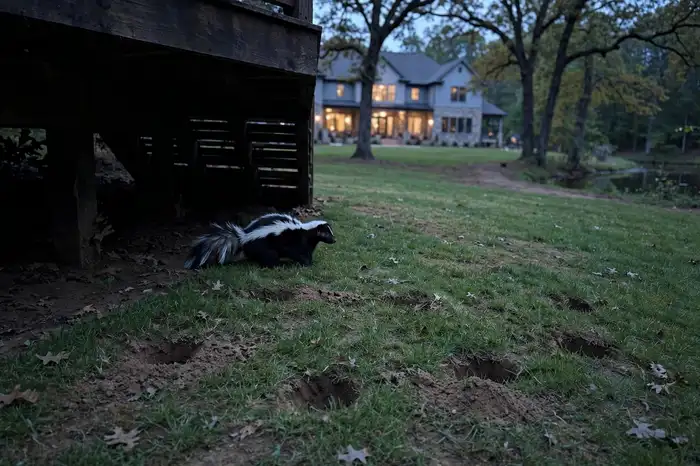
Aurora's lot edges are skunk habitat by design: where a manicured lawn meets woods or wetland, a skunk finds grubs and insects in the turf, earthworms after rain, and — under a low deck, a pool house, a porch or a shed set on piers — a dry, dark den site protected from wind and dogs. Most Aurora skunk calls begin as a smell with no animal attached, noticed on still evenings when the den's occupant comes and goes.
Skunks are unhurried, near-sighted and reluctant to spray, which rewards patient, exclusion-led work. The constraints are legal as much as practical: the skunk is one of Ohio's main rabies vectors and sits on the state's list of animals that cannot be carried away and released elsewhere, so the plan is built around getting the animal out and keeping the den closed, not transporting it.
Decks, pool houses and the woods-edge den
The den is almost always a void: the space beneath a low deck, the crawl area under a pool house or porch, or the gap under a shed floor. On Aurora lots those structures often sit near the tree line or a pond path, so a skunk can commute between cover, lawn and den without crossing open ground in daylight. The inspection confirms the den entry, checks whether the void connects anywhere — a utility trench, a foundation gap — and establishes whether a litter is present before anything is scheduled.
Winter sleep, February breeding, spring complaints
Skunks den through the coldest stretches, losing weight and emerging on milder nights, and they breed in late winter — which is why February and March produce a puzzling share of spray reports as males roam and are rebuffed. Mothers settle to raise litters in spring, often in exactly the deck void that was quiet all winter. A known den is best addressed before litters arrive; a den with young changes the plan to patience and timing rather than urgency.
Ohio law: skunks are not carried away
Under Ohio Administrative Code 1501:31-15-03(E)(3), a captured skunk must be released on the same property or humanely euthanized — taking it elsewhere to release is unlawful. The sensible first approach is therefore exclusion: a one-way arrangement at the den entrance that lets the skunk leave at night to feed and prevents its return, verified empty before the void is screened shut. When a skunk must be handled directly, a licensed operator does it with the slow, covered-trap technique the animal's temperament calls for, and handles the outcome as Ohio rules require.
Keeping the spray holstered
Nearly every spray story starts with a surprise — a dog lunging at a fence corner, a person stepping off a deck at dusk onto an animal that did not hear them coming. Skunks warn before they fire: foot-stamping, a turned back, a raised tail. Calm work at the right hour keeps those warnings from becoming necessary. If a dog does get sprayed, keep it outdoors while you deal with it; odor worked into indoor furnishings outlasts odor in open air by weeks.
Screening the void so the den stays closed
An emptied deck void on a wooded lot is an advertisement to the next skunk — and to opossums and groundhogs after that. The durable fix is buried metal screening around the structure's perimeter: mesh trenched into the soil and bent outward underground, so a digging animal meets metal in every direction it tries. Surface lattice alone stops nothing that digs; skunks pass under a decorative skirt in a single night.
Grub damage and the lawn between woods and house
The small, cone-shaped dig holes scattered over a lawn are a skunk's grub-hunting signature, often blamed on other animals. A yard that feeds a skunk nightly gives it reason to den nearby, so securing trash, feeding pets indoors and addressing a heavy grub load all reduce visits once the den itself is closed and screened. The goal is not a skunk-free woods edge — that does not exist in Aurora — but a house and deck that offer no shelter.
Common skunk questions in Aurora
A skunk is denned under my Aurora deck — how is it removed?+
Can a skunk be taken to a park or released in the country?+
Will the removal itself cause a spray?+
The dig holes in my lawn — is that the same skunk?+
How much does skunk removal cost in Aurora?+
Other Aurora problems that come with skunks
Our wildlife crew handles these closely related problems — the ones that most often turn up with a skunk issue.
Got more than skunks in Aurora?
Skunks are rarely the only thing using an attic or yard in Aurora. See everything we handle locally on the Aurora wildlife removal hub, or jump to Ohio wildlife removal.
Serving all of Portage County
Aurora is one part of Portage County. See wildlife removal in Portage County, OH for the county-wide picture — the animals we get called about most, and the other towns we cover.
One call to your Aurora skunk crew
The longer skunks stay in the attic, the more they chew and the bigger the cleanup. Call us and tell us about the job — we will confirm the local crew for your county before any work starts.
- Local to Portage County. ODNR-compliant handling — call to ask about licensing and insurance.
- Humane exclusion. One-way doors and steel sealing, not poison.
- Done right. Removal, exclusion and cleanup.