Raccoon Removal in Aurora, OH
Heavy steps overhead at night, and muddy prints on the pond dock in the morning? Raccoons work Aurora's water edges after dark and den in its chimneys and attics by day — and Ohio law shapes exactly how they can be handled. Call us and tell us about the job — we will confirm the local crew for your county before any work starts.
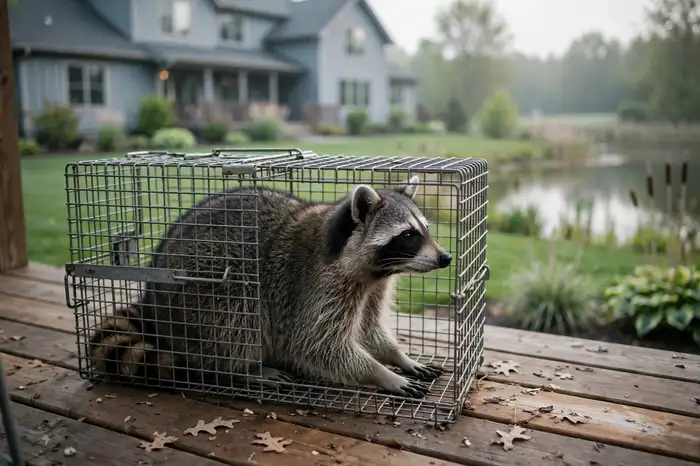
Raccoons in your Aurora home
An Aurora raccoon lives well. The ponds and wetlands supply frogs, fish, crayfish and eggs; the woods supply den trees; the neighborhood supplies bird seed, pet food and trash that is not always secured. When a female looks for a place to raise kits in spring, the offer she accepts is often a house: an uncapped chimney flue, a soffit corner she can peel, or a quiet attic above a wing nobody enters for weeks.
The sound is unmistakable once heard — deliberate, heavy movement, nothing like a squirrel's scurry — and a litter adds soft chattering. What makes raccoon work in Ohio a professional job is the combination of that biology with state law: kits cannot leave on their own for weeks, and a captured raccoon cannot legally be carried away and released somewhere else. The plan has to respect both facts at once.
Ohio law: a raccoon stays on its own property
Under Ohio Administrative Code 1501:31-15-03(E)(3), a captured raccoon must be released on the same property or humanely euthanized. Driving one to a park or a country road to let it go is unlawful, largely because raccoons are a principal rabies vector and moving them moves the disease — Portage County sits in the zone the state protects with oral rabies vaccine baiting. Our crew therefore leads with exclusion: one-way doors and sealing that let a raccoon leave a structure under its own power where that can work, with any captured animal handled precisely as the rule requires. A promise to haul a raccoon away and set it free is a promise to break Ohio law.
Chimneys, soffits and the quiet attic wing
The classic Aurora den is an unused, uncapped fireplace flue — dark, dry, vertical and safe — with kits raised on the smoke shelf above the damper. Big attics run a close second, especially over garage and guest wings. Signs include soot-smudged prints at the fireplace, debris in the firebox, a peeled soffit corner, and droppings concentrated in one attic spot. A chimney cap installed before the family is confirmed out traps them inside the flue, so on every raccoon job the cap and the sealing come last, not first.
Accounting for the kits
Spring litters are the complication that defines the work. For their first weeks, kits cannot climb, follow their mother through a one-way door, or survive being sealed in. Excluding or removing a mother without locating them trades a raccoon problem for a dead-animal problem in the least reachable part of the house. Our crew inspects with cameras and by hand where needed, counts the litter, and builds the removal around getting every kit out — sometimes by reuniting them with their mother outside the structure so she moves them herself.
The latrine in a spacious attic
Raccoons return to one spot to defecate, and in a large attic that latrine can grow quietly for a long time. The droppings may carry raccoon roundworm, whose eggs persist in the material and are a genuine health concern, particularly around children. Removal of contaminated insulation and sanitizing the area are therefore part of a complete raccoon job. That does not automatically mean re-insulating an entire attic — often only the affected section needs to come out, and a straight assessment of which is part of what our crew provides.
Sealing against strength and thumbs
A raccoon tests repairs the way it opened the original entry — with strength and dexterous paws. Closures here are heavy-gauge metal: a properly fitted chimney cap, reinforced covers on vents, and flashing anchored at roof returns and porch-roof seams. Foam, thin screen and plain wood are demonstrations, not repairs. On multi-level Aurora rooflines, the crew also checks the junctions a raccoon can reach from a lower roof, which is where many second entries hide.
Making the pond side less inviting at the house
The pond will keep feeding raccoons; that is its job. The house can stop adding to the menu. Trash secured in latched containers, pet food fed indoors, fallen fruit gathered, and bird feeders that do not spill seed across a deck all lower the nightly traffic across the roofline. Koi ponds close to the house are worth a conversation too — a raccoon reads a shallow ornamental pond as a stocked hunting pool, and netting or deeper edges change that calculation.
Common raccoon questions in Aurora
There is a raccoon in my Aurora attic — what should I do?+
Can you release a trapped raccoon at a park or nature preserve?+
I hear chattering from my fireplace — is that kits?+
A raccoon visits our pond and deck every night but lives elsewhere — is that a problem?+
How much does raccoon removal cost in Aurora?+
Other Aurora problems that come with raccoons
Our wildlife crew handles these closely related problems — the ones that most often turn up with a raccoon issue.
Got more than raccoons in Aurora?
Raccoons are rarely the only thing using an attic or yard in Aurora. See everything we handle locally on the Aurora wildlife removal hub, or jump to Ohio wildlife removal.
Serving all of Portage County
Aurora is one part of Portage County. See wildlife removal in Portage County, OH for the county-wide picture — the animals we get called about most, and the other towns we cover.
One call to your Aurora raccoon crew
The longer raccoons stay in the attic, the more they chew and the bigger the cleanup. Call us and tell us about the job — we will confirm the local crew for your county before any work starts.
- Local to Portage County. ODNR-compliant handling — call to ask about licensing and insurance.
- Humane exclusion. One-way doors and steel sealing, not poison.
- Done right. Removal, exclusion and cleanup.