Bat Removal & Exclusion in Aurora, OH
Droppings beneath a high gable vent, or a faint musk in an upstairs room in summer? Big brown bats favor the tall rooflines of larger Aurora homes — and Ohio law fixes the calendar for getting them out. Call us and tell us about the job — we will confirm the local crew for your county before any work starts.
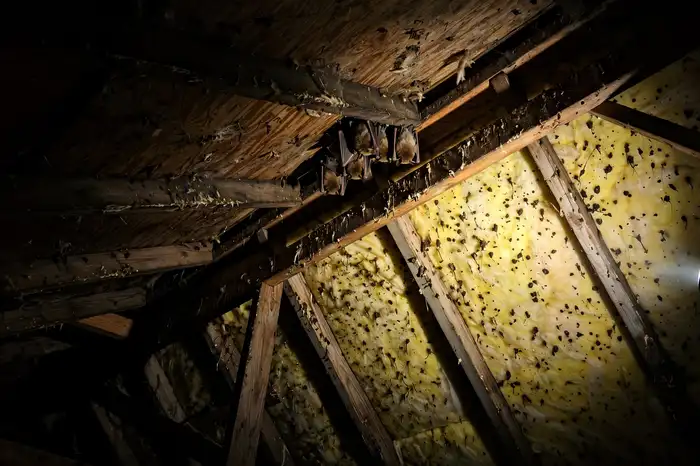
Bats in your Aurora home
The bat of the Aurora attic is the big brown bat, and the city's housing suits it in both summer and winter. High, warm gables over large roof spans make an excellent maternity roost in June, and the same deep, undisturbed attic bays — over a garage wing, above a bonus room — stay cold and quiet enough that big browns frequently hibernate in the building rather than traveling to a cave. Many Aurora colonies are discovered late precisely because the space they occupy is a space the household rarely enters.
Ohio regulates bat work more tightly than any other service on this page. Exclusion is the only legal removal method, it may only be performed for hire by a licensed operator, and the state calendar decides when. A bat job done in the wrong month is not just ineffective — it can seal flightless pups or sleeping adults inside the house.
Two closed seasons, two open windows
Ohio Administrative Code 1501:31-15-03(H)(5) bars bat exclusion from May 16 through July 31 when five or more bats are present — maternity season, when pups are born unable to fly — and from October 15 through March 31, when bats may be hibernating in the structure. Work inside either closed season requires prior written permission from the Chief of the ODNR Division of Wildlife. The open windows are April 1 to May 15 and August 1 to October 15. A discovery in June or January still deserves a call: the inspection, the entry map and the scheduling all happen then, so the exclusion runs the moment the window opens.
Hibernation in the attic changes the winter picture
Homeowners often assume the bats left in fall. Big brown bats commonly did not. They overwinter singly or in small groups tucked into wall voids, behind chimney chases and in quiet attic corners, silent and easy to miss. Sealing a house in February on the assumption that it is empty can entomb the very animals the work was meant to remove humanely — which is exactly the outcome the October-to-March closure exists to prevent. A winter inspection looks for hibernating bats first and talks about sealing second.
Entries on a large, many-gabled roofline
A bat passes through a gap roughly the width of a finger, and a large Aurora home offers candidates in places no ladder check from the driveway will spot: gable vents with a failed screen corner, flashing lifted by freeze and thaw at a dormer, trim that has shrunk along a rake board, and the seam where two roof planes or a porch roof meet the wall. The reliable evidence is below the entry — droppings gathered on a deck, a walk or in an attic bay directly under the roost, and faint staining at the gap itself. Our crew maps active entries from that evidence rather than sealing the whole house blindly.
Guano, rabies and a bat in the living space
Under a long-used roost, guano accumulates steadily, and dried droppings can carry the fungus associated with histoplasmosis — cleanup belongs to a crew with proper protection, not a homeowner with a shop vacuum. Bats are also the most frequently confirmed rabies species in Ohio. A colony roosting peacefully is not aggressive, but a bat found in a room where someone slept is treated as a possible exposure: do not handle it, close the room, and seek guidance from your doctor or the county health department, since the bat may need testing rather than release.
How a timed exclusion works on a big house
Inside a legal window, the crew seals every gap on the structure except the active entries, then fits those entries with one-way bat valves that let bats drop out at dusk to feed over the ponds and cannot find their way back in. Return visits confirm the colony has left before the valves come off and the final openings are sealed permanently. On a complex roofline the sealing list is long, and doing it completely the first time is what separates a finished job from a colony that simply moves to the next gable.
What not to do with a colony overhead
Do not caulk the entry when you find it. In summer that traps pups; in winter it traps hibernating adults; in any season, bats still inside will push into wall voids and living space looking for another way out. Mothballs, sprays and ultrasonic gadgets do not disperse a colony. The sequence that works is inspect, wait for the legal window if the calendar requires it, exclude one-way, verify, and seal.
Common bat questions in Aurora
I have bats in my Aurora attic — how do they get removed?+
Why can the exclusion not happen in July or in midwinter?+
A bat got into our living room — what should we do?+
How long has a colony been in a part of the attic we never use?+
How much does bat removal cost in Aurora?+
Other Aurora problems that come with bats
Our wildlife crew handles these closely related problems — the ones that most often turn up with a bat issue.
Got more than bats in Aurora?
On a many-gabled Aurora home, the gap a colony uses is rarely the only opening the winters have made. See everything we handle locally on the Aurora wildlife removal hub, or jump to Ohio wildlife removal.
Serving all of Portage County
Aurora is one part of Portage County. See wildlife removal in Portage County, OH for the county-wide picture — the animals we get called about most, and the other towns we cover.
One call to your Aurora bat crew
A colony overhead in a large home can go unnoticed for seasons while guano builds in an attic bay. Getting the timing right matters more than getting it fast. Call us and tell us about the job — we will confirm the local crew for your county before any work starts.
- Local to Portage County. ODNR-compliant handling — call to ask about licensing and insurance.
- Timed, one-way exclusion. Bat valves fitted in the April 1–May 15 or August 1–October 15 windows, then permanent sealing once the colony is confirmed out.
- Done right. Removal, exclusion and cleanup.