Wildlife Removal in Akron, OH
Akron was built up and down hills, in the era when rubber was king — sturdy older houses on graded, wooded lots, with the river valley's forest never more than a few streets away. Wildlife here does not commute in from farmland; it lives on the slope behind the house and treats the roofline, the retaining wall and the basement as part of its woods. Call us and tell us about the job — we will confirm the local crew for your county before any work starts.
Why Akron homes see the wildlife they do
Geography is the first thing to understand about wildlife in Akron. The city sits in and around the Cuyahoga Valley, and its neighborhoods climb wooded slopes, follow ridges and drop toward the river. That means an ordinary Akron backyard often ends not at another yard but at a steep, tree-covered bank — and the animals living on that bank, from flying squirrels to groundhogs, reach the house without ever crossing open ground. Branches overhang the roof, burrows honeycomb the slope, and the woods effectively begin at the back wall.
The houses themselves are the second thing. Much of Akron's stock went up in the rubber era — solid, older homes, many of them built into hillsides, with basements half-buried in the slope, retaining walls holding the lot in place, and foundations that have weathered a century of wet springs and freeze and thaw. An animal can approach such a house at three levels at once: the slope delivers it to the roof, the retaining wall gives it a burrow site at mid-height, and the hillside basement offers entry at the foundation where the grade is highest.
Our wildlife crew reads an Akron property by its slope as much as by its structure: where the woods touch the roof, where walls and banks are being tunneled, and where the foundation meets the hill. Removal follows Ohio law, sealing is done in metal and masonry materials that hold on a wet hillside, and the plan accounts for the woods staying right where they are — because they will.
A house on a slope gets approached at three levels
On flat ground, wildlife work separates neatly into attic problems and basement problems. On an Akron hillside the levels collapse. A lot cut into a slope can put the back of the basement at grade, a retaining wall at the height of the first floor, and overhanging branches within a squirrel's jump of the roof — all on the same side of the house. An inspection that only checks the front elevation misses the side where the hill does the delivering.
The hillside basement deserves particular attention. Where the grade rides high against the back or side wall, moisture rides with it, and mortar, window frames and vent covers on that buried elevation deteriorate faster than anywhere else on the house. Animals find those softened spots first. Sealing them, and keeping water moving away from the wall, is as much drainage work as animal work.
Retaining walls are the third structure on a sloped lot. The soil and voids behind a wall are sheltered, dry-ish and undisturbed — exactly what a groundhog, skunk or chipmunk wants — and a wall that begins to lean or shed soil is often announcing a burrow system behind it.
Valley woods, flying squirrels and wooded lots
The valley's mature forest is not scenery in Akron; it is the habitat the neighborhoods are set into. Big oaks and other hardwoods over wooded lots feed and house a full cast, and the animal that best represents the wooded Akron attic is the flying squirrel — nocturnal, social and small enough to enter through an opening a gray squirrel could never use. Night noise in an attic that backs onto woods is flying squirrels until proven otherwise.
Wooded lots also mean constant, ordinary pressure rather than occasional visits. Raccoons den in hollow trees a yard away from the roof they eventually enter. Bats work the valley's insect-rich air at dusk and roost in the big attics of older homes. Groundhogs and skunks live on the slopes and commute along the edges. A realistic Akron plan does not promise a wildlife-free lot; it promises a sealed house, with the woods left to be woods.
It also means trimming and screening decisions matter more than trapping decisions. Branches that bridge from the slope-side trees to the roof are animal highways, and vent and chimney openings on a house surrounded by habitat get tested every season, not once.
Rubber-era houses: solid bones, aging seams
Akron's rubber-era housing was built to last, and in many ways it has — which is why the wildlife problems are at the seams rather than in the structure. Original chimneys that no longer see regular fires become raccoon and bat housing. Soffits and fascia repaired in layers over decades separate a little more with every freeze-thaw cycle. Basement windows on the buried side of a hillside house sit in wells that stay damp and rot their frames.
These are houses worth sealing carefully rather than quickly. Metal flashing and mesh fitted to an older roofline, mortar repairs at the foundation, and screens that respect how an old house ventilates all last longer than foam and hope — and they suit the house, which matters to owners who have kept a century-old home in good order.
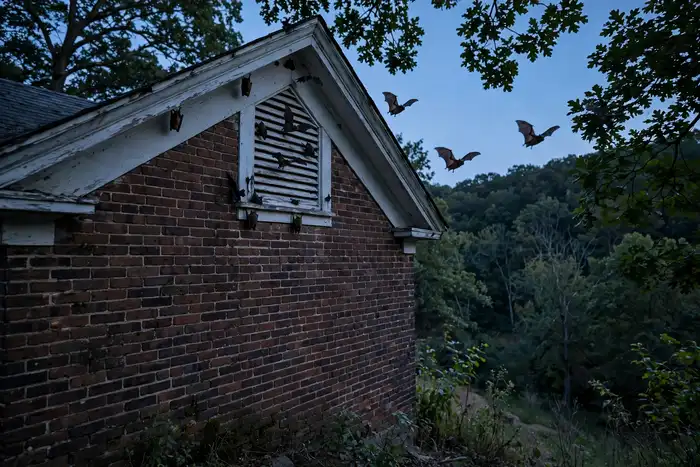
The age of the stock also explains the bat picture here. Tall, warm attics under steep older roofs are prime big brown bat roosts, and the same houses often hold the small, forgotten gaps at gables and chimneys that a bat colony needs.
Ohio seasons and Ohio rules set the calendar
Akron wildlife work runs on a strongly seasonal clock. Fall is the attic-entry peak, when squirrels, flying squirrels, raccoons and mice push indoors ahead of winter. Winter is denning and hibernation — groundhogs asleep underground, big brown bats hibernating in some attics, skunks riding out the coldest weeks in their dens. Spring brings emergence and litters: groundhogs digging out on the slopes, skunks raising young under porches, raccoons in chimneys. And summer is when bat exclusion is legally paused.
The rules behind that calendar are Ohio's. Removal for hire requires an ODNR Commercial Nuisance Wild Animal Control Operator license under Ohio Revised Code section 1531.40. Bat exclusion is closed from May 16 through July 31 when five or more bats are present, and from October 15 through March 31 for hibernation, in each case unless ODNR gives prior written permission; the open windows are April 1 to May 15 and August 1 to October 15. Raccoons, skunks, foxes and bats are Ohio's main rabies vectors, bats being the most frequently confirmed, and northeast Ohio sits in the oral rabies vaccine baiting area for raccoon-variant rabies. Finally, under Ohio Administrative Code 1501:31-15-03(E)(3), a captured raccoon, skunk or opossum cannot be relocated — the lawful outcomes are release on the same property or humane euthanasia — so our crew leads with exclusion, letting animals leave a structure on their own wherever that can work.
Wildlife we remove in Akron
From flying squirrels gliding in off the slope-side oaks to groundhogs tunneling behind a retaining wall, these are the calls Akron homeowners make most.
🐿️ Squirrels
Wooded Akron lots hold both gray squirrels and the nocturnal flying squirrels that glide from slope-side trees to the roof. Day noise and night noise mean different animals and different sealing — both peak in fall. See our full Akron squirrel removal guide →
🦝 Raccoons
Valley woods full of den trees sit a short climb from Akron roofs, and unused chimneys on rubber-era houses are spring nurseries. A rabies vector Ohio law does not allow to be relocated — exclusion-first, kits accounted for. See our full Akron raccoon removal guide →
🦇 Bats
Big brown bats roost in the tall attics of older Akron homes and hibernate in some through winter. ODNR closes exclusion May 16–July 31 and October 15–March 31 without written permission — timing is the whole job. See our full Akron bat removal guide →
🦨 Skunks
Skunks den under porches and behind retaining walls on Akron's sloped lots, raising litters in spring. A rabies vector that cannot be relocated in Ohio, handled by calm exclusion and buried screening. See our full Akron skunk removal guide →
🦔 Groundhogs
The signature Akron yard animal: burrows in slopes, banks and behind retaining walls, silent all winter in hibernation, then fresh digging at spring emergence that can undermine the wall itself. See our full Akron groundhog removal guide →
🐾 Opossums
Opossums work the valley floor and wooded edges at night and bed down in Akron garages, under porches and in hillside basement spaces. Ohio's no-relocation rule applies, so the shelter gets closed. See our full Akron opossum removal guide →
🐿️ Chipmunks
Chipmunks tunnel along foundations and through the soil behind retaining walls on wooded lots, moving surprising amounts of earth one cheekful at a time. Colonies, not singles, are the usual picture. See our full Akron chipmunk removal guide →
🐀 Mice, rats & voles
House mice pour into hillside basements at first frost, Norway rats work the older low-lying housing, and voles leave their trail systems in the lawn at snowmelt. Fall sealing is the turning point. See our full Akron rodent removal guide →
🐍 Snakes
Garter snakes, rat snakes and milk snakes from the valley woods — overwhelmingly nonvenomous. The call is identification and removal from a basement or garage cut into the hillside, not alarm. See our full Akron snake removal guide →
🪰 Dead animals
An odor that surfaces at spring thaw often traces to a winter death in a wall, attic or porch den on a sloped lot. Our crew locates it, removes it and sanitizes the area, then seals the entry. See our full Akron dead animal removal guide →
Animal-specific help in Akron
Deep, local guides for the problems we get called about most — with our wildlife crew behind every one.
How to get help in Akron
Tell us what you're hearing
Scratching in the attic, a snake by the porch, holes in the yard — call with your problem and your Akron address.
We connect you locally
Call us and tell us about the job — we will confirm the local crew for your county before any work starts.
They solve it — for good
Inspection, humane removal, full exclusion and cleanup — handled by our wildlife crew, following Ohio rules.
Common wildlife removal questions in Akron
Who do I call for wildlife removal in Akron?+
Why does my Akron home get so much wildlife pressure?+
I hear noises in my attic only at night — what is it?+
When do groundhogs become a problem in Akron?+
Can bats be excluded from my Akron attic in the summer?+
How much does wildlife removal cost in Akron?+
Serving all of Summit County
Akron is one part of Summit County. See wildlife removal in Summit County, OH for the county-wide picture — the animals we get called about most, and the other towns we cover.
One call to your Akron wildlife crew
Whether it's squirrels in an older in-town attic or a raccoon in a new subdivision crawlspace, the fastest fix is our wildlife crew, who knows Summit County wildlife. Call us and tell us about the job — we will confirm the local crew for your county before any work starts.
- Local to Summit County. ODNR-compliant handling — call to ask about licensing and insurance.
- One company, one call. Call us and tell us about the job.
- Done right. Removal, exclusion and cleanup.