Squirrel Removal in Akron, OH
Noise overhead that starts at dusk and pattering through the night? On Akron's wooded slopes that is the flying squirrel's schedule — while its gray cousins work the same roofs by day. Call us and tell us about the job — we will confirm the local crew for your county before any work starts.
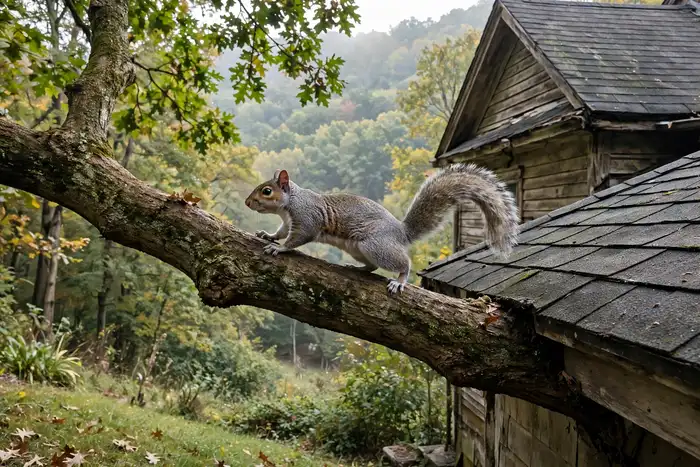
Squirrels in your Akron home
Akron has two attic squirrels, and telling them apart decides the whole job. Gray squirrels are the familiar daytime animals of the valley's oak-heavy neighborhoods, entering through chewed soffits and gable vents in the fall push. Flying squirrels are smaller, nocturnal and social; they glide from the tall trees on the slope behind the house, land on the roof, and slip through openings so small a homeowner would swear nothing could use them. A group of them in an attic makes a surprising amount of soft, rolling noise — usually blamed on mice until someone listens at midnight.
Both species choose Akron's older attics for the same reasons: steep, warm roofs on rubber-era houses, branches within gliding or jumping distance on the slope side, and small freeze-thaw gaps at the roofline that widen a fraction every winter. The damage is also shared — chewed wiring, shredded insulation and gnawed wood — and in a century-old attic that combination should not be left to run.
Day shift, night shift: reading the noise
Timing is the first diagnostic. Scratching and running in the early morning and again toward evening is gray squirrel behavior. Light pattering, soft thumps and rolling sounds that begin after dark and recur through the night point to flying squirrels — and usually to more than one, since they den in groups, especially in winter. Droppings and entry size confirm it: flying squirrels need only a small gap, often at a gable, a roof return or where a slope-side branch lets them reach an eave untouched from the ground.
The glide path from the valley woods
A flying squirrel does not climb your house from the ground the way a rat does; it launches. From a tall tree on the bank behind an Akron home, a glide can carry it well across a backyard and onto the roof. That is why ground-level fixes alone fail on sloped, wooded lots, and why the inspection starts by standing in the yard and reading the tree line against the roof: which branches overhang, which trunks lean toward the house, and which eaves sit within a glide of the slope.
Small animal, tight seal
Exclusion for flying squirrels is precision work. Every gap at the roofline has to be found and closed with metal, not just the one in use, because a group shut out of one opening will test the whole perimeter the same night. Our crew fits a one-way door at the active entry, confirms the attic has gone quiet and empty — including any young — and seals to a standard that assumes the next animal is smaller than the last. Gray squirrel work follows the same sequence, with heavier attention to chewed openings at soffits and vents.
Litters and the cost of a rushed seal
Squirrels here raise young in late winter and again in late summer. Seal a mother out with a litter inside and she will chew back in, frequently through a more expensive piece of roof than the first hole; leave the young sealed in and the problem becomes an odor problem. Checking for litters precedes any closing, on every squirrel job, and it is the step rushed work skips.
Wiring in an older attic
Squirrels chew constantly, and attic wiring is on the menu along with wood and duct insulation. In Akron's older housing, where an attic may still hold wiring from earlier eras above rooms the family has carefully restored, gnawed wiring is the argument for dealing with a fall invasion in fall — not for waiting to see whether the animals leave in spring. They usually do not; a winter den is defended, not abandoned.
Trees, feeders and lowering the pressure
After sealing, two habits help on a wooded lot. Keep branches cut back from the roof where the slope allows it, understanding that on some lots the trees are the lot's character and sealing has to carry the load alone. And move bird feeders away from the house: in winter a feeder concentrates every squirrel in the hollow at your walls, testing the seal daily. Neither habit replaces metal at the roofline; both reduce how often it gets tested.
Common squirrel questions in Akron
I hear noises in my Akron attic at night — are they flying squirrels?+
How do flying squirrels get onto my roof if nothing touches it?+
How do I get squirrels out of my attic in Akron?+
When is squirrel season worst in Akron?+
How much does squirrel removal cost in Akron?+
Other Akron problems that come with squirrels
Our wildlife crew handles these closely related problems — the ones that most often turn up with a squirrel issue.
Got more than squirrels in Akron?
Squirrels are rarely the only thing using an attic or yard in Akron. See everything we handle locally on the Akron wildlife removal hub, or jump to Ohio wildlife removal.
Serving all of Summit County
Akron is one part of Summit County. See wildlife removal in Summit County, OH for the county-wide picture — the animals we get called about most, and the other towns we cover.
One call to your Akron squirrel crew
The longer squirrels stay in the attic, the more they chew and the bigger the cleanup. Call us and tell us about the job — we will confirm the local crew for your county before any work starts.
- Local to Summit County. ODNR-compliant handling — call to ask about licensing and insurance.
- Humane exclusion. One-way doors and steel sealing, not poison.
- Done right. Removal, exclusion and cleanup.