Bat Removal & Exclusion in Akron, OH
Bats pouring from a gable at dusk over the valley, and droppings collecting below it? Akron's older attics are prime big brown bat roosts — and Ohio law, not the calendar on your wall, decides when they can be excluded. Call us and tell us about the job — we will confirm the local crew for your county before any work starts.
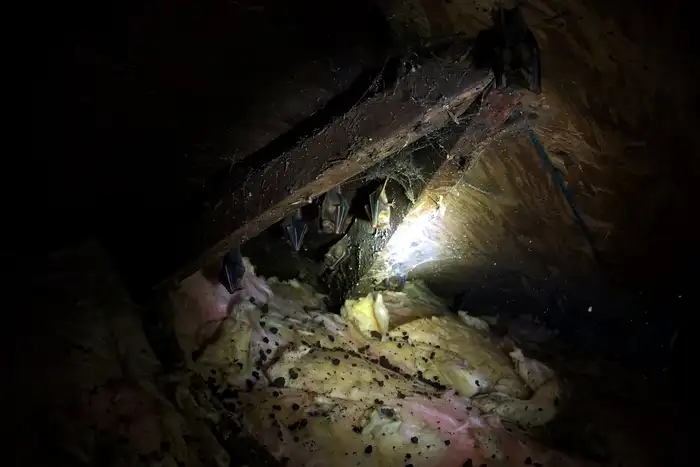
Bats in your Akron home
The Cuyahoga Valley is bat habitat of the first order — forest edges, river insects and, scattered through the neighborhoods above it, tall older houses whose attics stay warm all summer. The big brown bat is the species that uses them, roosting behind gable vents, at chimney flashing and along ridge lines, often in the same house for many years. Most Akron colonies are discovered the same way: droppings accumulating on a porch, a deck or the ground below an entry, or the sight of bats leaving at dusk.
What new callers rarely expect is that Ohio may not let anyone remove the colony today. Bat exclusion in this state is the only legal method, it must be done by a licensed operator, and it is closed for two long stretches of every year. The professional answer to a badly timed bat call is an honest inspection and a firm date — not a promise the law forbids keeping.
The ODNR blackout windows, plainly stated
Under Ohio Administrative Code 1501:31-15-03(H)(5), excluding bats is prohibited from May 16 through July 31 when five or more bats are present — maternity season, when the young cannot fly — and from October 15 through March 31, the hibernation period. Either closure yields only to prior written permission from the Chief of the ODNR Division of Wildlife. The working windows are April 1 to May 15 in spring and August 1 to October 15 in late summer and fall. Almost everything about an Akron bat job is scheduled backwards from those dates.
A colony that may never leave: hibernation in the attic
Big brown bats are cold-hardy, and in Ohio buildings they frequently stay through winter, hibernating in wall voids and quiet attic corners rather than migrating to a cave. A house can therefore hold bats in every month — roosting in summer, hibernating in winter — and the tempting midwinter assumption that they have gone is exactly what the October-to-March blackout protects against. Any winter plan starts with looking for hibernating animals.
Entries on a rubber-era roofline
Bats use gaps about a finger's width, and older Akron houses provide them where materials of different ages meet: gable vents whose screening has failed, flashing at original chimneys, ridge and eave gaps under layered roofing repairs, and the seams of porches added or rebuilt over the decades. Because a sloped lot puts some eaves within reach of the hillside and its trees, entries can exist on the slope side that are invisible from the street. Droppings below an opening are the crew's map of which gaps are active.
Guano, rabies and the bat indoors
Years of occupancy leave guano piled under a roost; disturbed, dried droppings can carry the fungus linked to histoplasmosis, so removal is protected work, not a broom-and-bucket chore. Bats are also Ohio's most frequently confirmed rabies species. A bat found in a bedroom, or in a room with a child or a pet, is treated as a possible exposure: do not handle it, keep the room closed, and seek guidance from your doctor or local health department — the bat may need testing rather than release. In the attic, left alone, bats are not aggressive and the colony is a timing problem, not an emergency.
How exclusion runs when the window opens
The crew seals every gap on the structure except the active entries, fits those with one-way bat valves, and lets the colony leave on its own over successive nights to feed over the valley. Confirmation — no bats emerging, no new droppings — precedes removing the valves and sealing the final openings. On a large, many-gabled older house the sealing list is the job; the valves are the easy part.
Mistakes that make a bat problem worse
Sealing the visible gap on discovery is the classic error: in summer it traps flightless pups, in winter it traps hibernating adults, and in any season it can drive bats into wall voids and living space. Mothballs, bright lights, sprays and ultrasonic gadgets do not clear a colony. Patience plus a licensed exclusion inside the window is the whole of the working answer.
Common bat questions in Akron
I found bats in my Akron attic in July — what happens now?+
When can bats legally be excluded in Ohio?+
Do the bats in my attic leave for the winter?+
A bat was in my bedroom overnight — what should I do?+
How much does bat removal cost in Akron?+
Other Akron problems that come with bats
Our wildlife crew handles these closely related problems — the ones that most often turn up with a bat issue.
Got more than bats in Akron?
A rubber-era Akron roofline that admits bats almost always has other small gaps the same inspection should catch. See everything we handle locally on the Akron wildlife removal hub, or jump to Ohio wildlife removal.
Serving all of Summit County
Akron is one part of Summit County. See wildlife removal in Summit County, OH for the county-wide picture — the animals we get called about most, and the other towns we cover.
One call to your Akron bat crew
A bat colony in a tall Akron attic can persist for years, adding guano each season, and a badly timed seal traps pups or hibernating bats inside the house. Call us and tell us about the job — we will confirm the local crew for your county before any work starts.
- Local to Summit County. ODNR-compliant handling — call to ask about licensing and insurance.
- Timed, one-way exclusion. Bat valves during April 1–May 15 or August 1–October 15, then permanent sealing after the colony is confirmed out.
- Done right. Removal, exclusion and cleanup.