Squirrel Removal in Thomaston, GA
In Thomaston squirrels do not need a forest. They need one overhanging street tree, one softened eave board on an older in-town house, and about a minute of chewing.
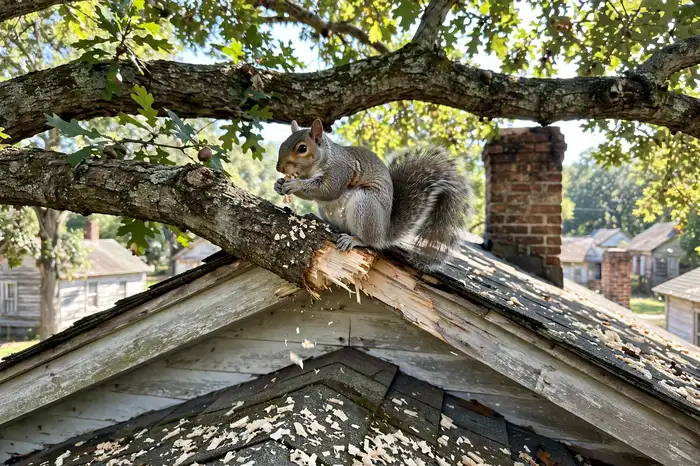
Street trees, soft eave boards and a short jump onto a Thomaston roof
The classic Thomaston squirrel house is easy to picture: an older in-town home, a broad street tree shading the front, and a roofline that has been patched in sections over many years. The tree gives the highway, the patchwork gives the weak points, and the attic gives warmth, quiet and room to nest directly above your bedroom. By the time nuts and shredded insulation appear, squirrels may have been commuting that route for a full season.
Calls usually start with sound rather than sight. A thump, a rapid scramble, rolling noises that homeowners describe as marbles, then silence while the animals are out feeding. Because mill-era Thomaston attics often have partial flooring, low pockets and additions at different heights, sound travels oddly — the room where you hear it is a clue, not a guarantee, and we treat it as a starting point for a roofline inspection rather than proof of where the hole is.
Where aging Thomaston rooflines open first for squirrels
Check the corners first. Eave returns, fascia ends and the meeting point between a porch roof and the main wall collect water, soften earliest and sit within easy reach of limbs and utility lines. Squirrels test those spots with their teeth because the wood gives. A fresh entry often shows pale, newly exposed wood around a dark older hole, plus scattered shavings on the ground or porch roof below. In Thomaston we walk the full perimeter looking for that pale-wood signature, not just the corner nearest the noise.
How mature in-town street trees turn into squirrel highways
A limb does not need to touch the house. Squirrels leap impressive gaps, land on shingles and walk the ridge like a sidewalk. We note every limb within jumping range, every line running to the roof, and every neighbouring tree that connects canopy to your lot. Trimming advice is specific — which limb, how far back, and which routes remain afterward — because random tree work costs money and can still leave the one bridge the squirrels actually use.
Inside a mill-era Thomaston attic: nests, nuts and chewed wiring
Older attics in Thomaston often hold a squirrel archive: leaf nests tucked into eave pockets, nut caches in wall tops, droppings along joist runs and insulation tunnelled into lanes. Wiring run through those same pockets gets gnawed, and stored boxes get shredded for nesting material. We document what we find with photos, point out any wiring that needs an electrician rather than a wildlife crew, and clear nesting from the entry zone so new sealing is not packed against old debris.
Getting squirrels out of a Thomaston house without sealing young inside
Timing matters in spring and late summer when young may be in the nest and unable to exit on their own. We check the nest area carefully before fitting any one-way exit or starting trapping, and we adjust the method if dependent young are present. Sealing a Thomaston attic too fast can leave young trapped in an eave pocket and create a far worse problem inside the wall, so patience at this step protects both the animals and the house.
Sealing Thomaston eave, vent and porch junctions so the route stays closed
Our sealing follows the squirrel logic of the house: hard material at chew points, properly backed repairs at softened fascia, screened vents that still breathe, and attention to the hidden junction where the porch roof dies into the wall. Soft caulk alone fails here — squirrels treat it as a removable plug. Where wood is rotted beyond a sound repair, we say so plainly and identify the carpentry needed, then seal what can be sealed correctly around it.
Signs a Thomaston squirrel problem has moved from attic to walls
If noise drops from ceiling level to inside a wall, or a sudden odour follows a period of frantic scratching, an animal may have fallen into a wall void or died there. Mill-era Thomaston framing has irregular voids, fire blocks and later wiring that trap animals easily. Call us promptly if the sound pattern changes that way — wall situations need a different plan than attic exclusion, and waiting rarely improves them.
Common squirrel questions in Thomaston
Why do squirrels pick my older Thomaston house over the newer houses on the street?+
I hear rolling sounds like nuts in my Thomaston ceiling. Is that squirrels?+
Will trimming my street tree alone solve a Thomaston squirrel problem?+
Can squirrels damage wiring in a mill-era Thomaston attic?+
How long does Thomaston squirrel exclusion usually take to go quiet?+
A squirrel fell into my Thomaston wall and went quiet. What now?+
Other Thomaston problems that come with squirrels
Our wildlife crew handles these closely related problems — the ones that most often turn up with a squirrel issue.
Got more than squirrels in Thomaston?
While we are in a Thomaston attic we also watch for bat staining at gables, raccoon rub marks at chimneys and rodent runs along joists — older Upson County houses often host more than the animal you heard first. See everything we handle locally on the Thomaston wildlife removal hub, or jump to Georgia wildlife removal.
Want the background before you call? Read our statewide guide: Squirrels in the attic: what it costs and why sealing too early backfires.
Serving all of Upson County
Thomaston is one part of Upson County. See wildlife removal in Upson County, GA for the county-wide picture — the animals we get called about most, and the other towns we cover.
One call to your Thomaston squirrel crew
Our Thomaston squirrel work closes the whole roofline, not just the loudest hole.
- Local to Upson County. Georgia DNR-compliant handling — call to ask about licensing and insurance.
- Whole-shell eave and gable sealing. We remove the animals, then work every softened corner, vent and junction on that mill-era shell, because a Thomaston squirrel excluded from one eave will test the next weak board the same afternoon if we leave it.
- Done right. Removal, exclusion and cleanup.