Rodent Control in Thomaston, GA
Mill-era crawlspaces, cluttered in-town storage and damp river-adjacent cover give Thomaston rodents everything they need — we cut the routes, the shelter and the food together.
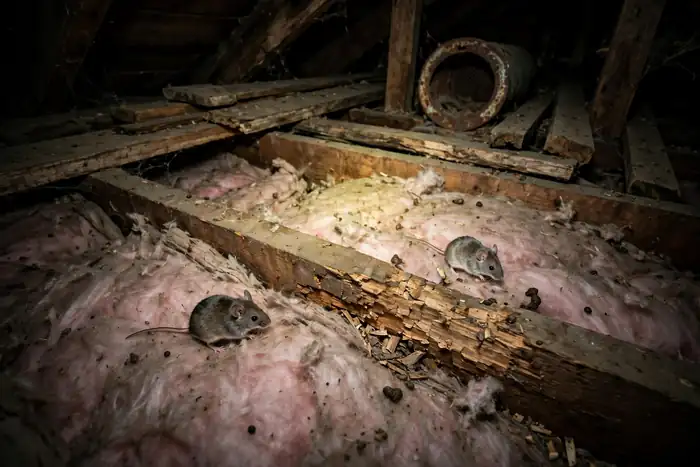
Rodents travelling Thomaston floor voids, storage rooms and wall chases
Rodents love the in-between spaces of older Thomaston housing. A mill-era floor sits over a crawlspace laced with plumbing and wiring, walls contain chases and voids added across several renovations, and attics over additions create warm, empty highways. A mouse needs a gap the width of a finger; a rat needs only a little more, and both can find those gaps at pipe entries, rotted sill sections and vents that no longer screen tightly.
Outside, Thomaston feeds them well. River-adjacent lots offer year-round cover and water, in-town storage buildings and garages offer undisturbed nesting, and bird feed, pet food and unsecured trash bridge any lean season. Control that only sets traps indoors fights the symptom while the lot keeps supplying recruits. Our Thomaston approach therefore always pairs indoor removal and sealing with an honest look at the storage and ground cover within a few yards of the walls.
Under a mill-era Thomaston floor: the crawlspace route system
In a crawlspace we read the ground and the structure together. Droppings cluster below pipe penetrations and along beam lines, insulation shows tunnelling, and the earth itself shows worn runs between piers. River-adjacent Thomaston crawlspaces add damp: moisture rots sill wood, and rotted wood is a gnawable doorway. We mark each penetration and soft section, seal them with materials rodents cannot chew through, and flag any moisture or rot that needs a different trade before it reopens our work.
In-town Thomaston storage: garages, sheds and rooms nobody opens
The quietest room wins. A garage corner stacked with boxes, a shed holding feed and seed, a storage room in an older in-town building opened twice a year — rodents nest where disturbance is lowest and food is closest. We inspect those spaces as carefully as the kitchen, because clearing a Thomaston house while a shed population thrives ten feet away guarantees reinvasion through the first gap anyone misses. Expect direct advice about containers, stacking off floors and clearing wall edges.
River-adjacent Thomaston lots and the outdoor rodent reservoir
Thick ground cover against a foundation, brush along a drainage line, and debris piles on damp ground create a protected outdoor population pressing constantly on the building. Trapping indoors against that pressure feels endless, because it is. We identify the cover that actually touches or shelters the route to the house, prioritise clearing a defensible margin at the walls, and leave the rest of a natural Upson County lot alone — the goal is a buffer at the structure, not a scorched yard.
Roof rats in Thomaston attics versus mice in the walls
Not every Thomaston rodent lives low. Roof rats travel limbs and lines into attics, leaving larger droppings along joist runs and gnawing stored material, while house mice work kitchens and wall voids on a much smaller scale. The control points differ — roofline and tree routes for one, pipe gaps and cupboard voids for the other — so we identify which animal, or whether both are present, before placing anything. Guessing wrong wastes weeks.
Sealing Thomaston entries with materials rodents cannot gnaw through
Foam alone is a snack-flavoured plug to a rat. Lasting Thomaston exclusion uses metal flashing, hardware cloth, backer material and properly fitted vent screens, shaped to irregular older openings rather than standard modern ones. We pay special attention to the spots previous repairs attempted: a chewed-out patch tells us exactly which route the population values most, and that route gets the strongest rebuild on the house.
After Thomaston rodent removal: keeping a clean house unattractive
Once animals are out and entries closed, small habits decide whether the job holds. Dry goods in sealed containers, pet food not left in open bags in storage, feed and seed in lidded metal or heavy plastic, boxes raised and pulled off walls so inspections stay possible, and droppings or new gnawing reported early rather than after a season. We leave Thomaston homeowners with that short, specific list based on their building, not a generic pamphlet.
Common rodent questions in Thomaston
Why do rodents keep returning to my older Thomaston house after I trap them myself?+
Are the droppings under my Thomaston house from rats or mice?+
My Thomaston storage building has rodents but my house does not. Should I act now?+
Does living near damp river ground mean Thomaston rodents can never be controlled?+
Is baiting alone a good plan for a Thomaston rodent problem?+
What should I clean after rodents are removed from my Thomaston home?+
Other Thomaston problems that come with rodents
Our wildlife crew handles these closely related problems — the ones that most often turn up with a rodent issue.
Got more than rodents in Thomaston?
Rodent runs in a Thomaston crawlspace often reveal snake access, armadillo burrowing at piers and moisture problems under the house, and we report anything of that kind we come across during rodent work. See everything we handle locally on the Thomaston wildlife removal hub, or jump to Georgia wildlife removal.
Want the background before you call? Read our statewide guide: Roof rats in Georgia: why bait alone never ends it.
Serving all of Upson County
Thomaston is one part of Upson County. See wildlife removal in Upson County, GA for the county-wide picture — the animals we get called about most, and the other towns we cover.
One call to your Thomaston rodent crew
Our Thomaston rodent work treats the building as a route map, not a place to scatter bait and leave.
- Local to Upson County. Georgia DNR-compliant handling — call to ask about licensing and insurance.
- Trace the runs, close the gaps, remove the animals. We follow droppings, grease marks and gnawing through crawlspace and attic, seal the entries those runs connect, and set removal along the runs themselves — then we show you the storage and food changes that keep a new population from moving into a clean, sealed house.
- Done right. Removal, exclusion and cleanup.