Dead Animal Removal in Thomaston, GA
In a mill-era Thomaston house, odour travels through old framing channels and plumbing chases far from where the animal actually lies — we track it to the source, not the strongest-smelling room.
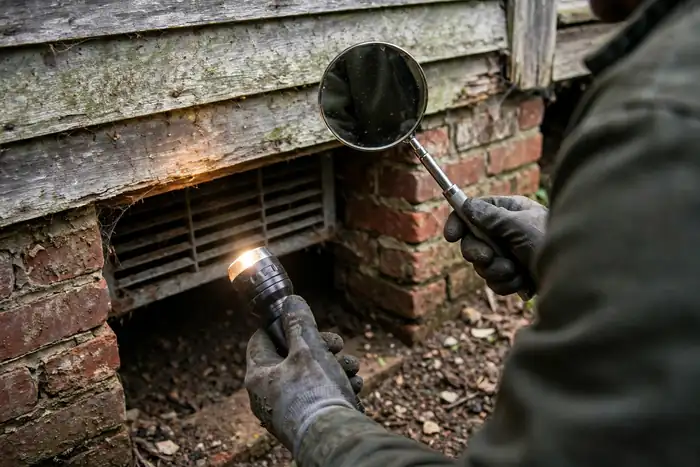
A carcass hidden in a Thomaston wall, attic pocket or under-floor void
Few household problems concentrate the mind like a dead animal nobody can find. In Thomaston the search is complicated by the housing itself: mill-era walls contain irregular voids, blocked cavities and chases cut for plumbing and wiring added across a century, and crawlspaces under pier foundations give an animal room to travel and die far from any access hatch. The room that smells worst is often simply where those channels vent, not where the carcass rests.
Call sooner rather than later, and tell us the prelude. Days of scratching in a wall that suddenly stopped, a squirrel that vanished from an attic, a rodent problem recently treated by someone — those histories locate voids better than odour alone. We would also rather hear that the smell is already fading: that timing still helps us judge size and position, and retrieval still matters, because a carcass left in a Thomaston wall draws flies and staining long after the worst odour passes.
Reading odour through mill-era Thomaston framing channels
Old framing is leaky in every direction. Heat rising through a wall chase carries odour upward, a bathroom fan or return vent pulls it sideways, and a carcass below the floor can perfume the room above a pier rather than the room beside it. We work room to room and floor to floor, compare strength at outlets, vents and baseboards, and map the pattern against how your Thomaston house was actually framed and added onto. That map, not a single strong sniff, chooses the opening location.
Wall voids in Thomaston homes: the trapped-animal story behind the smell
The common Thomaston wall case begins with a live animal — a squirrel that slipped down from an attic, a rodent that fell from a top plate — unable to climb the smooth inside of a void interrupted by fire blocks or later wiring. Scratching that moves downward over a day or two, then stops, is the classic history. Retrieval usually means one careful opening low on that wall. We confirm the void with the least invasive checks available before any cutting, and we cut once, in the place the evidence supports.
Crawlspace carcasses under Thomaston pier foundations
Under a Thomaston house, an opossum, raccoon or feral animal may die beneath insulation, behind a pier or at the far end from the access door, and odour seeps up through floor gaps across several rooms. Crawlspace retrieval is slow, physical work in a confined, damp space, sometimes complicated by river-adjacent moisture. We locate by systematic search rather than odour alone, remove the carcass and any heavily soiled material it rests on, and report any live-animal burrows or gaps we pass on the way.
Attic pockets, eave corners and chimney-adjacent carcasses in Thomaston
Attic deaths hide in eave pockets where insulation is deep and access is poor, or beside chimneys where animals den in warmth. Flies gathering at an upstairs window or vent often betray these locations before odour peaks below. In a layered Thomaston attic we may work from the roof side or a gable rather than crawling insulation — whichever route reaches the carcass with the least damage to your home is the route we choose, and we explain it before starting.
Cleanup, staining and what actually needs replacing in a Thomaston void
After retrieval, the honest scope varies. Sometimes removing the carcass and a small amount of soiled insulation ends the problem within days as the void airs. Sometimes fluids have stained drywall or saturated material that will hold odour until it is replaced. We show you what we found, separate what must go from what will recover, and avoid inflating a single-animal retrieval into an attic-wide restoration you do not need.
Preventing the next Thomaston carcass: sealing the live route
Every carcass arrived by a route a live animal used: a chewed eave, a crawlspace gap, an open vent, a burrow at a pier. Leaving that route open means the next animal can repeat the story in the same void. After retrieval we identify the most likely entry, quote its sealing plainly, and prioritise it while the memory of the smell is fresh. Prevention after a dead-animal call has the highest success rate of any wildlife work we do in Thomaston, because nobody needs convincing.
Common dead animal questions in Thomaston
The smell in our Thomaston house is strongest in the bathroom, but we heard scratching in a bedroom wall. Which is right?+
Will the Thomaston odour just go away if we wait it out?+
How much wall will you need to cut in our Thomaston home?+
We recently had rodent treatment and now there is a terrible smell in our Thomaston walls. Is that connected?+
There are flies all over one upstairs Thomaston window but only a faint smell. Should we call?+
Can you find a dead animal under our Thomaston house if the crawlspace is very low?+
Other Thomaston problems that come with dead animals
Our wildlife crew handles these closely related problems — the ones that most often turn up with a dead animal issue.
Got more than dead animals in Thomaston?
A dead animal in a Thomaston structure is evidence of a live-animal route, so after retrieval we will point out the squirrel, rodent or raccoon entry that should be sealed to prevent a repeat performance in the same wall. See everything we handle locally on the Thomaston wildlife removal hub, or jump to Georgia wildlife removal.
Want the background before you call? Read our statewide guide: Dead animal in a wall or attic: how long the smell lasts.
Serving all of Upson County
Thomaston is one part of Upson County. See wildlife removal in Upson County, GA for the county-wide picture — the animals we get called about most, and the other towns we cover.
One call to your Thomaston dead animal crew
Our Thomaston dead-animal work locates first, opens once, and then closes the route that let the animal in.
- Local to Upson County. Georgia DNR-compliant handling — call to ask about licensing and insurance.
- Locate precisely, retrieve cleanly, explain the entry. We narrow the void by odour pattern, fly activity, framing layout and any history of scratching in that wall, retrieve the carcass through the smallest workable opening, remove contaminated material with it, and tell you how the animal most likely entered so the same void does not claim another.
- Done right. Removal, exclusion and cleanup.