Raccoon Removal in Thomaston, GA
Between Flint River bottom foraging, in-town trash and tall older chimneys, Thomaston gives raccoons food, water and a den on almost every lot — our job is to take the den away.
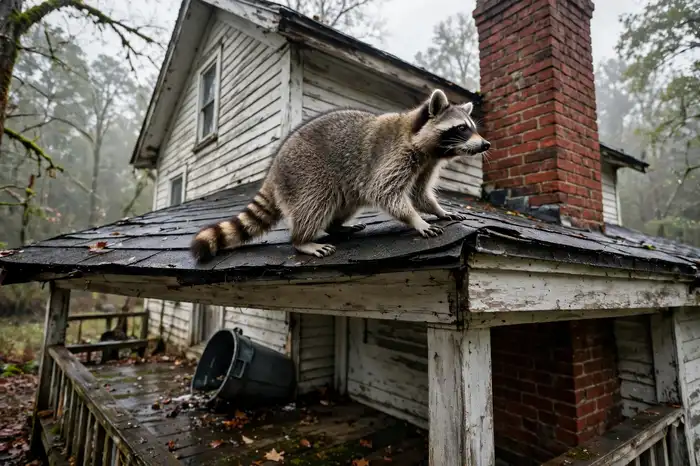
A raccoon den in a Thomaston attic or an uncapped older chimney
Raccoons read Thomaston like a menu with a bedroom attached. Low ground toward the Flint River offers frogs, crayfish and insects, in-town lots offer trash cans, pet food and garden produce, and the older housing stock offers big chimneys, broad attics and soffits a strong animal can pull open. A raccoon does not need all three on one lot — it travels well at night — but Thomaston frequently provides all three within a short walk.
Most calls begin in spring, when females search for a den that is warm, dry and safe from predators. An uncapped flue looks to a raccoon like a hollow tree, and an attic reached through a lifted soffit offers even more room. Once young are born inside, the job changes completely: the mother will return persistently, the young cannot leave on their own, and any plan that ignores them fails. That is why our first Thomaston question is always about timing and sounds, not trap placement.
Chimneys on older Thomaston homes: the hollow-tree den
A raccoon in a flue often announces itself with scratching that echoes oddly, chattering young, and a strong smell near the fireplace. Older Thomaston chimneys may lack caps entirely or carry a cap rusted and lifted at one corner. Never light a fire to drive animals out — that can kill young, start a chimney fire or drive a panicked animal into the house. Keep the damper closed if it is safe to do so, keep the room clear, and call us to assess the flue from outside first.
River-bottom feeding routes that bring raccoons to Thomaston doors
On lots sloping toward damp ground, raccoons follow the same nightly lanes: along drainage, under low decks, past trash storage, up the one tree or post that reaches the roof. Muddy prints on a porch, tipped cans and latrine deposits on a flat roof section map that lane clearly. We use that map twice — once to intercept the animals, and once to tell you exactly which outdoor attractants to change so a new raccoon does not inherit the route.
How a raccoon tears into a mill-era Thomaston roofline
Unlike squirrels, raccoons pry. Strong forepaws pull at soffit panels, lift shingles at roof returns, bend vent covers and widen a small water-damaged spot into an entry in one visit. Thomaston houses with patched or layered roofing give them purchase points. Our inspection tests soffits and returns by hand where reachable, because a panel that looks intact from the driveway may move half an inch under pressure — more than enough invitation.
Young raccoons in a Thomaston attic: why the plan starts with them
If young are present, removing only the mother strands them to die inside the structure, and removing only the young guarantees a frantic mother tearing to get back in. We locate the nest, judge the age of the young, and sequence the work so the family comes out together wherever possible. In a mill-era Thomaston attic that may mean working through a gable or an addition ceiling rather than the obvious hatch — we choose access by where the nest actually is.
Latrines, droppings and cleanup after a Thomaston raccoon den
Raccoons reuse latrine sites on roofs, in attics and on flat porch covers, and their droppings can carry health risks that deserve respect. Keep children and pets away from those areas and do not sweep dry droppings yourself. After removal we advise what cleanup your situation needs, which insulation is compromised, and what can be disinfected versus what should be replaced, scaled to the actual den rather than sold as a blanket attic overhaul.
Caps, screens and soffit repairs that hold against the next Thomaston raccoon
A raccoon repair has to withstand a strong, patient animal testing it at 2 a.m. We fit sturdy chimney caps, secure screening that cannot be peeled from a corner, and soffit repairs anchored into sound framing rather than into the damaged material that failed. On older Thomaston chimneys we also check the crown and flashing, because a perfect cap on a crumbling crown is a short-lived fix and you deserve to know that before paying for it.
Common raccoon questions in Thomaston
There are raccoon sounds in my Thomaston chimney. Can I light a fire to get them out?+
Will a Thomaston raccoon be released in the countryside nearby?+
Why did a raccoon choose my Thomaston house this spring?+
I found raccoon droppings on my Thomaston porch roof. Should I clean them myself?+
Raccoons keep tipping trash cans on our river-side Thomaston lot but none are inside. Can you still help?+
How do you keep a Thomaston raccoon from just ripping the repair open?+
Other Thomaston problems that come with raccoons
Our wildlife crew handles these closely related problems — the ones that most often turn up with a raccoon issue.
Got more than raccoons in Thomaston?
Raccoon traffic around a Thomaston home often exposes other openings — squirrel-chewed eaves, bat gaps at gables, rodent holes at the crawlspace — and we will point out every one we see while the raccoon work is underway. See everything we handle locally on the Thomaston wildlife removal hub, or jump to Georgia wildlife removal.
Want the background before you call? Read our statewide guide: Raccoon in the attic: babies, rabies law and what happens next.
Serving all of Upson County
Thomaston is one part of Upson County. See wildlife removal in Upson County, GA for the county-wide picture — the animals we get called about most, and the other towns we cover.
One call to your Thomaston raccoon crew
Our Thomaston raccoon work pairs careful den removal with repairs that deny the next mother the same address.
- Local to Upson County. Georgia DNR-compliant handling — call to ask about licensing and insurance.
- Den-first removal, then structural denial. We establish whether young are present, remove the family using the method that fits that den, then cap, screen or repair the entry so the strong, clever next raccoon who tests it finds solid material instead of a reopened hole.
- Done right. Removal, exclusion and cleanup.