Bat Removal in Monticello, GA
Call us when a dusk flight pours from a gable above the square, staining appears under an attic vent, or faint chattering carries through an old chimney wall. Monticello's tall, quiet attics are exactly the roosts bats look for in Jasper County.
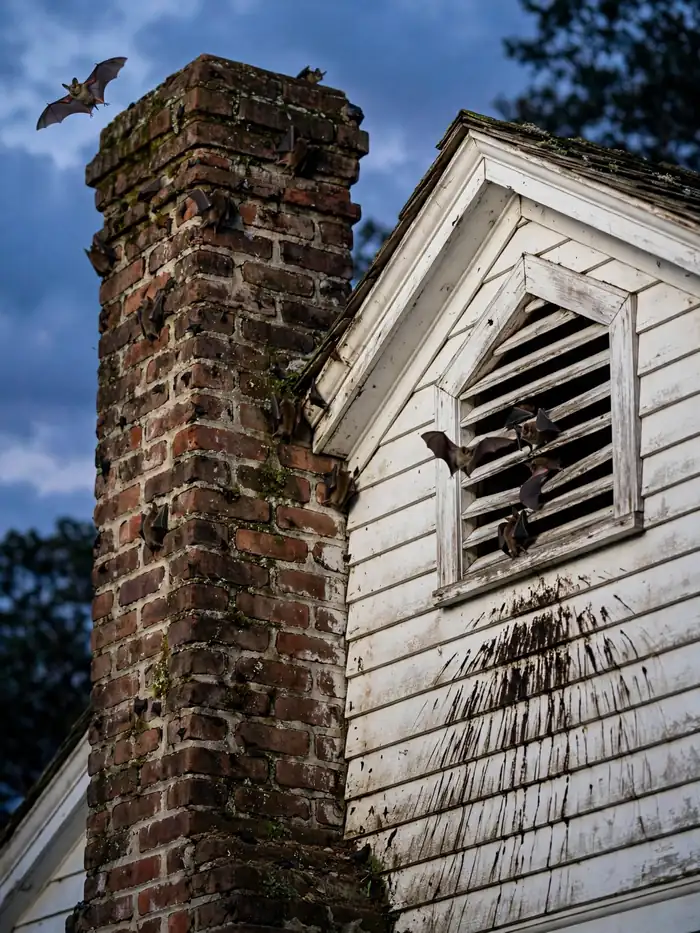
A Quiet, High Monticello Attic Is a Standing Invitation to a Bat Colony
A bat does not need a broken window or a hole you can see from the street. Around Monticello's older houses, a bat needs a mortar joint that has crumbled on a chimney shoulder, a gable vent with a warp in its frame, or a quarter-inch separation where a later roof meets the original wall. From those unremarkable seams, a colony reaches an attic that stays dark, high, and undisturbed for months at a time, which is all a roost requires.
Jackson Lake and the creeks and pasture ponds across Jasper County feed the other half of the equation. Bats hunt insects over water and along tree lines at dusk, then commute a short distance to the warmest roost nearby. A tall house in town, with a steep roof soaking up afternoon sun, outperforms a hollow tree on both warmth and safety. That commute is why a homeowner can watch bats over a country pond one evening and find the same kind of animals leaving their own gable the next.
Mortar Seams and Chimney Shoulders on Monticello's Brick Stacks
Brick chimneys age from the top down. The crown cracks, mortar washes out of the upper joints, and the shoulder where a wide stack narrows becomes a shelf of small, shadowed openings. Bats find those joints by feel as they land and crawl, and a colony can enter along a chimney for years while the attic door shows only a scattering of guano below one corner.
We examine chimney masonry as bat habitat, not just roof furniture. Pointing out which joints are open, which are merely weathered, and whether the flue itself is involved shapes the repair list, and on an antebellum stack that distinction saves both money and historic brick.
Gable Vents and Soffit Gaps Above Monticello's Oldest Attics
The classic Monticello bat entry is a gable vent: louvered, high on the house, screened long ago with mesh that has since rusted or pulled from its frame. Bats land on the louvers, slip behind them, and drop into the attic wall space. Staining is the giveaway, a dark smudge fanning below the vent where bodies and wings have brushed the siding night after night.
Soffits on porches and additions run a close second. A separation along a porch soffit gives bats a concealed slot leading straight over the porch ceiling and, in older framing, onward into the house walls. We follow those stains and smudges rather than guessing, because sealing the wrong vent while the porch slot stays open accomplishes nothing.
Guano, Chattering, and the Smell Inside a Monticello Bat Attic
Most homeowners meet their colony indirectly. Guano pellets collect beneath the roost and crumble like dry insect remains, which is exactly what they mostly are. A faint, high chattering can carry through a chimney chase or a bedroom ceiling at dusk as the colony stirs. In warm weather a sweet, musty odor rises from an attic that has hosted bats for more than one season.
We document where guano has accumulated and how heavily before recommending next steps, and we advise against sweeping or disturbing a heavy deposit yourself. The amount present in a Monticello attic varies enormously, from a single seasons scatter in a gable corner to a deep deposit over old insulation, and honest assessment keeps the response proportionate.
April Through July in Georgia: Monticello Bat Work and Maternity Season
Timing is the legal and humane core of bat work. In Georgia, bat exclusion is restricted from April 1 to July 31, because that is maternity season, when females raise pups that cannot fly. Excluding the adults during those months strands the pups inside to die in the walls and attics, creating a worse problem than the colony itself.
If you call during that window, we can still inspect a Monticello house, map the entries, identify the roost, and prepare a plan, but the exclusion itself waits until the pups are flying. We would rather explain that calendar on the first visit than sell you work that should not be done yet, and most homeowners, once they understand the reason, agree with the wait.
One-Way Exits and Sealing an Antebellum Monticello Roofline
When the season allows, exclusion works by generosity at one door and firmness at all the others. We seal the secondary gaps along mortar, vents, and soffits first, then fit one-way devices at the main exits so bats leave at dusk and find no way back in. Over several nights the colony relocates on its own to the tree lines and outbuildings bats also use around Jasper County.
After activity at the exits stops, the devices come off and those final openings are sealed to match the house. On an old Monticello home that finish work matters aesthetically as well as functionally, and we use materials suited to brick and aged wood rather than smearing a modern patch across a historic facade.
A Single Bat in a Monticello Bedroom Versus a Colony in the Attic
One bat circling a bedroom at two in the morning is a different call from a colony overhead. A single bat often entered through an open chimney damper, a window, or a door left ajar at dusk, and it may have had contact questions that matter: if anyone slept in the room or a pet caught the bat, tell us when you call, because that changes the advice we give about the animal itself.
Do not swat at it or chase it with a broom. Close the room if you can do so safely, open an exterior window or door if there is one, and keep people and pets out. Whether the visitor proves to be a lone stray or the scout of a gable colony, our inspection answers that question with evidence instead of assumption.
Common bat questions in Monticello
Why can bat exclusion not be done at our Monticello house in June?+
How are bats getting into our antebellum attic if we cannot see a hole?+
We saw bats leaving our Monticello gable at dusk. How many might be inside?+
Is the guano in our Monticello attic dangerous to clean up ourselves?+
Could bats be inside our chimney rather than the attic?+
A bat got into our Monticello bedroom last night. What should we do now?+
Other Monticello problems that come with bats
Our wildlife crew handles these closely related problems — the ones that most often turn up with a bat issue.
Got more than bats in Monticello?
Chimneys are shared territory in an old Monticello house. If raccoons have used your flue or squirrels have chewed the flashing beside it, our raccoon and squirrel pages cover those repairs, which often need scheduling alongside the bat work. See everything we handle locally on the Monticello wildlife removal hub, or jump to Georgia wildlife removal.
Want the background before you call? Read our statewide guide: Bats in your attic: Georgia law, maternity season and what exclusion costs.
Serving all of Jasper County
Monticello is one part of Jasper County. See wildlife removal in Jasper County, GA for the county-wide picture — the animals we get called about most, and the other towns we cover.
One call to your Monticello bat crew
Exclusion here is a question of calendar as much as carpentry.
- Local to Jasper County. Georgia DNR-compliant handling — call to ask about licensing and insurance.
- We time the one-way exits to the season and the colony. Our crew identifies the primary exits, fits exclusion devices that let bats leave and not return once the season and the pups allow it, and seals mortar and vent gaps afterward, and we will confirm the local crew for your county before any work starts.
- Done right. Removal, exclusion and cleanup.