Squirrel Removal in Monticello, GA
Call us when daytime chewing echoes from a tall roof near the square, or when a faint patter starts only after the house goes quiet at night. In Monticello those two patterns often mean two different squirrels using the same old house.
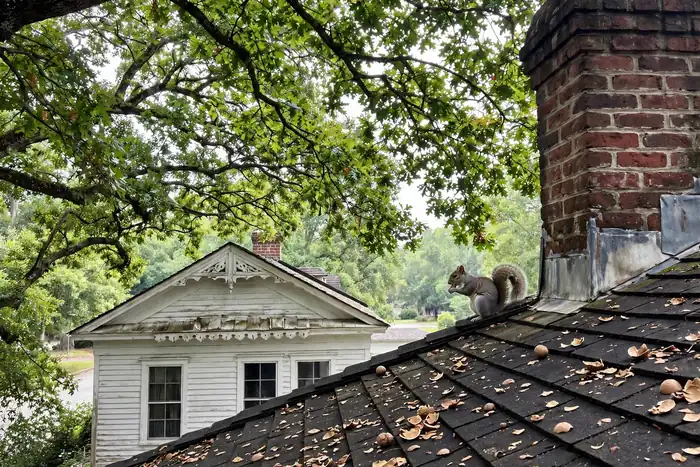
Gray Squirrels at Noon, Flying Squirrels at Midnight in Monticello
The hardwoods are part of Monticello's charm, and around the older streets they are enormous. Oaks and other shade trees tower over houses that were tall to begin with, and their limbs hang directly above ridges, chimney stacks, and porch roofs. A gray squirrel does not need a ladder built for it here. It climbs in the yard, crosses a limb, drops two feet to shingles, and commutes that route so regularly that the bark and the roof edge both show the wear.
After sunset the picture changes. Flying squirrels glide from those same trees to the upper corners of old houses, then squeeze into the attic through gaps left where eaves, fascia, and original siding no longer meet cleanly. Homeowners near the square often report a soft landing thump and light scurrying late at night, sounds easy to mistake for mice. Sorting out which species is present, and when it is active, is the first job on a Monticello squirrel call, because the entry points and the removal approach differ.
How Monticello's Towering Hardwoods Deliver Squirrels to the Roofline
Look up from almost any older Monticello yard and the route is obvious once someone points it out: a limb from a mature oak reaching over the gutter, a pecan branch brushing a gable, or a tree in the side yard close enough that a squirrel can leap to a porch roof and walk up from there. Wind moves those limbs, limbs rub shingles and flashing loose, and the squirrel gains both a highway and a weakened entry point in the same place.
We start a visit in the yard, not the attic, mapping every branch within leaping distance and every trunk close enough to climb. Trimming guidance is specific to your trees and roof, because cutting back a single bridging limb can matter more than sealing three holes a squirrel can simply chew beside again next week.
Chimney Flashing and Gable Corners on Tall Monticello Houses
Height hides damage. On a tall two-story house in Monticello, the junction where a masonry chimney passes through the roof sits far above anyone doing yard work, and the flashing there may date from a roofing job generations of owners ago. Squirrels exploit the lifted edge, chew the soft material beneath it, and enter the attic beside the chimney without ever appearing at ground level.
Gable corners tell a similar story. Original trim shrinks and separates, leaving a vertical slot at exactly the height a flying squirrel glides to. We inspect those corners with binoculars from the ground and then up close where access allows, and we look inside for the droppings and nut caches that confirm which corner is active.
Nut Caches, Chewed Wiring, and Nest Debris in a Monticello Attic
Inside an old Monticello attic, squirrel sign has a particular look. Hickory and acorn shells collect in the low pockets where roof meets floor. Nest material gets shredded from whatever insulation is present and packed into a chimney-side corner. Most concerning is the chewing: squirrels gnaw constantly, and wiring, vent pipes, and the wooden framing of an old house all take that pressure.
We show you what we find rather than describing it from the driveway. Photographs of entry holes, caches, and any wiring damage help you decide on repairs with a clear picture of what happened above your ceiling, and they give an electrician a starting point if gnawed cable needs attention after the animals are gone.
Removing Squirrels From a Monticello House Without Driving Them Deeper
An old house gives a trapped-feeling squirrel too many escape routes into wall voids and chimney chases, so rushing the attic usually makes the job longer. Our crew works from the confirmed entry points, using removal methods matched to whether we are dealing with gray squirrels active by day or flying squirrels that only emerge at night, and timed around young in the nest when the season calls for it.
Once activity stops, we verify the quiet before sealing. A Monticello attic that has gone silent at the hours you used to hear movement is the sign we wait for. Only then do the patches, screens, and flashing repairs go on, each fitted to the irregular sizes that old construction tends to present.
Porch Roofs and Additions: Monticello's Lower Squirrel Staircases
Many tall houses in town gained lower pieces over the years: a porch roof here, a side addition there, a rear extension with its own shallow slope. Each junction creates a step a squirrel can climb in stages and a seam where two roofs of different ages meet imperfectly. Those seams are prime chewing territory, and they are easy to miss when attention stays fixed on the main ridge.
We walk those lower roofs and their junctions deliberately. A gap at a porch-roof tie-in can be the whole story behind attic noise on the opposite side of the house, because squirrels travel the attic freely once they are in. Sealing the staircase matters as much as sealing the top step.
Keeping Squirrels Out of Monticello Homes Shaded by Old Trees
Prevention here is honest, practical work: keep limbs cut back from the roofline where you can, store bird seed and pet food where a yard squirrel cannot treat it as a daily ration, and have loose flashing and vent screens repaired before autumn, when squirrels push hardest for winter shelter. In a town with this much canopy, a yearly look at the roof edge is worth more than any single repair.
Call us if a new noise starts after a storm, too. Storm-shifted limbs and lifted shingles on a tall Monticello house create openings overnight, and catching a squirrel entry in its first week is far simpler than removing a settled nest with young in the spring.
Common squirrel questions in Monticello
How can we tell if our Monticello attic has flying squirrels instead of gray squirrels?+
A huge oak hangs over our old Monticello roof. Is the tree the problem?+
Can squirrels really get in beside our tall brick chimney?+
We hear chewing at night in our house near the square. Could that still be squirrels?+
What happens if squirrels have young in our Monticello attic?+
Will sealing one hole be enough for an older Monticello house?+
Other Monticello problems that come with squirrels
Our wildlife crew handles these closely related problems — the ones that most often turn up with a squirrel issue.
Got more than squirrels in Monticello?
If the noise turned out to be in the chimney rather than the attic, look at our raccoon and bat pages as well. Raccoons den in Monticello flues and bats roost along old mortar, and both are often discovered while we are investigating what a homeowner assumed was a squirrel. See everything we handle locally on the Monticello wildlife removal hub, or jump to Georgia wildlife removal.
Want the background before you call? Read our statewide guide: Squirrels in the attic: what it costs and why sealing too early backfires.
Serving all of Jasper County
Monticello is one part of Jasper County. See wildlife removal in Jasper County, GA for the county-wide picture — the animals we get called about most, and the other towns we cover.
One call to your Monticello squirrel crew
Once the squirrels are out, the work turns to the particular roof that let them in.
- Local to Jasper County. Georgia DNR-compliant handling — call to ask about licensing and insurance.
- We seal the route the squirrels actually used. Our crew checks flashing, gable vents, porch-roof junctions, and the places where additions meet the original house, and we will confirm the local crew for your county before any work starts. Limb advice is part of the conversation too, because a hardwood canopy touching a Monticello roof will keep delivering squirrels no matter how well one hole is patched.
- Done right. Removal, exclusion and cleanup.