Rodent Control in Monticello, GA
Call us when scratching travels inside a bedroom wall, droppings appear along a pantry baseboard, or a storage building outside town keeps showing gnawed feed bags. Old Monticello houses give rodents a highway system, and we know how to shut it down.
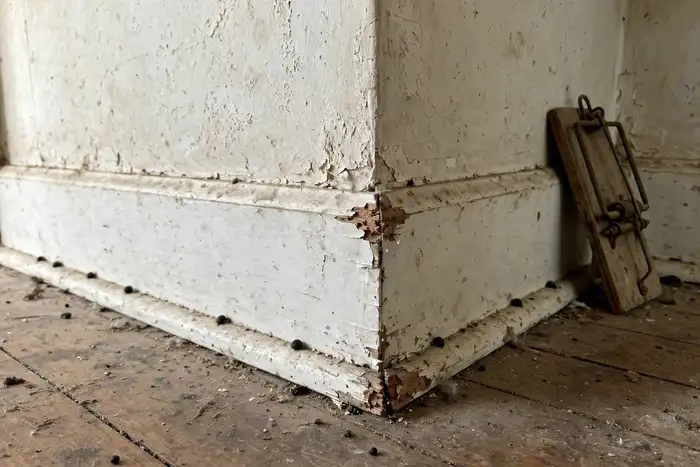
Balloon Framing and Old Foundations Give Monticello Rodents the Run of the Walls
A mouse needs a gap roughly the width of a pencil, and a house built around Monticello's courthouse square a century ago offers gaps no one has counted. Sills settle. Mortar softens. A pipe added decades after the house was built passes through a hole cut generously and never sealed. From a rodent's perspective, the foundation line of an old in-town home is less a wall than a colonnade, and once inside, the open framing of the era lets it travel from crawlspace to attic without ever entering a room.
On the country lots beyond town, the starting point is usually a storage building. Feed, seed, and stored pet food in a barn or shed build a rodent population all summer, and when autumn cools, that population tests the farmhouse walls nearby. We treat Monticello rodent calls as a property story, not a single-room complaint, because the scratching in your wall and the gnawed sack in your outbuilding are very often the same animals on the same route.
Open Wall Runs in Monticello's Pre-War Houses, From Crawlspace to Attic
Modern platform framing blocks each floor with horizontal plates. Much of Monticello's older housing stock was framed differently, with long vertical runs that stay open behind the plaster or paneling from bottom to top. A rat entering at the foundation can surface in a second-floor wall, and droppings found in the attic may belong to an animal that has never crossed a living space.
That architecture dictates our inspection route. We check the crawlspace and the attic on the same visit and compare sign at both ends of the run. Sealing and removal are planned for the whole vertical path, because treating only where the noise is loudest leaves the same animals traveling the rest of the system.
Farm Storage Buildings and Feed Rooms Feeding Jasper County Rodents
Ask where the feed is kept and most country rodent problems explain themselves. A torn sack in a Jasper County storage building sustains rats through the seasons when outdoor food is scarce, and a spill swept into a corner becomes a permanent feeding station. Rodents nest close to that supply, in wall cavities, under pallets, and inside stored equipment that sits undisturbed for months.
Our visit covers the storage building with the same care as the house: droppings along walls, rub marks at door thresholds, burrows at the slab edge. The fixes are practical rather than fancy, lidded hard containers for feed, pallets raised and pulled from walls, and thresholds and vents repaired so a rat cannot walk in at ground level each night.
Kitchens, Pantries, and Porch Entries in Old In-Town Monticello Homes
Inside town houses, rodents announce themselves in the kitchen first. Droppings appear in the dead space under a sink cabinet, a bag of rice is gnawed in a pantry built into an old chimney alcove, or scratching sounds behind the stove where a gas or water line passes through the floor. Each of those lines is a rodent route, drilled oversize in some earlier renovation and left open ever since.
Porches deliver rodents to those kitchens. A broken porch skirt admits animals beneath the house, the crawlspace carries them to the pipe runs, and the pipes carry them up. We inspect that chain in order rather than setting traps in the pantry and hoping, which is why our sealing list for an in-town house almost always includes at least one porch or foundation item.
Gnawed Wiring and Shredded Insulation in Monticello Attics and Walls
Rodents chew because their teeth never stop growing, and an old Monticello attic offers them insulation to shred for nesting, stored boxes to hollow out, and wiring runs to gnaw where cables pass through studs. The wiring is the serious item on that list. A bare conductor inside a wall of century-old timber is a fire risk that justifies acting on rodent sign promptly rather than tolerating it as a seasonal nuisance.
During the inspection we note insulation damage, stored-item losses, and any visible cable chewing, and we photograph what we find. If wiring damage is present, we will say plainly that an electrician should look after the rodents are gone, because our sealing work should not bury a hazard inside a closed wall.
Rats Along Monticello's Woodland Edge Versus Mice in the Pantry
The two animals behave differently enough to matter. Rats in Jasper County often live partly outdoors, burrowing along a woodland edge, a barn foundation, or a brushy drainage, and enter buildings to feed. Mice move in completely, raising generation after generation inside the wall voids and attic of a single Monticello house. The evidence differs too, in dropping size, burrows, and the scale of gnawing.
Identifying which animal, or whether both are present, shapes everything that follows: where we look, what we seal first, and how long the removal phase should take. We will tell you which sign we found and why we read it that way, so the plan makes sense in terms of your house rather than a generic rodent script.
Sealing a Century-Old Monticello Foundation Without Sealing Rodents Inside
Order matters on an old house. If the foundation gaps, porch openings, and pipe penetrations are sealed while rodents are still traveling the wall runs, the animals die inside those walls and the call becomes a dead-animal problem instead. We sequence the work so removal comes first and the full seal follows once activity has ended, even when that means a return visit.
The sealing itself respects the house. Gaps in old brick get proper material, not a smear that fails in a season. Vent screens are fitted to openings that predate standard sizes. And we walk you around the finished work pointing at each closure, because on a pre-war Monticello home the list is specific enough that you should be able to check it yourself.
Common rodent questions in Monticello
Why do rodents in our old Monticello house seem to be in every wall at once?+
Our storage building outside Monticello has gnawed feed bags. Is the house at risk?+
How can we tell whether we have rats or mice in our Jasper County home?+
Is it safe to just use poison in our Monticello attic for rodents?+
What are the most common rodent entry points on a pre-war Monticello house?+
Rodent noises in our walls stopped on their own last winter. Should we still call?+
Other Monticello problems that come with rodents
Our wildlife crew handles these closely related problems — the ones that most often turn up with a rodent issue.
Got more than rodents in Monticello?
Rodents are the food supply behind many other Monticello calls. If snakes have appeared at your crawlspace or owls and hawks are not keeping pace, our snake page explains the predator side of the same problem on Jasper County lots. See everything we handle locally on the Monticello wildlife removal hub, or jump to Georgia wildlife removal.
Want the background before you call? Read our statewide guide: Roof rats in Georgia: why bait alone never ends it.
Serving all of Jasper County
Monticello is one part of Jasper County. See wildlife removal in Jasper County, GA for the county-wide picture — the animals we get called about most, and the other towns we cover.
One call to your Monticello rodent crew
Lasting rodent control in an old house is carpentry as much as trapping.
- Local to Jasper County. Georgia DNR-compliant handling — call to ask about licensing and insurance.
- We close the runs and the foundation gaps together. Our crew maps entries at the foundation, porch, and roofline, seals the gaps rodents are using, and sets a removal plan for the animals already inside, and we will confirm the local crew for your county before any work starts.
- Done right. Removal, exclusion and cleanup.