Dead Animal Removal in Monticello, GA
Call us when a powerful odor blooms in one room of a very old house, flies gather at a window near the chimney, or a smell under the porch will not clear. In Monticello the animal is often inside the framing itself, and finding the exact cavity is the whole job.
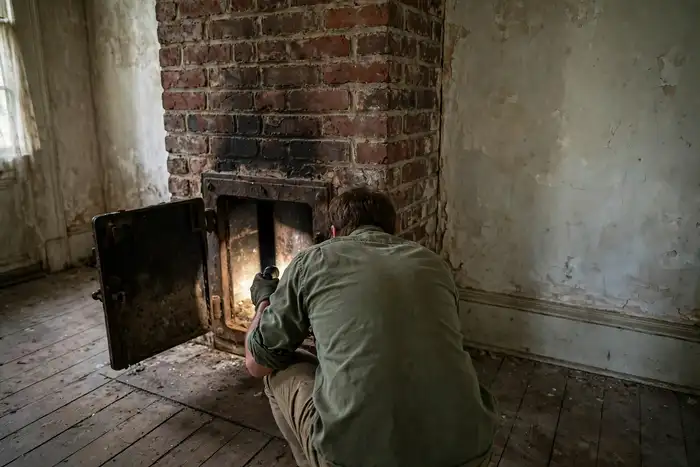
Connected Voids in a Century-Old Monticello House Spread One Odor Everywhere
There is a particular misery to a dead animal in an old Monticello house, and it comes from the architecture. A carcass in a modern wall stays a one-room problem. In a pre-war house around the square, the wall voids connect: chimney chase to attic, attic to the open framing runs, runs down to the crawlspace. Odor travels those connections on warm air, so a squirrel that died beside a second-floor chimney can scent a whole staircase, and the family cannot tell which room, floor, or even wall to blame.
Our dead-animal work in Jasper County is therefore mostly detective work. We map where the smell is strongest by hour and by room, because odor rises and concentrates as a house warms through the day. We check the chimney cleanout, the crawlspace, the porch cavity, and the attic in a deliberate order. Only when the evidence points to one cavity do we talk about opening anything, and we open as little of a historic Monticello wall as the removal allows.
Pinpointing a Carcass Inside a Monticello Wall Void Without Guessing
We start with your nose and a floor plan. The room where the odor is worst in the morning may not be the room holding the carcass, because warm air carries scent upward through an open wall run and pools it in an upper bedroom. We check room by room, floor by floor, and sniff at baseboards, outlets, and the seams around a chimney breast, where void air leaks into living space and betrays what is behind that exact stretch of wall.
Flies are honest witnesses. A cluster of flies at one window, returning day after day to the same corner of a Monticello room, usually means they are emerging from the void nearest that window, having found the carcass from inside the wall. Combined with the odor map, that cluster often narrows the search to a single bay between two studs.
Animals Trapped in Monticello Chimney Voids and Behind Dampers
Chimneys claim animals in old houses with grim regularity. A squirrel or bird slides down a flue with no cap and cannot climb the smooth liner, ending on the smoke shelf above a closed damper. A raccoon young one separates from its mother in the stack. The result is an odor that pours from the fireplace itself and spikes every time the house warms and the chimney draws.
We check the firebox, the damper, and the cleanout before assuming a wall must be opened, because a chimney carcass can often be reached through the chimney system that trapped it. If the animal is in the void beside the flue rather than in it, we will explain the difference and the access it requires, in plain terms, before any cutting is discussed.
Dead Animals Beneath Monticello Porches and in Pre-War Crawlspaces
Ground-level deaths are the other Monticello pattern. An opossum or a sick raccoon crawls beneath a deep porch seeking shelter, dies in the cavity there, and the odor rises through the porch floorboards and the front rooms on every warm afternoon. In the crawlspace proper, a carcass near a vent can scent whichever room the prevailing air reaches, which misleads families about the location for days.
The advantage of a crawlspace case is access. We can usually reach and remove the animal without touching the houses fabric at all, then check the porch skirt and crawlspace door that let it in. Those openings are almost always visible once we are under there: a rotted board, a door that no longer latches, a vent screen long gone.
What Died in Your Monticello House, and What Its Story Tells Us
Identifying the animal is not morbid curiosity; it is the diagnosis. A dead rodent in a wall points back to an active rodent route that still needs sealing. A dead squirrel beside a chimney points to flashing and a limb bridge. A bat carcass near a gable raises the colony question covered on our bat page, including the maternity-season timing that governs any follow-up work.
We tell you what we found and what we think happened, and we separate clearly what must be done now from what can be scheduled. A homeowner in a historic Monticello house deserves that sequence in writing-sized clarity, not a rush into repairs while the odor is still making the house unlivable.
Removing a Carcass From a Historic Monticello Wall With Minimal Opening
When a wall must be opened, placement is everything. We choose the smallest, least visible access that reaches the cavity we identified, often low on the wall, behind where furniture stands, or through a closet side of the same bay, and we size the opening to the removal rather than demolishing a plaster field that has survived a century.
After the carcass is out, the cavity is treated to neutralize residual odor, and we advise honestly on the patching ahead. Old plaster and modern board patch differently, and while repair of the finish is a separate trade, we leave the opening clean, measured, and photographed so your plasterer or carpenter starts with a tidy, known job.
How Long the Odor Lasts in a Monticello House, Answered Honestly
Families always ask, and the honest answer depends on size and whether the animal is removed. A mouse in a wall may scent a room for a couple of weeks and fade. A raccoon-sized carcass in a chimney void can hold a Monticello house hostage far longer, especially as Georgia heat builds, and waiting it out in summer is a miserable strategy we do not recommend for anything larger than a rodent.
Once the carcass is removed and the cavity treated, the improvement is usually fast: a sharp drop within a day and a faint remainder that clears as the void air exchanges. If an odor does not follow that pattern after removal, we say so and look again, because a second animal in a connected void is a real possibility in these old, linked wall systems.
Common dead animal questions in Monticello
The smell in our old Monticello house is worst upstairs, but we think the animal died downstairs. Is that possible?+
Flies keep gathering at one window in our Monticello home. Does that mean something died in that wall?+
Could the dead animal be in our chimney even though we never use the fireplace?+
Will you have to cut into the historic plaster walls of our Monticello house?+
Something died under our porch in Jasper County. Can that be reached without tearing up the porch?+
How quickly will the odor go away once the animal is removed from our Monticello home?+
Other Monticello problems that come with dead animals
Our wildlife crew handles these closely related problems — the ones that most often turn up with a dead animal issue.
Got more than dead animals in Monticello?
A carcass in a wall usually means living animals had a route first. If scratching or droppings suggest rodents are still traveling your Monticello wall runs, our rodent page covers the follow-up that keeps this from happening again next season. See everything we handle locally on the Monticello wildlife removal hub, or jump to Georgia wildlife removal.
Want the background before you call? Read our statewide guide: Dead animal in a wall or attic: how long the smell lasts.
Serving all of Jasper County
Monticello is one part of Jasper County. See wildlife removal in Jasper County, GA for the county-wide picture — the animals we get called about most, and the other towns we cover.
One call to your Monticello dead animal crew
After removal, we close the story that put the animal inside.
- Local to Jasper County. Georgia DNR-compliant handling — call to ask about licensing and insurance.
- We identify the entry the living animal used. Our crew traces the chimney gap, porch opening, or foundation break that admitted the animal, and explains the sealing that keeps a repeat out of the same void, and we will confirm the local crew for your county before any work starts.
- Done right. Removal, exclusion and cleanup.