Opossum Removal in Vero Beach, FL
A pale, slow shape under the deck, pet food vanishing from the lanai, a musky smell near the garage shelving. An opossum has moved from passing through to living here — a polite eviction is all it needs.
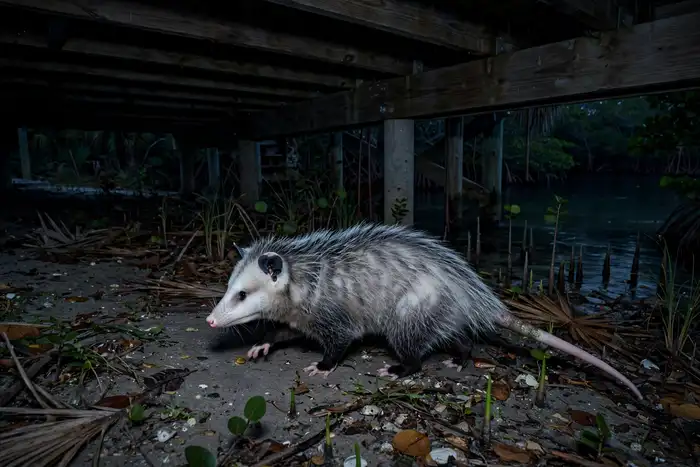
Opossums in your Vero Beach home
The Virginia opossum is the tenant Vero Beach homeowners feel guiltiest about calling on. It is slow, it is not aggressive, it eats the ticks and fallen fruit nobody wants, and it would plainly rather be left alone. The trouble is the address it chooses for its daytime sleep: beneath an island deck a few inches off the sand, inside a mainland garage behind the stored paint, or in the crawlspace of an older home whose vent screen rusted through two summers ago. Left for a season, that sleeping place becomes a fouled den — and if the sleeper is a female, a den with passengers.
Opossums are marsupials, and through much of the year a female carries young in her pouch and later on her back, which turns a simple eviction into a headcount problem. They also rotate dens naturally, so the question on a Vero Beach call is always whether this is a one-night guest or a resident with a routine. Droppings in one corner, bedding dragged into place and a smell that strengthens week by week answer it. Our job is to remove the resident, passengers included, and close the shelter so the next wanderer reads the property as full.
Island decks and mainland garages: the two classic dens
Beachside decks built low over sand are opossum architecture by accident — shade, dryness, and a gap at the skirting that no one inspects. Mainland garages run a close second, especially where a side door is left ajar for air and the shelving offers a dark lane behind stored goods. Crawlspaces under older homes complete the list, entered through a single failed vent. Each den is removed differently, but all three end the same way: the opening fitted with a barrier the next animal cannot push, dig or squeeze past.
The lagoon route that delivers them
Opossums here travel the wet edges — mangrove shoreline, canal banks, the drainage swales behind mainland streets — eating snails, fallen citrus and whatever the raccoons missed. A yard on that route with an open deck void and a pet bowl on the lanai is not unlucky; it is advertised. After removal we walk that route with you: where the animal entered the yard, what it ate, and which gap it slept in. Closing the gap without removing the food reward invites a replacement, and in lagoon neighbourhoods the replacement is already on the route.
Young in the pouch, young in the den
The headcount on an opossum job is never assumed to be one. A female removed in haste can leave pouch young hidden in the den material, and a den sealed on a schedule can seal juveniles inside it — both convert a quiet call into an urgent one within days. Our crew inspects the den space thoroughly before closure, and where young are present and mobile, the timetable is set so the family leaves together. It is slower by a day or two and faster by every measure that matters afterward.
Odor, soiling and the animal that does not leave
A living opossum's damage is mostly sanitation: droppings, urine-soaked bedding, and a musk that soaks into stored material near the den. The heavier call is the opossum that dies in the void it chose — under a deck in August heat, the discovery announces itself through the floor. Prompt removal after a den is vacated, and sealing that retires the address, prevent both versions. If you are reading this because the smell has already started, the dead-animal page describes how that search works; the fix begins with the same inspection.
A word of proportion on rabies
Opossums sit at the low end of rabies risk among Florida mammals — their body temperature runs cool for the virus, and confirmed cases are rare. That is reassurance, not an invitation to handle one: a cornered opossum gapes, hisses and can bite, and any wild animal acting disoriented in daylight deserves distance and a call. Keep dogs from cornering the animal under the deck, which is how nearly every opossum incident in this county begins, and let the removal stay as calm as the species usually is.
Common opossum questions in Vero Beach
Can I just wait for an opossum to move on by itself?+
Is the opossum under my deck hurting anything?+
Why does it keep coming to my lanai at night?+
What happens to the opossum after removal?+
Do opossums dig up the lawn like armadillos?+
Other Vero Beach problems that come with opossums
Our wildlife crew handles these closely related problems — the ones that most often turn up with a opossum issue.
Got more than opossums in Vero Beach?
Opossums are rarely the only thing using an attic or yard in Vero Beach. See everything we handle locally on the Vero Beach wildlife removal hub, or jump to Florida wildlife removal.
Serving all of Indian River County
Vero Beach is one part of Indian River County. See wildlife removal in Indian River County, FL for the county-wide picture — the animals we get called about most, and the other towns we cover.
One call to your Vero Beach opossum crew
The longer opossums stay in the attic, the more they chew and the bigger the cleanup. Call us and tell us about the job — we will confirm the local crew for your county before any work starts.
- Local to Indian River County. FWC-compliant handling — call to ask about licensing and insurance.
- Humane exclusion. One-way doors and steel sealing, not poison.
- Done right. Removal, exclusion and cleanup.