Squirrel Removal in Palm City, FL
The attic erupts at sunrise — galloping, rolling nuts, a nest being redecorated over your bed. Palm City's gray squirrels have claimed the warmest box on their canopy route. Call us and describe the schedule; with squirrels, the schedule is the confession.
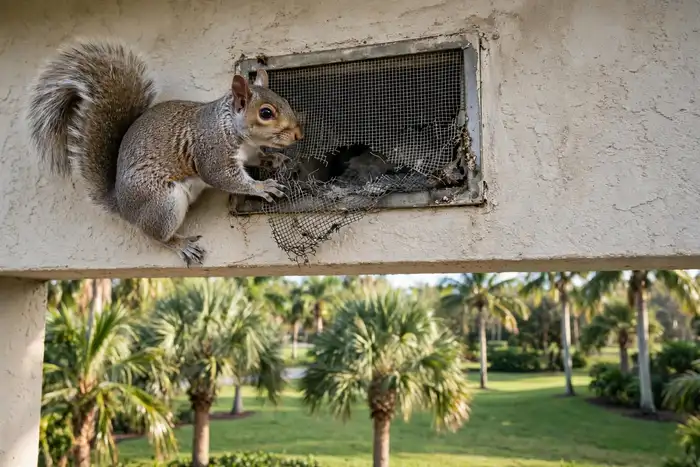
Squirrels in your Palm City home
Palm City's subdivisions are squirrel suburbs in the literal sense: oak hammocks preserved between the lots, street trees grown together over decades, and a canopy so continuous that a gray squirrel can commute from the canal-side hammock to your fascia board without once touching the ground. From the branch, the roof is a short drop onto tile or shingle, and from the roof the attic is a matter of finding the one soft soffit corner or tired vent screen on the whole perimeter — a search squirrels conduct with hereditary patience.
What follows is a nesting colony with a daily commute: out at dawn to forage, back and forth through the day with nesting material and food, home by dusk. Two kin complete the local picture without changing it. The fox squirrel — large, slow and a Florida species of special concern — belongs to open pine ground out west and is not an animal we handle. And on rare occasions a Palm City attic holds flying squirrels instead, betrayed by faint rustling after full dark rather than the dawn gallop.
A commuter, not a squatter — until it nests
The progression on most Palm City squirrel jobs runs the same way: a scout finds the gap in autumn, the gap becomes a weather shelter, the shelter becomes a nest, and the nest becomes a nursery. Homeowners tolerate the first stage because the noise is brief and daytime; by the nursery stage the attic holds a family, the insulation is tunneled and trampled, and stored boxes are being shredded into bedding. Early exclusion — at the shelter stage — is a one-visit job, which is the entire argument for calling at the first sunrise gallop rather than the third month of it.
Palm City entry points, ranked by use
Soffit corners lead, their panels softened by decades of wet-season humidity and lifted by years of thermal cycling. Behind them: gable vents screened in mesh that has gone to rust lace, the junction where the pool-cage roofline meets the house wall, conduit penetrations at the plate, and the trim lines under tile edges where leaf dams hold moisture against the wood. A proper inspection reads the whole perimeter with binocular patience, because the squirrel is using the best hole, not the most visible one, and second-best holes stay in reserve.
Two breeding seasons on the Treasure Coast
Gray squirrels in this climate raise litters in winter and again in summer, so the odds that a Palm City attic nest holds helpless young are real across much of the calendar. Exclusion timing bends to that fact. A mother sealed away from a nest does not accept the verdict — she attacks the work at its weakest seam with a desperation that opens roofs — and young sealed inside become a dead-animal call. We verify the nest's status first, and where young are present the family leaves together on a schedule the young can survive.
Teeth, wire and insulation: the quiet ledger
A squirrel's teeth grow its whole life, and the attic is its sharpening stone: eave trim, duct insulation, stored belongings and the sheathing of electrical cable all get worked. The gnawed-conductor risk is the headline — bared wire in a nest-lined attic is an ignition scenario that accumulates invisibly — but the steady cost is thermal: nests compress and foul the insulation blanket until whole ceiling sections stop insulating, and Palm City air conditioning pays the difference every month from May to October.
Exclusion built for a canopy street
Our Palm City method: a one-way door fitted at the entry in active use, every other gap on the roofline closed in galvanized flashing and hardware cloth, then confirmation visits until the attic reads empty and silent before the final door comes off and its hole is armored like the rest. On a canopy street the completeness is the point — half-sealed houses do not lose their squirrels, they relocate them two rafters over, and the colony's scent-marking on a used den keeps advertising the address until the steel makes the advertisement pointless.
Limbs, feeders and the honest limits of trimming
Cutting canopy contact back helps any exclusion live a quieter life, and we will mark the specific limbs doing the bridging on your lot. But Palm City's oaks are protected by affection, HOA rules and common sense alike, and total canopy separation is rarely achievable — which is fine, because steel does not care how the squirrel arrived. Feeders belong off the house during and after a job, and rusted vent screens get replaced in metal in the same pass, not the next one.
Common squirrel questions in Palm City
The noise stops every evening. Does that rule out worse animals?+
How long does squirrel exclusion take in Palm City?+
A huge, slow squirrel with a dark face is in my yard out west. Is that the same animal?+
Should I have the attic wiring checked after squirrels?+
How much does squirrel removal cost in Palm City?+
Other Palm City problems that come with squirrels
Our wildlife crew handles these closely related problems — the ones that most often turn up with a squirrel issue.
Got more than squirrels in Palm City?
Squirrels are rarely the only thing using an attic or yard in Palm City. See everything we handle locally on the Palm City wildlife removal hub, or jump to Florida wildlife removal.
Serving all of Martin County
Palm City is one part of Martin County. See wildlife removal in Martin County, FL for the county-wide picture — the animals we get called about most, and the other towns we cover.
One call to your Palm City squirrel crew
The longer squirrels stay in the attic, the more they chew and the bigger the cleanup. Call us and tell us about the job — we will confirm the local crew for your county before any work starts.
- Local to Martin County. FWC-compliant handling — call to ask about licensing and insurance.
- Humane exclusion. One-way doors and steel sealing, not poison.
- Done right. Removal, exclusion and cleanup.