Rodent Removal in Palm City, FL
Gnawing in the walls after midnight, droppings in the garage, oranges hollowed on the tree before you can pick them. Palm City's roof rats are the busiest animals in Martin County — and the least welcome. Call us; rat work is the work we do most here.
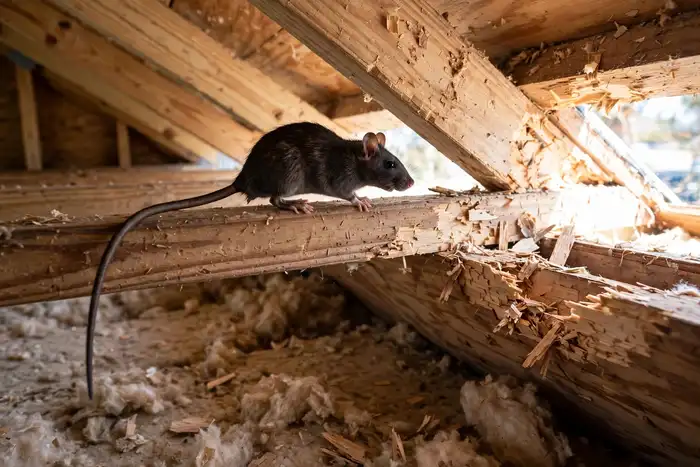
Rodents in your Palm City home
If Palm City has a signature wildlife problem, it wears four names: roof rat, fruit rat, palm rat, citrus rat — one animal, the black rat, a born climber that treats this community's design as a purpose-built habitat. The subdivisions west of Stuart offer it everything in sequence: royal and queen palms whose dead-frond skirts harbor nests, oak limbs bridging canopy to roofline, backyard citrus ripening from September through March, pool cages whose rooflines make covered highways, and canals that stitch the whole grid together with vegetated banks.
The result is pressure that generalist companies, leading with raccoons and squirrels, chronically underestimate here. Palm City's rat colonies do not live in one attic; they live in the neighborhood, commuting between palm skirts, soffits and fruit trees along routes that cross a dozen lots. That is why our Palm City rodent work is built lot by lot but thought street by street: trap the animals inside, seal the structure completely, and strip the specific invitations — the touching frond, the untrimmed skirt, the fallen fruit — that keep your address on the colony's route map.
The anatomy of a Palm City rat run
Follow one colony's night: out of the palm skirt at dusk, along the fence rail, up the pool-cage frame, across the cage roofline to the house wall, in at the soffit corner worn soft by wet summers. Side routes branch to the citrus tree, the compost bin, the neighbor's feeder. Rub marks — dark grease smears — mark the habitual paths. Our inspection traces the whole run, because sealing the soffit while the cage junction stays open just reroutes the traffic twenty feet.
Tile roofs and the gaps nobody sees from the ground
Palm City's prevalent tile roofs hide their rodent doors well. Rats enter at the open ends of barrel tile rows, at valley and hip junctions where debris dams moisture against the trim, at lifted tiles over a ridge, and at plumbing and conduit penetrations. From the street the roof looks immaculate; from the attic, daylight shows at a half-dozen points. Tile work is slow, specific sealing — and it is the difference between a rat job that holds and one that becomes a quarterly ritual.
Citrus season is rat season
From September, when the first backyard oranges color, through the March tail of the grapefruit, Palm City feeds its rat population from its own trees. The sign is diagnostic: fruit hollowed out on the tree or dropped with a neat scooped rind, quite different from a raccoon's rough tearing or an opossum's trampled mess. Colonies time breeding to this plenty, which is why autumn rat calls here involve litters in the insulation by the holidays. Picking fruit promptly, clearing drops weekly and rat-proofing the compost removes the colony's reason to defend your lot as territory.
The pool cage is a highway interchange
A screened pool enclosure gives a climbing rat three gifts: a frame it can run like scaffolding, a flat roofline in direct contact with the house wall, and a warm, sheltered void where the cage meets the soffit — a junction that is, on many Palm City homes, the single least-sealed seam on the building. Rats nest in that junction, drop into the attic from it, and use the cage to reach upper rooflines no ground route serves. Expect our crew to spend real time on the cage connection; on canal-side lots it is the job's center of gravity.
Seasonal homes and the plumbing route
Palm City has its own snowbird pattern — owners who close the house for the northern summer and return to the October attic sounds. A vacant house is a rat opportunity twice over: storm-season soffit damage goes unnoticed for months, and the water evaporating from unused drain traps opens a documented sewer route into the house that bypasses the roofline entirely. Return-home infestations with no visible exterior entry are a Palm City specialty, and our inspections check trap condition and plumbing penetrations alongside the roof — sealing the wrong route is the most expensive mistake in rodent work.
Why we trap and seal rather than bait
Poison is the shortcut that bills you twice. A baited rat dies on its own schedule, frequently inside a wall or under insulation, and in Palm City heat that carcass becomes a dead-animal emergency layered on the live-rat problem — while the colony replaces the dead from the palm rows outside. Our method traps animals where they can be accounted for, closes the building in metal and mortar-grade materials, and verifies quiet over consecutive checks. One Norway rat note: the heavy ground rat of northern basements is rare on this coast, and the occasional house mouse is a footnote — the climbing roof rat is the Palm City story, start to finish.
Common rodent questions in Palm City
How bad is the roof rat problem in Palm City, really?+
I hear them in one wall. Is the colony really in the whole attic?+
Our HOA trims the common palms but not mine. Does that matter?+
We are heading north for the summer. How do we not come back to rats?+
How much does roof rat removal cost in Palm City?+
Other Palm City problems that come with rodents
Our wildlife crew handles these closely related problems — the ones that most often turn up with a rodent issue.
Got more than rodents in Palm City?
Rodents are rarely the only thing using an attic or yard in Palm City. See everything we handle locally on the Palm City wildlife removal hub, or jump to Florida wildlife removal.
Serving all of Martin County
Palm City is one part of Martin County. See wildlife removal in Martin County, FL for the county-wide picture — the animals we get called about most, and the other towns we cover.
One call to your Palm City rodent crew
The longer rodents stay in the attic, the more they chew and the bigger the cleanup. Call us and tell us about the job — we will confirm the local crew for your county before any work starts.
- Local to Martin County. FWC-compliant handling — call to ask about licensing and insurance.
- Humane exclusion. One-way doors and steel sealing, not poison.
- Done right. Removal, exclusion and cleanup.