Dead Animal Removal in Palm City, FL
It started as a faint wrongness in the guest room and now the whole house knows. Something died inside the structure — and in a Palm City summer, the situation edits itself daily. Call us now; waiting is the only move that makes it worse.
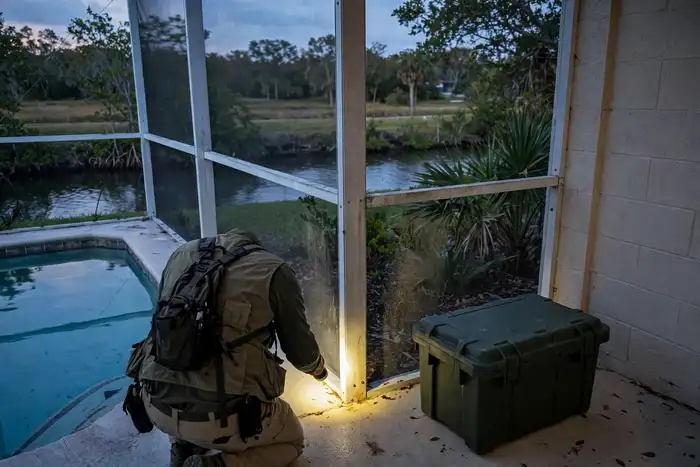
Dead Animals in your Palm City home
Palm City's dead-animal calls follow from its two headline animals. Roof rats live barely a year and opossums only a few, and both species spend those lives commuting through attics and wall voids — so a steady share of them end there, in a wall beside a plumbing run or under insulation nobody disturbs. What turns a hidden carcass into a household crisis is the subdivision house itself: ductwork running through the same attic the animal died in, an air handler that distributes the evidence to every vent, and Florida heat and humidity accelerating the whole process from Monday's faint smell to the weekend's emergency.
Our Palm City work runs the sequence in order — locate, remove, sanitize, seal — and the order matters. Locating is diagnostic work done from odor gradients, fly behavior and the geometry of the voids, before a single cut is made. Removal and sanitation restore the space to something a family can live over. Sealing closes the entry that admitted the animal, because in a community where the colony lives in the palm rows outside, an unsealed entry is simply an appointment for the sequel.
Why the smell surges when the air runs
Homeowners report the pattern precisely: the house smells worst in the rooms the air conditioning serves first, and the odor pulses with the handler's cycle. The system is breathing through the attic and wall cavities the animal died in, warming the source and delivering it room to room. Annoying as it is, that pattern is our best instrument — the rooms served earliest and strongest usually bracket the void we want, and odor that concentrates at one wall, one closet or one end of the attic narrows a whole-house search to a few feet of drywall.
The returning-owner case, Palm City style
Palm City's seasonal homes produce the region's signature version: a house closed from May to October, an animal that entered through a storm-shifted soffit or a dried-out drain trap in the empty plumbing, died inside by midsummer, and ripened for months in a sealed, hot house. The owners meet it at the front door in October. The work is the same sequence at larger sanitation scope — soaked insulation and materials assessed honestly — followed by the conversation that prevents a repeat: a pre-departure sealing each spring, and a return inspection each fall before the suitcases come in.
Where the animals actually are
Wall voids top the Palm City list — an animal that drops from the top plate down a plumbing or wiring chase cannot climb the smooth studs back out. Attics follow, especially the far corners above garages and lanais where insulation hides everything. Then the subdivision specifics: the junction void where a pool cage meets the house wall, crawlspace-like gaps under slab additions, and the duct chases themselves. Each has an access logic, and most retrievals are completed from an attic, a cleanout or an existing opening — a wall cut, when the evidence truly demands one, is small and placed, never exploratory.
Sanitation that respects the materials
Retrieval removes the source; it does not decontaminate what the source soaked. In Palm City humidity, fluids in insulation and drywall paper keep feeding odor and bacteria after the carcass is gone, so the affected insulation section comes out, hard surfaces are cleaned and enzyme-treated, and saturated drywall is cut back to material that tests clean. We show you the boundary between salvageable and not before the scope is agreed — the honest line is usually a smaller job than homeowners fear and a larger one than a spray bottle promises.
Sealing: the step that retires the address
The job ends where it began — at the entry. The soffit corner the rat used, the vent the opossum pushed, the dried trap that admitted a sewer-route rat into a vacant house: each gets its correct closure, metalwork where metalwork belongs and a plumbing fix where it does not. There is a standing rule behind the sequencing: we never seal a structure until it is verified empty, because sealing a live animal in is precisely how these calls are manufactured. Exclusion done in the right order is both the prevention and the proof.
Common dead animal questions in Palm City
How long does a dead-animal smell last in this heat if I leave it?+
Can you find it without tearing the house apart?+
We found it the day we returned for the season. What should we do first?+
Could the smell be something other than a dead animal?+
How much does dead animal removal cost in Palm City?+
Other Palm City problems that come with dead animals
Our wildlife crew handles these closely related problems — the ones that most often turn up with a dead animal issue.
Got more than dead animals in Palm City?
Dead Animals are rarely the only thing using an attic or yard in Palm City. See everything we handle locally on the Palm City wildlife removal hub, or jump to Florida wildlife removal.
Serving all of Martin County
Palm City is one part of Martin County. See wildlife removal in Martin County, FL for the county-wide picture — the animals we get called about most, and the other towns we cover.
One call to your Palm City dead animal crew
The longer dead animals stay in the attic, the more they chew and the bigger the cleanup. Call us and tell us about the job — we will confirm the local crew for your county before any work starts.
- Local to Martin County. FWC-compliant handling — call to ask about licensing and insurance.
- Humane exclusion. One-way doors and steel sealing, not poison.
- Done right. Removal, exclusion and cleanup.