Bat Removal in Palm City, FL
A stream of bats pours from your gable at dusk and fans out over the canal. Impressive — and better watched from a neighbor's yard. Palm City bat work runs on Florida's strict calendar, so call early and let us put your house in the right window.
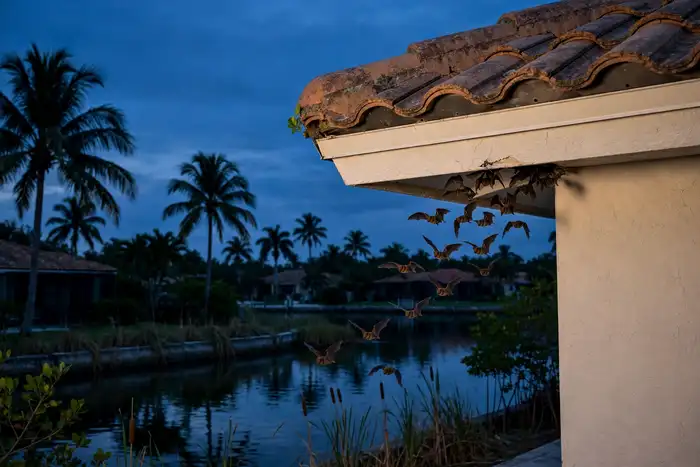
Bats in your Palm City home
Palm City's canals are a bat cafeteria. Still water, lush bank vegetation and the insect clouds that rise off both at dusk draw the two species that dominate Martin County roost calls: the Brazilian free-tailed bat, a fast, high-flying colony bat that pours out of roosts at sunset in visible streams, and the evening bat, a smaller species that works lower over the water and favors the gable ends and soffit voids of houses exactly like Palm City's. A subdivision street at dusk, watched carefully, will show you which roofs on the block are doing the housing.
Florida permits exactly one remedy and fences it with a calendar. Bats may never be harmed or killed; exclusion with one-way devices — valves that let the colony leave to hunt and refuse it re-entry — is the only method, and it is lawful only from August 15 to April 15, outside the maternity season when flightless pups occupy the roost. That blackout lands squarely inside hurricane season, which makes Palm City bat work a game played months ahead: homeowners who call in autumn get excluded in autumn; those who call in May get inspected, documented and scheduled.
Reading a Palm City roost from the ground
Colonies advertise themselves to anyone who looks at the right hour. The dusk emergence is definitive — bats exiting one seam in a stream over several minutes — but daytime sign accumulates too: guano pellets like coarse pepper below a gable seam, staining streaked down the fascia from a tile edge, a faint musty sweetness near one attic hatch. Free-tailed colonies chatter audibly through a quiet ceiling; evening bat roosts are smaller and quieter, often found by droppings alone. Our dusk watch confirms the active seams before a single device is ordered.
Tile roofs, gables and the subdivision seam list
Palm City's housing stock hands bats a menu of narrow slots: the shadow gap under the edge course of barrel tile, open gable vents on decades-old screens, the soffit corner where two roof planes hand off, ridge caps lifted by years of thermal movement, and the seam where a pool-cage roofline bolts to the fascia. Bats need a slot, not a hole — a thumb-wide gap is a doorway. Exclusion therefore means a whole-house seam audit: the colony's active exits receive devices, and every other slot is sealed in the same campaign, because a colony refused at one gable simply tries the next.
The maternity blackout, and what a summer call still accomplishes
From mid-April to mid-August a Palm City roost is a nursery, and the law is absolute: no exclusion devices, no sealing of active exits, because the pups inside cannot fly and would be stranded. That does not make the summer visit useless. We identify the species, map the exits at dusk, assess the guano in the attic, seal seams the colony is not using, repair storm damage elsewhere on the roof, and book the exclusion for the first legal week — pre-inspected houses go first, and their colonies are typically out within days.
Hurricane season: the blackout's difficult overlap
The timing trap in Martin County is that the months when exclusion is forbidden are also the months when storms tear rooflines open. A June or September storm that lifts tile and soffit can hand a displaced colony a brand-new roost in your house — and the lawful response is still staged: emergency roof repairs, documentation of the colony's entries, and exclusion the moment the calendar allows. The corollary is the spring window: March through May, before the blackout and the storms, is when a Palm City roofline can be sealed bat-tight on your schedule rather than the weather's.
Exclusion night by night
When the window is open and the devices go on, the colony does the work itself. Night one: the bats exit through the one-way valves to hunt the canals and find the doors barred on return; they cluster, test the sealed seams, and bivouac nearby. Over the following nights — devices stay in place across the required run of consecutive nights, with weather warm enough for flight — the colony relocates to the hollow trees, dead palms and bat houses of the neighborhood, and exit watches confirm the roost is empty. Only then are the devices removed and their openings sealed like every other seam. The bats keep eating Palm City's mosquitoes; they simply stop sleeping at your address.
Guano, attics and the one protected bat
Years-long roosts leave guano that stains, smells and should not be breathed as dust — dried droppings can carry a fungus, so cleanup proceeds with protection; we scope honestly between a swept corner and a restoration. One caveat shapes every job: the federally endangered Florida bonneted bat occurs in southern Florida, is not a typical subdivision roost bat, and may not be excluded at all if ever encountered — work would stop and FWC would direct it. Identification precedes devices on every colony we touch.
Common bat questions in Palm City
When is the best time of year for bat removal in Palm City?+
I found the bats in May. Am I really waiting until August?+
A bat got into the living room. What do we do tonight?+
Will a bat house in the yard solve my attic colony?+
How much does bat exclusion cost in Palm City?+
Other Palm City problems that come with bats
Our wildlife crew handles these closely related problems — the ones that most often turn up with a bat issue.
Got more than bats in Palm City?
Bats are rarely the only thing using an attic or yard in Palm City. See everything we handle locally on the Palm City wildlife removal hub, or jump to Florida wildlife removal.
Serving all of Martin County
Palm City is one part of Martin County. See wildlife removal in Martin County, FL for the county-wide picture — the animals we get called about most, and the other towns we cover.
One call to your Palm City bat crew
The longer bats stay in the attic, the more they chew and the bigger the cleanup. Call us and tell us about the job — we will confirm the local crew for your county before any work starts.
- Local to Martin County. FWC-compliant handling — call to ask about licensing and insurance.
- Humane exclusion. One-way doors and steel sealing, not poison.
- Done right. Removal, exclusion and cleanup.