Raccoon Removal in Palm City, FL
Thumping steps over the ceiling at 2 a.m., the trash cart tipped with the lid worked open, a masked face watching you from the canal bank at dusk. Palm City raccoons are bold, numerous and organised. Call us before the litter in the attic doubles the job.
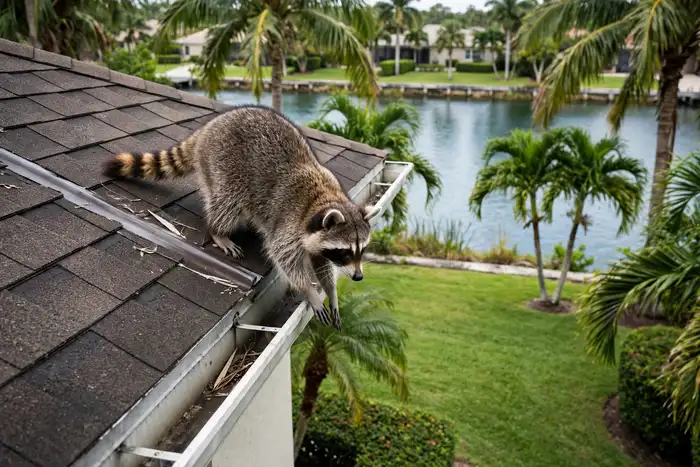
Raccoons in your Palm City home
Palm City's raccoon population runs on the canal grid. The waterways threading the subdivisions supply fish, frogs, snails and the shoreline pickings raccoons have worked since before there were subdivisions, and the neighborhoods layered over them supply the rest: trash carts, backyard citrus, pet food on lanais, and dry, elevated attic dens in the riverfront and near-river streets. A raccoon's night here is a commute — canal bank to hedge line to your soffit — and its day is spent sleeping in the warmest, quietest box on the route, which it would very much like to be your attic.
Removal is professional work in Florida for reasons beyond the animal's strength and dexterity. Raccoons are a rabies-vector species, their attic latrines can carry a persistent roundworm risk, and the state's rules govern what happens to a captured animal tightly. Our crew works under FWC Rule 68A-9.010 with the property owner's authorisation, leading with exclusion — the family out under its own power where possible, the entry rebuilt in material a raccoon's hands cannot argue with, and the den site cleaned to a standard you would store luggage in again.
The commute: canal, hedge, roofline
Understanding the route defeats the raccoon. Palm City's hedge lines and fence rows are raccoon roads, connecting the canal banks to individual lots with cover the whole way, and the mature landscaping means many roofs are reachable from an overhanging limb or a pool-cage frame without the animal ever crossing open ground. Our inspection walks the route backward from the entry — over the cage, along the fence, down to the bank — because sealing the attic while the commute stays open just changes which night the next raccoon auditions.
Litters set the schedule
Most Palm City attic calls between late winter and early summer are maternity calls. A mother raccoon chooses the attic precisely because it is warm, dry and defensible, and her kits cannot climb, walk a one-way door or survive a night separated in the cold corner of a roof void. The sequence is therefore fixed: locate the litter by sound and sign, arrange the mother's comings and goings so the family exits together or is removed together, verify the void is empty, and only then build the steel closure. Any shortcut through that order creates a worse job — a frantic mother re-entering through a new hole she tears herself, or young left behind in the insulation.
The latrine is a cleanup, not a footnote
A raccoon attic concentrates its waste in one latrine corner, used night after night until the insulation is saturated and the ceiling drywall below is threatened. Those droppings can carry the eggs of a roundworm that remains viable in material for years, which is why the cleanup is handled as a defined scope — contaminated insulation removed, the area treated — rather than a shrug and a deodorizer. We photograph the latrine, show you the honest extent, and price the restoration you actually need: sometimes a corner's worth of batts, sometimes a broader pull, never a mystery.
Entries on Palm City roofs
The raccoon's preferred Palm City doors are the soffit panel pushed up at a corner where it has gone soft, the gable vent whose screen surrendered years ago, the tile-roof trim junction worried loose at a valley, and the pool-cage connection where the cage frame meets the wall. Each gets rebuilt in heavy-gauge galvanized material anchored to structure, not to the trim it replaces — a raccoon tests repairs with the strength of a small, motivated locksmith, and a cosmetic patch fails that test in a single night.
What the law does with a trapped raccoon
Homeowners routinely ask for the raccoon to be 'taken out to the country.' Florida's actual rule: a captured native animal must be released or euthanized within 24 hours, and a release is lawful on the capture property itself or off site only within Martin County, only onto at least 40 contiguous acres, and only with that landowner's written permission. That legal narrowness is exactly why exclusion leads our method — the animal departs the structure voluntarily, no release site is needed, and the steel closure is what the next decade of quiet attics is actually made of.
After the family: closing the commissary
With the attic empty and armored, the lot itself can be demoted from the raccoon route map: latched cart lids, pet food indoors after dark, citrus drops gathered before they ferment, bird feeders rested during an active period, and the hedge gap at the canal bank noted for what it is. Palm City will always have raccoons — the canals see to that — but a sealed house on a tightened lot drops off the den list, and the commute simply passes it by.
Common raccoon questions in Palm City
How do I tell a raccoon from roof rats in the attic?+
Can the mother and kits just be sealed out while she is away feeding?+
My dog treed a raccoon from the canal bank. Should I be worried about disease?+
Will sealing work if the whole street has raccoons?+
How much does raccoon removal cost in Palm City?+
Other Palm City problems that come with raccoons
Our wildlife crew handles these closely related problems — the ones that most often turn up with a raccoon issue.
Got more than raccoons in Palm City?
Raccoons are rarely the only thing using an attic or yard in Palm City. See everything we handle locally on the Palm City wildlife removal hub, or jump to Florida wildlife removal.
Serving all of Martin County
Palm City is one part of Martin County. See wildlife removal in Martin County, FL for the county-wide picture — the animals we get called about most, and the other towns we cover.
One call to your Palm City raccoon crew
The longer raccoons stay in the attic, the more they chew and the bigger the cleanup. Call us and tell us about the job — we will confirm the local crew for your county before any work starts.
- Local to Martin County. FWC-compliant handling — call to ask about licensing and insurance.
- Humane exclusion. One-way doors and steel sealing, not poison.
- Done right. Removal, exclusion and cleanup.