Snake Removal in Palm City, FL
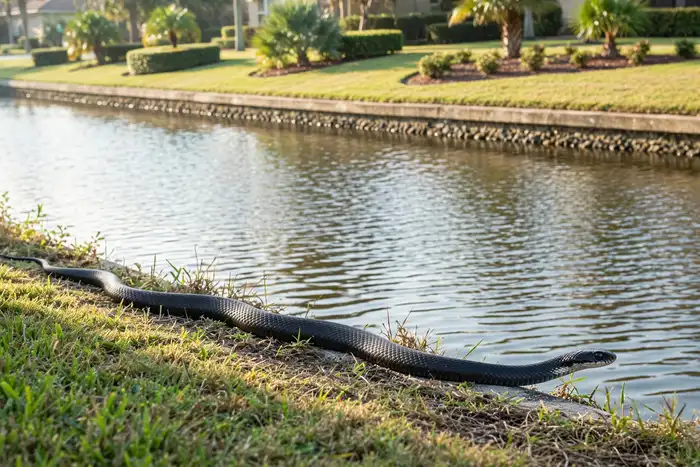
It is stretched along the canal bank in the morning sun, or coiled by the feed bins, and nobody agrees on what it is. Keep the disagreement at a distance and call us — snake work begins with a name, not a shovel.
Snakes in your Palm City home
Palm City's snakes split along its two landscapes. Along the canals and the South Fork, the daily cast is water snakes, racers and rat snakes — hunters of fish, frogs and the roof rats the subdivisions also host. Out west, the wet flatwoods edges and pasture margins add the small, gray, secretive snake that generates the most genuine concern here: the dusky pygmy rattlesnake. Martin County's venomous list has four names — cottonmouth, eastern diamondback rattlesnake, dusky pygmy rattlesnake and eastern coral snake — and every Palm City snake call is, at bottom, a sorting exercise between those four and the harmless majority that resembles them.
That sorting is the service. The Florida banded water snake in your canal is a harmless fish-eater that gets killed for impersonating a cottonmouth; the southern black racer on the driveway is a beneficial blur that wants only to leave; the corn snake and eastern rat snake in the pool cage are there because your roof rats are there. Our crew identifies from distance first, and the species — not the adrenaline — decides whether the call ends in a capture, a release at the property's wild edge, or a handshake and habitat advice.
The pygmy rattlesnake: Palm City's small print
Most venomous-snake anxiety in Florida pictures a six-foot diamondback; Palm City's realistic case is under two feet long. The dusky pygmy is gray with dark blotches and a reddish stripe down the back, thick-bodied for its size, and common exactly where subdivision meets wet ground — canal banks, retention pond edges, marshy vacant lots, the damp margins out west. It relies on camouflage and holds still when approached, which is how gardeners meet it at close range. Its rattle is a faint buzz most people never hear. Teach the household this snake's description before any other; it is the one your lot most plausibly hosts.
Water snake or cottonmouth, canal edition
The banded water snake and the cottonmouth share canals, banding and a talent for alarming homeowners, and separating them is a distance skill: the harmless water snake carries a narrow head with dark vertical bars on the chin and flees into the water flat and fast; the cottonmouth is heavy-bodied and blocky-headed with a dark band through the eye, and likelier to hold its ground, sometimes gaping white-mouthed. Juveniles of both are boldly patterned and the most misidentified of all. Rule of the house: no clear view of the head, no verdict — treat it as a cottonmouth and let us make the call in person.
The diamondback and the coral snake, kept in proportion
The eastern diamondback is the heavy, unmistakable rattlesnake of Palm City's drier ground — open pine and pasture margins out west — a snake that prefers retreat to confrontation. The eastern coral snake is its opposite: small, glossy, red-yellow-black banded, living in leaf litter and mulch, so retiring that most residents never learn one shares their street. Both deserve the same rule: admire from distance, keep dogs leashed and hands away, and let any necessary handling be ours.
Rat snakes are a report on your rodents
A corn snake in the garden or an eastern rat snake descending the pool cage is delivering free intelligence: climbing rat snakes follow climbing rats. Where a Palm City home hosts rat snakes repeatedly, a roof rat colony is usually commuting the same soffits. We will remove a rat snake from a bad location — a cage, a garage, a tack room — and release it at the property's wild edge as Florida's on-site rule allows, but the durable answer couples that with the rodent sealing that removes the attraction for snake and rat alike.
The indigo: the snake with its own law
The eastern indigo snake — huge, glossy blue-black, orange-chinned, docile — is federally protected and may not be handled, moved or harassed by anyone, including us. Western Palm City's open ground is indigo country, and a sighting is a piece of luck, not a service call: note it, enjoy it, and if it is ever in genuine danger, that conversation belongs to FWC. A crew that offers to 'take care of' a big black snake for you is advertising a federal problem.
How our snake calls run
Arrival means binoculars before boots: identify from range, and let the species set the method. Harmless snakes in bad places are captured gently and released on site at the property's wild edge. Venomous snakes are taken with hooks, tubes and a locking container by a trained handler — live venomous reptiles move only under permit in Florida — and dispositioned lawfully. Then the habitat conversation: rodent sealing, brush trimmed back from cages and steps, feed and woodpiles raised in the barn, so the property stops advertising itself to the next snake on the canal.
Common snake questions in Palm City
A small gray snake with blotches is coiled by my retention pond. What is it likely to be?+
There is a snake inside my pool cage. How did it get in, and what now?+
Should the black snake by my canal be removed?+
Do snakes come back after a removal?+
How much does snake removal cost in Palm City?+
Other Palm City problems that come with snakes
Our wildlife crew handles these closely related problems — the ones that most often turn up with a snake issue.
Got more than snakes in Palm City?
Snakes are rarely the only thing using an attic or yard in Palm City. See everything we handle locally on the Palm City wildlife removal hub, or jump to Florida wildlife removal.
Serving all of Martin County
Palm City is one part of Martin County. See wildlife removal in Martin County, FL for the county-wide picture — the animals we get called about most, and the other towns we cover.
One call to your Palm City snake crew
The longer snakes stay in the attic, the more they chew and the bigger the cleanup. Call us and tell us about the job — we will confirm the local crew for your county before any work starts.
- Local to Martin County. FWC-compliant handling — call to ask about licensing and insurance.
- Humane exclusion. One-way doors and steel sealing, not poison.
- Done right. Removal, exclusion and cleanup.