Armadillo Removal in Palm City, FL
Your lawn wakes up a little more excavated every morning, and the burrow under the barn apron is now a small cave system. One nine-banded armadillo can do all of it, on a route it repeats nightly. Call us — armadillo jobs are won at the burrow.
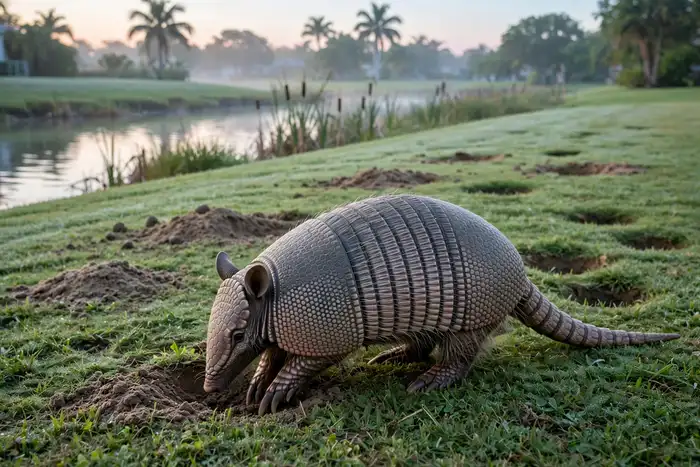
Armadillos in your Palm City home
Palm City's two landscapes — groomed subdivision lawns along the canals, working pasture and grove ground out west — agree on one thing: the soil is sandy, moist and full of grubs, which makes the whole community a nine-banded armadillo buffet with burrowing soft enough to dig by hand. Armadillos here are lawn and ground animals, not house animals. Their damage is excavation in two registers: surface rooting, dozens of shallow holes nosed into turf hunting insects, and the burrow — a chambered tunnel dug for daytime shelter under a slab edge, a pool deck, a barn apron, any structure that shades dry ground.
One piece of Florida law must be said before any armadillo work is sold: the species is nonnative, and captured armadillos may never be relocated or released. The friendly promise to 'take him out to the country' is not a service anyone can lawfully sell in this state. Our crew will explain the rule and what removal actually involves, plainly, before you authorize anything — an armadillo job that starts with an honest conversation tends to end with a closed burrow system and no sequel.
One animal, a repeated route
Armadillos are habitual to a degree homeowners underestimate. The same individual works the same sequence of yards, ditch banks and pasture edges night after night, rooting where the grubs were yesterday and sleeping in the same burrow by day. That habit is the job's opportunity: damage appearing in a widening circuit around one structure almost always means one resident with one burrow, not an invasion. Our first task on a Palm City call is burrow-finding — the soil fans, the entrance worn at one side, the tracks with their dragging tail line in the sand.
Subdivision lawns and the grub economy
An irrigated Palm City lawn holds its moisture beautifully, and moisture is what keeps grub and earthworm populations near the surface where an armadillo's nose works. The rooting that results — conical holes an inch or three deep, turf peeled in strips along a bed edge — looks catastrophic at breakfast and is mostly cosmetic, except where it repeats nightly on the same ground. Treating the lawn for grubs alone rarely ends visits, because the animal eats broadly and digs partly from memory; the burrow's location, not the menu, decides whether your yard is on the route.
The western register: barns, aprons and pasture edges
Out west the stakes change from cosmetic to structural. Burrows under barn aprons and equipment pads undermine the concrete animals and machinery stand on; burrow systems along pasture fence lines open holes a horse can step in; and rooting in paddocks churns ground that hooves then finish. Fringe-property jobs are scoped like small civil works: map every entrance, remove the resident, close the system, and armor the apron edges worth armoring. It is the same animal as the subdivision lawn case, playing for higher stakes.
Burrows under slabs and pool decks
A burrow is an excavation project: a main chamber with side tunnels, dug a little deeper each week, exporting the soil your slab or deck was bearing on. Voids telegraph upward slowly — a paver field rippling, a deck edge dropping a fraction, a slab cracking along a line that 'came from nowhere.' Armadillo burrows also get adopted: a closed-out armadillo system, left open, becomes premium housing for opossums within the season. Verified-empty closure of the whole system, not a shoveled mouth, is what converts removal into a finished job.
Removal under Florida's nonnative rule
Because the armadillo is nonnative, Florida's framework has no release option: transport and relocation of captured nonnative wildlife are prohibited, full stop. Removal is set at the burrow itself, timed to the animal's crepuscular habits — armadillos emerge at dusk and work through the night — and handled by the crew without drama. We regard the plain explanation as part of the service: you will know exactly what the law allows and what will happen on your property before the first evening's work begins.
After closure: the next prospector problem
Palm City's armadillo population is a standing feature of canal banks and pasture edges, so the goal on any lot is a property that fails the next animal's inspection: burrows closed and, where the structure justifies it, edges screened with buried mesh; lawn irrigation tuned so the turf is less of a grub farm; and the ditch and bank lines on fringe properties walked once a season for fresh digging. A lot that offers no burrow and slim rooting drops off the route — armadillos, like all habitual animals, spend their nights where the spending is good.
Common armadillo questions in Palm City
A company offered to trap our armadillo and release it in the woods. Is that legal?+
How many armadillos are tearing up my lawn?+
Will grub treatment for the lawn solve it?+
The burrow is under my pool deck. How serious is that?+
How much does armadillo removal cost in Palm City?+
Other Palm City problems that come with armadillos
Our wildlife crew handles these closely related problems — the ones that most often turn up with a armadillo issue.
Got more than armadillos in Palm City?
Armadillos are rarely the only thing using an attic or yard in Palm City. See everything we handle locally on the Palm City wildlife removal hub, or jump to Florida wildlife removal.
Serving all of Martin County
Palm City is one part of Martin County. See wildlife removal in Martin County, FL for the county-wide picture — the animals we get called about most, and the other towns we cover.
One call to your Palm City armadillo crew
The longer armadillos stay in the attic, the more they chew and the bigger the cleanup. Call us and tell us about the job — we will confirm the local crew for your county before any work starts.
- Local to Martin County. FWC-compliant handling — call to ask about licensing and insurance.
- Humane exclusion. One-way doors and steel sealing, not poison.
- Done right. Removal, exclusion and cleanup.