Opossum Removal in Fort Pierce, FL
A slow shape under the porch steps at midnight is unremarkable here. The droppings under the bathroom floor and the smell rising through the boards are not — an opossum has taken the crawlspace. Tell us where it is denning and we will move it along without fuss.
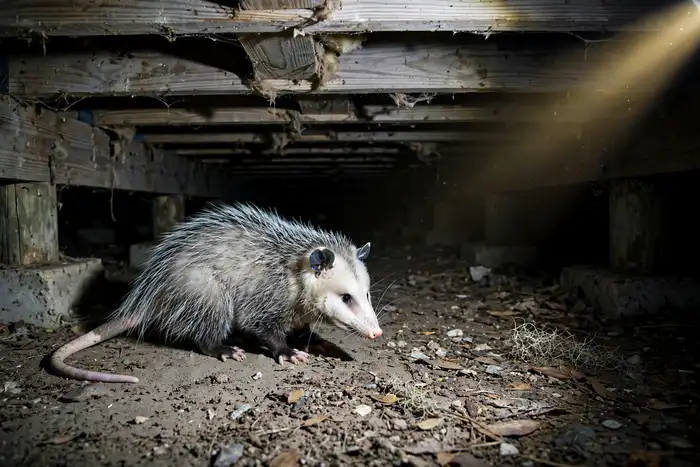
Opossums in your Fort Pierce home
Fort Pierce's older housing gives the Virginia opossum something newer subdivisions rarely do: a proper under-house. Homes standing on pier foundations have a shaded, dry crawlspace running the full footprint, entered through vents and access doors that have been quietly failing for decades. An opossum working the lagoon edge or the grove margin at night — insects, snails, fallen fruit, carrion — finds that crawlspace by smell and settles into the far corner by dawn.
It is a tenant most homeowners misjudge in both directions. An opossum is not aggressive, rarely carries rabies, and would rather freeze or feign death than fight. But weeks of droppings under a floor, a litter raised in the insulation, and an animal that may simply die in a space nobody enters are real costs. Removal here is a sanitation job with a carpentry tail — the vent or door it used matters as much as the animal.
Resident, or just passing under the house?
A transient opossum uses a crawlspace for a night or two and leaves almost nothing. A resident leaves a file: droppings concentrated in one corner, bedding dragged and arranged, a sweet, musky odor that comes and goes with the humidity, and activity sounds — slow scratching, not scurrying — at the same floor spot night after night. In Fort Pierce the surest test is the access door: a resident's route wears the soil at one vent smooth.
Pier foundations: the classic Fort Pierce den
Raised bungalows and cottages are this city's opossum hotels. The crawlspace stays cooler than the attic, floods rarely on the higher old-town ground, and offers plumbing chases leading straight up into wall voids. From a den under the house, an opossum occasionally follows those chases upward, which is how a homeowner meets one in a bathroom wall. Our inspections start underneath, with a light and a map of every vent, door and penetration — the under-house is a room, and we treat it like one.
Porches, sheds and the lagoon side of the lot
Where a house sits on a slab, the den moves to the next best cover: beneath a low porch or deck, under a shed set on blocks in White City or Fort Pierce South, inside a woodpile against the back fence. Lagoon-side lots add a steady supply of animals commuting the seawall and mangrove edge, so a porch den on those streets is refilled promptly if the void is left open. The closure — a buried barrier edge or proper skirting — is written into every porch job for that reason.
Counting passengers before anything closes
A female opossum in season is rarely a single animal. Young ride first in the pouch and later on her back, and a den checked carelessly can hide juveniles in bedding while their mother is out feeding. Sealing a crawlspace with young inside is the mistake this trade is known for, and it announces itself within days. We clear the den space by hand and eye before any vent is repaired, and the closure schedule bends to the family's, not ours.
How removal works under Florida rules
The work runs under FWC Rule 68A-9.010 with the property owner's authorisation. A live-caught native opossum may be released on the same property, or moved only within St. Lucie County onto forty or more contiguous acres where the receiving landowner has agreed in writing, and that release-or-euthanize decision is made within twenty-four hours of capture. In practice the destination matters less than the door: an animal evicted from a repaired crawlspace goes back to its night route along the water and groves, which is where it was making an honest living all along.
The death nobody notices — until they do
Opossums live fast and briefly, and an old animal denning in the crawlspace of a house that sits empty between winter rentals may not be alive by the time the next occupants arrive. The discovery is olfactory and instant. Live removal while a den is active is the cheap version of this story; we raise it on every crawlspace call, because Fort Pierce has enough part-year houses to make the pattern a familiar one.
Common opossum questions in Fort Pierce
Is the opossum under my house a danger to my family?+
Why my crawlspace and not the neighbor’s?+
Do opossums chew wiring or damage the structure?+
Can it be released at the lagoon or in a grove?+
What does opossum removal cost in Fort Pierce?+
Other Fort Pierce problems that come with opossums
Our wildlife crew handles these closely related problems — the ones that most often turn up with a opossum issue.
Got more than opossums in Fort Pierce?
Opossums are rarely the only thing using an attic or yard in Fort Pierce. See everything we handle locally on the Fort Pierce wildlife removal hub, or jump to Florida wildlife removal.
Serving all of St. Lucie County
Fort Pierce is one part of St. Lucie County. See wildlife removal in St. Lucie County, FL for the county-wide picture — the animals we get called about most, and the other towns we cover.
One call to your Fort Pierce opossum crew
The longer opossums stay in the attic, the more they chew and the bigger the cleanup. Call us and tell us about the job — we will confirm the local crew for your county before any work starts.
- Local to St. Lucie County. FWC-compliant handling — call to ask about licensing and insurance.
- Humane exclusion. One-way doors and steel sealing, not poison.
- Done right. Removal, exclusion and cleanup.