Wildlife Removal in Streetsboro, OH
Streetsboro was built at a crossroads and is still growing outward from it — subdivisions in former fields, retail along the corridors, and woods and wetlands never more than a street away. Animals did not leave when the houses arrived; they moved into the edges between them. Call us and tell us about the job — we will confirm the local crew for your county before any work starts.
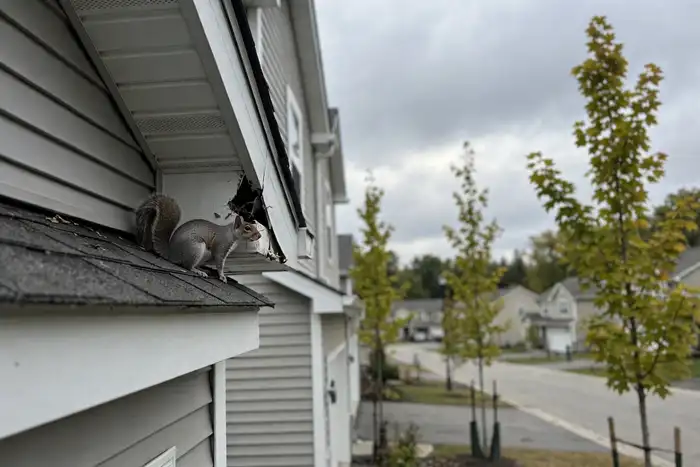
Why Streetsboro homes see the wildlife they do
Growth is the whole wildlife story in Streetsboro. A generation ago much of this city was farmland, woodlots and wetland along the turnpike corridor; today it is rooftops — but the fields and woods did not vanish, they were subdivided around. A typical Streetsboro home backs onto a retention pond, a drainage swale, an undeveloped parcel or a strip of woods the builder left standing, and that edge where lawn meets wild ground is precisely where raccoons travel, groundhogs dig and skunks den.
The housing itself is mostly newer, which fools people. Newer construction has tight walls but plenty of wildlife doors: roof vents with light screening, soffits that flex, bath-fan exits, deck voids, and the settling that opens small gaps around foundations and utility lines in the first several winters. In a commuter city, houses also sit empty all day and quiet all week — ideal conditions for an animal to move into an attic in fall and be discovered by its noises on a weekend morning.
Our wildlife crew works Streetsboro the way the city is laid out: subdivision by subdivision, the roofline above, the deck and foundation at grade, and the corridor edges — retail dumpsters, drainage ditches, pond banks — that keep restocking the neighborhoods with animals. We remove what has moved in the way Ohio law requires, seal it out with metal, and give straight advice about the edge habitat behind the fence, because here that edge is permanent.
New subdivisions on old fields: edge habitat by design
Every Streetsboro subdivision platted into farmland created miles of brand-new edge — the boundary where mowed lawn meets tall field, woods or wetland. Edge is the most wildlife-dense habitat there is. Groundhogs graze the lawn and bolt for burrows dug into the bank behind it. Skunks patrol the boundary at night. Raccoons commute along the drainage swales the way people use the sidewalks. A house at the end of a cul-de-sac against undeveloped land does not have occasional wildlife; it has a nightly shift of it.
Retention ponds complete the pattern. Nearly every newer development holds one, and its banks, outflow and surrounding rough grass concentrate frogs, insects and small mammals — which concentrate their predators at the lot lines of the homes around it. None of this means the neighborhood is badly built. It means the sealing and screening at each house has to assume constant pressure, because the pressure is built into the map.
The practical consequence is that Streetsboro work is rarely one-and-done for a street. When our crew finishes a house, we say plainly if the lot's position — corner, cul-de-sac end, pond frontage — means the homeowner should expect to stay ahead of sealing and screening rather than consider wildlife a closed chapter.
Retail corridors, drainage and the raccoon supply line
Streetsboro's commercial corridors feed wildlife at an industrial scale, and the animals do not respect the zoning line at bedtime. Dumpsters behind restaurants and stores, storm drains and culverts running under the highways, and the ditches along the turnpike and I-480 interchanges give raccoons and opossums food, water and covered travel routes that end, conveniently, in residential streets. A neighborhood a quarter mile from a retail strip can carry city-level raccoon pressure with suburb-level housing.
That is why raccoon and rodent calls here often persist at homes that are doing everything right. The yard can be clean and the trash latched and the pressure still arrives nightly along the drainage. The answer is not frustration with the corridor — it is not changing — but a house sealed as if the pressure were permanent: chimney capped, vents armored, soffits closed in metal, and no pet food or open compost doing local recruiting on top of the corridor's supply.
Norway rats follow the same infrastructure in the corridor districts, traveling drains and dumpster lines. A rat sighting near a Streetsboro home close to commercial ground is taken seriously and early, because rats work from burrows at the foundation and breed into a colony while a homeowner is still deciding whether they really saw one.
A commuter city: empty houses, fall move-ins, weekend discoveries
Streetsboro empties out on weekday mornings, and wildlife keeps commuter hours in reverse. Animals explore quiet houses by day and settle into attics in fall without an audience. The classic call here comes on a Saturday: scratching heard over the family room that was probably there, faintly, for weeks; droppings found in a garage while getting out decorations; a groundhog burrow discovered when the mower finally reaches the back bank in spring.
Fall is the decisive season regardless. As the first frost arrives, squirrels, raccoons and house mice push to get indoors for winter, testing the vent screens and soffit corners that settlement and freeze–thaw have loosened. In newer subdivisions, the first five to ten winters are when those small construction gaps appear — a home that was tight at closing can present its first real entry at year six, to a homeowner who reasonably assumed new meant sealed for good.
The useful habit for a commuter household is a scheduled one: a roofline and foundation check each fall before the push, feeders and trash routines that do not recruit, and a call at the first noise rather than after a season of it. Animals removed in October are a small job; the same animals discovered in February have had four months to chew, soil and multiply the work.
Ohio rules that shape the work: licensing, bats and relocation
Wildlife removal for hire in Ohio is licensed work. It requires an ODNR Commercial Nuisance Wild Animal Control Operator license under Ohio Revised Code section 1531.40, and Streetsboro homeowners should expect any crew charging for this work to operate under that license. Bats follow a strict state calendar: exclusion is barred from May 16 through July 31 when five or more bats are present, because that is maternity season and the pups cannot fly, and from October 15 through March 31, when big brown bats may be hibernating inside the structure itself — in either period only with prior written ODNR permission. The open windows are April 1 to May 15 and August 1 to October 15.
Rabies and relocation rules shape the ground-animal work. Raccoons, skunks, foxes and bats are Ohio's main rabies vectors, and Portage County sits within the state's long-running effort to hold raccoon-variant rabies back with oral vaccine baiting to the east. Under Ohio Administrative Code 1501:31-15-03(E)(3), a captured raccoon, skunk or opossum cannot be taken away and released elsewhere: the lawful outcomes are release on the same property or humane euthanasia. That is why our crew leads with exclusion — one-way doors and thorough sealing that let an animal leave a structure on its own where possible — and handles anything captured exactly as Ohio rules require.
Wildlife we remove in Streetsboro
From a groundhog at the subdivision bank to a raccoon commuting in from the retail corridor, these are the calls Streetsboro homeowners make most.
🐿️ Squirrels
Newer roofs, first gaps. As subdivisions settle through their first winters, squirrels find the loosened soffit corners and vent screens and move into attics each fall for the season. See our full Streetsboro squirrel removal guide →
🦝 Raccoons
Fed by the corridors, housed by the subdivisions. Raccoons travel Streetsboro's drainage lines nightly and den in chimneys and attics — a rabies-vector species Ohio law does not allow to be taken away and released elsewhere. See our full Streetsboro raccoon removal guide →
🦇 Bats
Big brown bats roost behind gable vents on newer Streetsboro homes — and may hibernate in the attic all winter. Exclusion is legal only April 1–May 15 and August 1–October 15 without written ODNR permission. See our full Streetsboro bat removal guide →
🦨 Skunks
Skunks den under the decks and porches of homes backing onto fields and woods, and grub-hunt the lawns between. A rabies vector that cannot be moved off the property under Ohio law, so exclusion and screening carry the job. See our full Streetsboro skunk removal guide →
🦫 Groundhogs
Field-edge royalty. Groundhogs burrow into subdivision banks, under decks and sheds and along retention-pond edges, then hibernate from late fall — spring emergence restarts the digging all at once. See our full Streetsboro groundhog removal guide →
🐾 Opossums
Opossums drift in along the ditches and drainage corridors and bed down in garages and under decks. Ohio law does not allow them to be carried off and released, so the shelter gets closed once the animal is out. See our full Streetsboro opossum removal guide →
🐿️ Chipmunks
Chipmunks tunnel along the foundations, stoops and patio edges of newer homes, hollowing soil in beds and behind the low walls that edge subdivision lots. See our full Streetsboro chipmunk removal guide →
🐀 Rats, mice & voles
House mice invade at first frost through settling foundations, Norway rats work the ground near the retail corridors and drains, and voles run the new lawns under snow. Three animals, three plans. See our full Streetsboro rodent removal guide →
🐍 Snakes
Garter snakes in the new lawns, rat snakes in garages near the fields, and watersnakes at the retention ponds. Almost every Streetsboro snake is harmless — the job is identification and calm removal. See our full Streetsboro snake removal guide →
🪰 Dead animals
An odor building in one room of a newer home, noticed first on a quiet weekend, usually means an animal died in a wall or attic. Our crew locates it, removes it and seals the gap it came through. See our full Streetsboro dead animal removal guide →
Animal-specific help in Streetsboro
Deep, local guides for the problems we get called about most — with our wildlife crew behind every one.
How to get help in Streetsboro
Tell us what you're hearing
Scratching in the attic, a snake by the porch, holes in the yard — call with your problem and your Streetsboro address.
We connect you locally
Call us and tell us about the job — we will confirm the local crew for your county before any work starts.
They solve it — for good
Inspection, humane removal, full exclusion and cleanup — handled by our wildlife crew, following Ohio rules.
Common wildlife removal questions in Streetsboro
Who do I call for wildlife removal in Streetsboro?+
Our subdivision is fairly new — why do we have so many animals?+
When do most Streetsboro wildlife problems start?+
Can bats be removed from my attic in summer or winter?+
Will you trap a raccoon and release it out in the country?+
How much does wildlife removal cost in Streetsboro?+
Serving all of Portage County
Streetsboro is one part of Portage County. See wildlife removal in Portage County, OH for the county-wide picture — the animals we get called about most, and the other towns we cover.
One call to your Streetsboro wildlife crew
Whether it's squirrels in an older in-town attic or a raccoon in a new subdivision crawlspace, the fastest fix is our wildlife crew, who knows Portage County wildlife. Call us and tell us about the job — we will confirm the local crew for your county before any work starts.
- Local to Portage County. ODNR-compliant handling — call to ask about licensing and insurance.
- One company, one call. Call us and tell us about the job.
- Done right. Removal, exclusion and cleanup.