Bat Removal & Exclusion in Streetsboro, OH
Droppings collecting below a gable vent on a newer home, or scratching faintly in a wall in summer? Big brown bats use Streetsboro's rooflines more than owners realize — and Ohio law sets the schedule for removing them. Call us and tell us about the job — we will confirm the local crew for your county before any work starts.
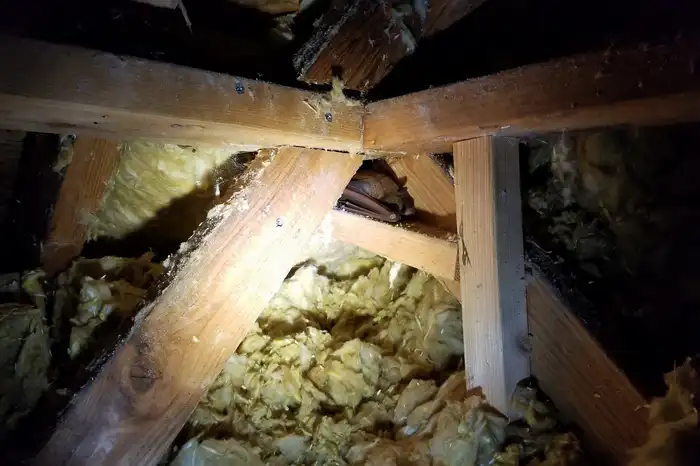
Bats in your Streetsboro home
Homeowners in newer Streetsboro subdivisions are often surprised to have bats at all, but the big brown bat asks very little of a house: a gap the width of a finger at a gable vent, a rake trim board or a chimney flashing, and a warm, quiet attic behind it. The fields, ponds and tree strips around the developments supply the insects; the roofline supplies the roost. Colonies here are usually found by droppings under an entry or by a single bat that takes a wrong turn into a living room.
What surprises people more is the law. Bats may only be removed by exclusion, only a licensed operator may do it for hire, and the state calendar forbids the work for much of the year. A bat job rushed in the wrong month does not remove a colony — it seals one in.
Two closed seasons, two open windows
Ohio Administrative Code 1501:31-15-03(H)(5) bars bat exclusion from May 16 through July 31 when five or more bats are present — maternity season, when the pups cannot yet fly — and from October 15 through March 31, when bats may be hibernating inside the structure. Either closed season can only be overridden with prior written permission from the Chief of the ODNR Division of Wildlife. The open windows are April 1 to May 15 and August 1 to October 15. A discovery in June or in the middle of winter is still worth a call: inspection, entry mapping and scheduling happen then, so exclusion begins the day the window opens.
Big brown bats hibernate in Ohio attics
The assumption that bats leave in fall is wrong for this species in this state. Big brown bats tolerate cold roosts and commonly overwinter right inside Ohio homes, tucked singly into wall voids and quiet attic corners in hibernation, making no sound and leaving no fresh sign. Sealing a Streetsboro house in January on the theory that it stands empty can entomb animals that are very much present — the precise outcome the October-to-March closure exists to prevent. A winter visit therefore starts by looking for hibernating bats, not by reaching for the sealant.
Entries on a newer Streetsboro home
Newer construction narrows the list but does not empty it. Bats enter where gable vent screening has failed at a corner, where trim has shrunk along a rake or corner board, at flashing shifted by freeze and thaw, and at the seam where a porch or garage roof meets the wall. Because these gaps are small and high, the evidence is usually on the ground: droppings gathered on a patio, walk or window ledge directly below the entry, sometimes with faint staining at the gap itself. Our crew reads that evidence to identify the active entries before any sealing is planned.
Guano, rabies and the bedroom bat
Under a roost used for seasons, guano accumulates in the attic, and dried droppings can carry the fungus associated with histoplasmosis — cleanup calls for proper protection rather than a homeowner and a vacuum. Bats are also the most frequently confirmed rabies species in Ohio. A colony in the attic is not aggressive, but a bat discovered in a room where someone was sleeping is treated as a possible exposure: do not handle it, close the room, and get guidance from your doctor or the county health department, because the animal may need to be captured for testing rather than simply released outside.
How a timed exclusion works
Within a legal window, the crew seals every gap on the home except the active entries, then fits those entries with one-way bat valves that let bats drop out at dusk to hunt over the ponds and fields and bar their return. Follow-up checks confirm the colony has fully left before the valves are removed and the last openings sealed for good. The work is a sequence of visits across days, and on a two-story home with several gables the complete sealing list is what decides whether the colony stays gone.
What not to do when you find the entry
Do not caulk the gap. In summer it traps flightless pups inside to die; in winter it traps hibernating adults; in any season, bats still indoors will work into walls and living space hunting another exit. Mothballs, sprays and ultrasonic devices do not move a colony and are not a substitute for the legal method. The working order is inspect, wait for the window if the calendar demands it, exclude one-way, verify, and seal.
Common bat questions in Streetsboro
I have bats in my Streetsboro attic — how are they removed?+
Why can the work not happen in July or midwinter?+
A bat got into our bedroom — what should we do?+
Our home is new — how did bats get in at all?+
How much does bat removal cost in Streetsboro?+
Other Streetsboro problems that come with bats
Our wildlife crew handles these closely related problems — the ones that most often turn up with a bat issue.
Got more than bats in Streetsboro?
On a settling Streetsboro home, the gap a colony uses is rarely the only opening the first winters have opened. See everything we handle locally on the Streetsboro wildlife removal hub, or jump to Ohio wildlife removal.
Serving all of Portage County
Streetsboro is one part of Portage County. See wildlife removal in Portage County, OH for the county-wide picture — the animals we get called about most, and the other towns we cover.
One call to your Streetsboro bat crew
Bats slip into newer homes through gaps nobody caulked, and sealing at the wrong moment traps pups or sleeping adults inside. Timing is the whole job. Call us and tell us about the job — we will confirm the local crew for your county before any work starts.
- Local to Portage County. ODNR-compliant handling — call to ask about licensing and insurance.
- Timed, one-way exclusion. Bat valves fitted in the April 1–May 15 or August 1–October 15 windows, then permanent sealing once the colony is confirmed out.
- Done right. Removal, exclusion and cleanup.