Groundhog Removal in Streetsboro, OH
A mound of fresh dirt on the bank behind your lot, and tunnels reaching under the deck? Streetsboro's field edges are groundhog country, and a burrow system grows all season once it starts. Call us and tell us about the job — we will confirm the local crew for your county before any work starts.
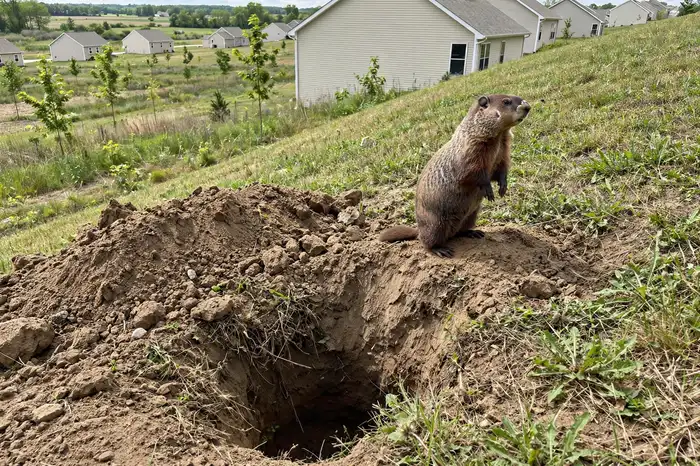
Groundhogs in your Streetsboro home
If Streetsboro's growth created one perfect groundhog landscape, this is it: grazing lawns for food, undeveloped field and woodland for cover, and ready-made burrow shelters in every subdivision bank, retention-pond edge, deck and shed in the city. The groundhog — the woodchuck — digs its system in spring, grazes along the edges all summer, and disappears into true hibernation before winter, which gives the whole problem a strict calendar.
Most homeowners meet the burrow before the animal: a fan of pale excavated dirt on a bank, a second, hidden entrance discovered under a deck edge, a garden row clipped to the ground overnight. That excavated soil came out from under something, and the systems here reach widely — the garden damage is the visible tax, but the void under a structure is the bill.
Banks, pond edges and the shape of a system
Streetsboro groundhogs start where digging is easy and cover is close: the sloped bank between lots, the rough edge of a retention pond, the woodline at the back of a development. From there the system extends — multiple entrances, a nest chamber, side runs — until part of it lies under a deck, a shed or a patio. A burrow in a pond bank adds a special risk, since tunneling through its compacted core can start leaks and erosion. Our crew maps entrances at the bank and at the building together before deciding where removal and screening will actually hold.
What the excavation does under a structure
A burrow system is a soil-removal operation. Every mound on the lawn is volume taken from beneath a slab edge, a deck footing or a foundation run, and over a season or two that leaves structures bearing on loosened or hollow ground. Burrows also collect followers: an emptied groundhog system is prime real estate for skunks and opossums, which is why a finished job closes and screens the system rather than leaving a vacant, ready-made den at the house.
Hibernation and the spring restart
Groundhogs are true hibernators, underground on stored fat from roughly late fall into late winter. A burrow that looks abandoned in January most likely holds a sleeping animal. Males emerge first in late winter, litters arrive in spring, and digging resumes at full pace almost immediately. That makes early spring the decisive window: a system addressed at emergence prevents a season of excavation, and every plan first accounts for the possibility of young in the burrow before exclusion or trapping is set.
How removal and exclusion work
Ohio's nuisance rules give woodchucks their own section, including where traps may be set, and a licensed operator works within it. Depending on the system's position, the plan is trapping at the active entrances or a one-way exclusion arrangement that lets the animal leave and bars its return. Once the burrow is confirmed empty, the entrances are closed and the structure's edge receives buried metal screening — mesh trenched into the soil and bent outward — so the next digger at that bank or deck meets a barrier instead of soft, pre-dug ground.
Fences, fill dirt and other short stories
A standard subdivision fence does not stop a groundhog; it climbs low fences and digs beneath the rest. Garden fencing only works with its base buried and bent outward, the same principle as screening at the house. Shoveling the mound back into the entrance is the most common wasted afternoon in groundhog work — an active animal clears it in days, and fill placed in winter can entomb a hibernating groundhog to die in place, converting a burrow problem into a dead-animal problem under your deck. Flooding and repellents fail the same way, against an animal holding a second exit.
Common groundhog questions in Streetsboro
A groundhog is digging under my Streetsboro deck — what should I do?+
The burrow looks empty in winter — can I fill it in?+
When do groundhogs come out in Streetsboro?+
Will a groundhog damage anything besides my garden?+
How much does groundhog removal cost in Streetsboro?+
Other Streetsboro problems that come with groundhogs
Our wildlife crew handles these closely related problems — the ones that most often turn up with a groundhog issue.
Got more than groundhogs in Streetsboro?
Groundhogs are rarely the only thing using an attic or yard in Streetsboro. See everything we handle locally on the Streetsboro wildlife removal hub, or jump to Ohio wildlife removal.
Serving all of Portage County
Streetsboro is one part of Portage County. See wildlife removal in Portage County, OH for the county-wide picture — the animals we get called about most, and the other towns we cover.
One call to your Streetsboro groundhog crew
The longer groundhogs stay in the attic, the more they chew and the bigger the cleanup. Call us and tell us about the job — we will confirm the local crew for your county before any work starts.
- Local to Portage County. ODNR-compliant handling — call to ask about licensing and insurance.
- Humane exclusion. One-way doors and steel sealing, not poison.
- Done right. Removal, exclusion and cleanup.