Raccoon Removal in Streetsboro, OH
Deliberate, heavy movement overhead at night, and trash scattered despite a latched can? Streetsboro raccoons commute from the corridors and ditches to den in subdivision chimneys and attics. Call us and tell us about the job — we will confirm the local crew for your county before any work starts.
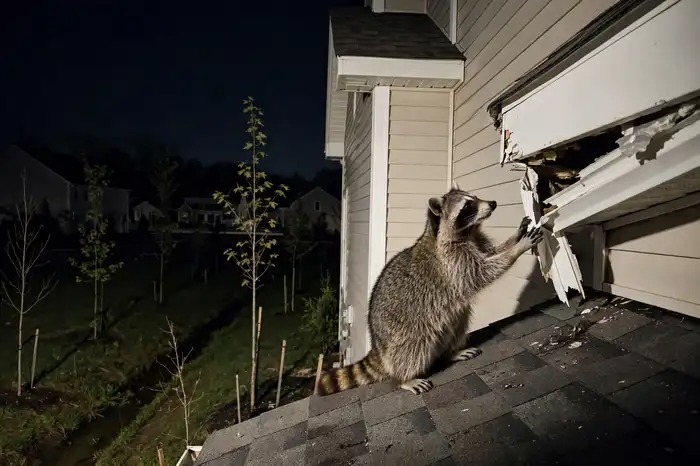
Raccoons in your Streetsboro home
A Streetsboro raccoon has the best of both worlds, and it knows the route between them. After dark it works the retail corridors — dumpsters, loading areas, storm drains — and the drainage ditches that thread the city, then it beds down for the day in the subdivisions those same ditches pass through. The den it wants in spring is a house: an uncapped chimney, a soffit corner it can peel open, or an attic above a garage in a home that sits quiet all day.
The household evidence is heavy thumping rather than scratching, a litter's chattering in season, and entry damage a smaller animal could not manage. Ohio law and raccoon biology together dictate the response: kits cannot leave on their own for weeks, and a captured raccoon cannot legally be transported and released somewhere else. Raccoon work here is planned work, done by a licensed operator.
Ohio law: a raccoon is not hauled away
Under Ohio Administrative Code 1501:31-15-03(E)(3), a captured raccoon must be released on the same property or humanely euthanized. Driving one out to farmland or a park to let it go is unlawful, principally because raccoons are a leading rabies vector and moving them moves disease — Portage County sits in the zone the state defends with oral rabies vaccine baiting. Our crew leads with exclusion: one-way doors and sealing that let a raccoon leave a structure under its own power where that can work, with any captured animal handled precisely as the rule requires. Anyone offering to haul a Streetsboro raccoon away and set it free is offering an illegal service.
The corridor commute ends at your roofline
Understanding the commute explains the persistence. Drainage swales behind the lots, culverts under the drives and the ditch lines along the highways are raccoon roads — covered, watered and connected to food at the commercial end. A home whose lot backs onto a swale is on that road whether the owner knows it or not. Sealing such a house has to assume a skilled, strong nightly visitor: a proper chimney cap, reinforced vent covers, and flashing anchored where a lower roof meets a wall, because that junction is the raccoon's favorite staircase landing.
Finding the kits before anything closes
Spring is kit season, and an attic or chimney raccoon in Streetsboro from March onward is a mother until proven otherwise. Kits cannot climb or follow her through a one-way door for their first weeks. Excluding her, or sealing her out, without accounting for them leaves young to die inside the structure — trading the raccoon problem for a dead-animal problem in the worst location in the house. Our crew locates litters with cameras and inspection before a single opening is closed, and builds the plan around accounting for every kit, including reuniting them outside so the mother moves them herself where that is possible.
The latrine above the ceiling
Raccoons defecate in one chosen spot, and in an attic that latrine concentrates droppings that may carry raccoon roundworm, whose eggs persist and are a genuine health concern, especially where children are concerned. A complete job includes removing contaminated material and sanitizing the area. It does not automatically mean stripping an entire attic of insulation — often only the affected section needs to come out, and our crew will tell you plainly which case yours is.
Sealing against an animal with hands
A raccoon opens what a squirrel cannot: it peels, pries and lifts. Closures rated for raccoons are heavy-gauge metal, fastened to structure rather than to trim — chimney caps, armored vent covers, flashing at roof returns and porch junctions. Thin screen, foam and light wood are delays measured in nights. On Streetsboro's two-story colonials and split-levels, the crew pays particular attention to what a raccoon can reach from a garage roof or a fence line, which is where second entries are usually started.
Cutting the local recruiting
The corridor will keep supplying raccoons; a household can stop adding its own attractions. Cans with lids that truly latch, pet food fed indoors, grills cleaned, fallen fruit gathered and no open compost at the fence line all reduce the nightly stops at your address. Combined with metal sealing, that is what converts a house on the raccoon road into a house the road merely passes.
Common raccoon questions in Streetsboro
There is a raccoon in my Streetsboro attic — what should I do?+
Can you release a trapped raccoon in a rural area instead?+
Why do raccoons keep coming to our street specifically?+
I hear chattering in the chimney — are those babies?+
How much does raccoon removal cost in Streetsboro?+
Other Streetsboro problems that come with raccoons
Our wildlife crew handles these closely related problems — the ones that most often turn up with a raccoon issue.
Got more than raccoons in Streetsboro?
Raccoons are rarely the only thing using an attic or yard in Streetsboro. See everything we handle locally on the Streetsboro wildlife removal hub, or jump to Ohio wildlife removal.
Serving all of Portage County
Streetsboro is one part of Portage County. See wildlife removal in Portage County, OH for the county-wide picture — the animals we get called about most, and the other towns we cover.
One call to your Streetsboro raccoon crew
The longer raccoons stay in the attic, the more they chew and the bigger the cleanup. Call us and tell us about the job — we will confirm the local crew for your county before any work starts.
- Local to Portage County. ODNR-compliant handling — call to ask about licensing and insurance.
- Humane exclusion. One-way doors and steel sealing, not poison.
- Done right. Removal, exclusion and cleanup.