Raccoon Removal in Painesville, OH
Slow, heavy footsteps overhead instead of scurrying, plus chattering from the chimney on a spring night? That is a mother raccoon raising a litter where Painesville houses offer her the best shelter — an unused flue, an attic or a garage ceiling. Call us and tell us about the job — we will confirm the local crew for your county before any work starts.
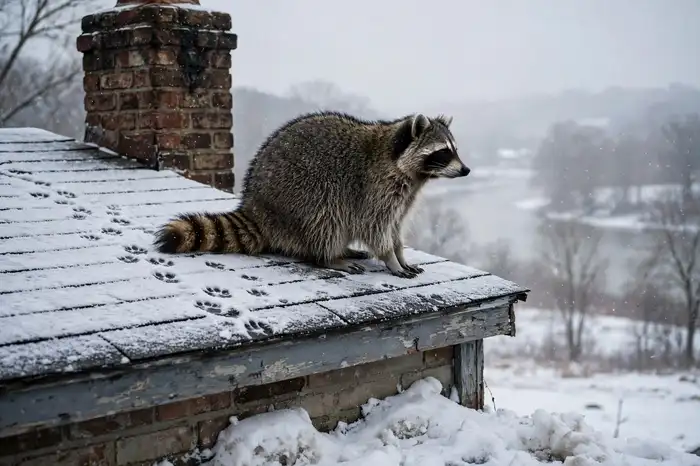
Raccoons in your Painesville home
Painesville feeds raccoons well. The Grand River and its banks, backyard fruit, unsecured trash and pet food left in garages make an in-town lot worth visiting nightly — and the housing gives a visiting raccoon somewhere to stay. Older chimneys that no longer serve a working fireplace, roomy attics under tall roofs, and garage ceilings over quiet storage are exactly the dry, elevated dens a female looks for when litters arrive in spring.
Two facts govern the work. Kits stay put for weeks and cannot follow their mother out, so any plan that ignores them fails badly. And Ohio law closes off the answer many people expect: a raccoon cannot be caught here and let go somewhere else. The job has to be built on inspection, timing and exclusion, which is why it belongs with a licensed crew rather than a borrowed trap.
Why the answer is never a ride out of town
Ohio Administrative Code 1501:31-15-03(E)(3) gives a caught raccoon two lawful endings: let go on the same property, or humane euthanasia. There is no third option involving a park, a farm or a woodlot in another township. The rule is disease control — raccoons are among Ohio's named rabies vectors, and shipping them around ships the risk with them. Our crew starts instead with one-way exclusion that lets a raccoon walk out of a structure by itself, and treats any case that truly needs handling strictly within that rule.
Unused flues and garage ceilings: the spring nurseries
A cold chimney flue is a ready-made den — vertical, dry, dark and safe from dogs — and a female will settle on the smoke shelf and raise her litter there. Paw marks in soot, sticks and leaves in the firebox, and kit noises from the chimney are the tells. Garages run the same play at lower height: a ceiling space over stored boxes, entered where the eaves have opened. In both places the cap, screen or board that would keep raccoons out must wait until the family is verifiably gone.
Counting kits before anything closes
Raccoon litters in Ohio are a spring event, and young kits are hidden deep — in insulation, in a flue, in a soffit run. If the mother is excluded and the entry sealed while kits remain, she will tear at the house to reach them and the kits will die inside it, converting a live-animal job into a carcass job in the worst location available. Our crew uses inspection and cameras to account for the whole litter, and the removal timeline is set by the kits, not by convenience.
The latrine corner nobody finds until later
Raccoons return to one spot to relieve themselves, and in a spacious attic or garage ceiling that latrine can accumulate quietly. The droppings may carry raccoon roundworm eggs, which survive a long time and matter most where children or pets could contact contaminated material. Cleanup — removing fouled insulation where it is fouled, treating the area — is part of a complete raccoon job. It is not automatically a whole-attic insulation replacement, and you should expect a straight answer about how much actually needs to come out.
Sealing for an animal with hands and leverage
A raccoon tests repairs the way it opened the original entry: by pulling. Entries are therefore closed in heavy-gauge metal — a properly fitted chimney cap, reinforced vent covers, flashing at porch-roof and garage-roof junctions, and eave returns rebuilt where wood has softened. Anything a strong animal can flex, peel or chew will be flexed, peeled or chewed, usually within the first week.
Making an in-town lot less worth visiting
Sealing holds best when the yard stops paying rent. Trash in cans with lids that latch, pet food fed indoors or in a garage that actually closes, grills scraped down and bird seed stored in metal all reduce the nightly draw — especially this close to the river, where raccoon traffic is a permanent feature. You are not trying to empty the corridor; you are making your house the least rewarding stop on it.
Common raccoon questions in Painesville
There are raccoons in my Painesville chimney — what happens first?+
Can the raccoon just be taken to a park and released?+
I saw a raccoon out at midday near the river — is it sick?+
Something heavy is walking in my garage ceiling — could that be raccoons?+
How much does raccoon removal cost in Painesville?+
Other Painesville problems that come with raccoons
Our wildlife crew handles these closely related problems — the ones that most often turn up with a raccoon issue.
Got more than raccoons in Painesville?
Raccoons are rarely the only thing using an attic or yard in Painesville. See everything we handle locally on the Painesville wildlife removal hub, or jump to Ohio wildlife removal.
Serving all of Lake County
Painesville is one part of Lake County. See wildlife removal in Lake County, OH for the county-wide picture — the animals we get called about most, and the other towns we cover.
One call to your Painesville raccoon crew
The longer raccoons stay in the attic, the more they chew and the bigger the cleanup. Call us and tell us about the job — we will confirm the local crew for your county before any work starts.
- Local to Lake County. ODNR-compliant handling — call to ask about licensing and insurance.
- Humane exclusion. One-way doors and steel sealing, not poison.
- Done right. Removal, exclusion and cleanup.