Wildlife Removal in Painesville, OH
Painesville is a county seat built in layers — older houses on in-town streets, raised front porches, detached garages behind the house, and the Grand River cutting along the low ground below town. Animals use every part of that layout, from a porch void to a garage rafter to a foundation that has settled for decades. Call us and tell us about the job — we will confirm the local crew for your county before any work starts.
Why Painesville homes see the wildlife they do
Most Painesville wildlife calls start with the age of the house rather than the size of the animal. In-town homes here were raised when a front porch sat high over an open void, a garage stood separate at the back of the lot, and a stone or block foundation was expected to breathe a little. Those details read differently to wildlife. The porch void is a dry den. The garage is a quiet shelter with bird seed and pet food in the corner. A soft mortar joint or a gap where a utility line enters is a doorway that stays hidden behind shrubs and snow.
The Grand River adds pressure that a purely inland town does not have. Its banks, brushy edges and low ground give raccoons, opossums, skunks and watersnakes food and cover within a short walk of residential streets, and wet years push some of that activity uphill into yards and outbuildings. Add lake-effect snow that piles against foundations, melts, refreezes and pries at rooflines, and a Painesville house can offer animals a route in at the bottom in one season and at the top in the next.
Our crew therefore inspects a Painesville property as a whole lot, not just a roof: foundation and porch first, garage and shed next, then chimneys, soffits and vents above. Animals are handled the way Ohio rules require, young are accounted for before anything closes, and openings are sealed with metal and masonry-ready materials that can stand up to another Lake County winter. Taking one animal out and leaving the porch open or the garage gap untouched seldom ends the story on these streets.
Older in-town houses: porches, garages and foundations do the inviting
A raised porch is the signature Painesville shelter. Skirting breaks, soil washes out at one corner, and suddenly there is a dark, rain-proof space big enough for a skunk family, an opossum or a groundhog burrow — often with a second route through an old foundation opening into the basement or crawlspace. Homeowners usually notice the smell or the digging long before they see the animal, and by then the void may have been used for weeks.
The detached garage runs a close second. Older garages have gaps under doors that have racked with the seasons, open eaves, stored seed and tools, and rafters nobody looks at from one year to the next. Raccoons den in the ceiling space, mice nest in stored material, and a rat snake may follow those mice inside. A proper Painesville inspection walks the garage and any shed with the same care as the attic, because on these lots the outbuilding is often where the problem actually lives.
Foundations finish the picture. Stone and early block work shifts a fraction each winter, porch steps pull away from walls, and pipes enter through holes that were never tightly packed. Sealing that level — repointing where mortar has gone, fitting metal where animals chew or squeeze, screening vents without choking airflow — is unglamorous work, and it is what keeps ground-level animals out for good.
The Grand River corridor keeps wildlife close to town
Stand anywhere on Painesville's low ground and the pattern is easy to read. The river provides water year-round, its edges hold frogs, fish and fallen fruit, and brush along the banks gives animals a covered route that barely touches an open lawn. Raccoons travel it nightly. Opossums amble out of it after dark. Near the banks and in wet yards, northern watersnakes hunt — harmless fish-eaters that startle people precisely because they are large, dark and quick to defend themselves when cornered.
That closeness means a sealed house matters more, not less. A home a street or two from the corridor will be visited again; the question is whether the visitor finds anything open. Trash kept in a garage with a gap under the door, a porch void behind broken skirting, or an uncapped chimney all answer that question the wrong way. Our crew pairs removal with a hard look at what the property offers along the river-to-house route: food, cover and entry, in that order.
Wet seasons sharpen the effect. High water and saturated low lots push ground animals toward higher, drier shelter, and a porch or garage that stayed empty through a dry summer can gain a tenant in a soggy spring. If activity around your home changes after heavy rain, say so when you call — it helps the crew read the property the way the animals do.
Lake-effect snow, thaw and the fall push indoors
Painesville sits close enough to Lake Erie to take real lake-effect snow, and the snow does more than bury the porch steps. It loads older roofs, dams meltwater at the eaves, and works ice into soffit joints and chimney flashing. Each thaw lets water in a little deeper; each refreeze wedges the opening wider. By the time leaves fall, a vent screen that rusted at one edge or a gable joint that opened a quarter inch can admit bats, squirrels or mice.
Autumn is when that damage gets used. Squirrels choose winter dens, mice stream toward warmth at the first hard frost, and raccoons test chimneys and porch roofs before the deep cold. A house that sounded quiet all summer can develop scratching in October without anything mysterious happening — the openings were made by winter, and fall is simply when animals move into them.
The counter is a fall check done before the rush: rooflines and vents inspected while ladders are still easy, weak flashing and screens renewed in metal, foundation gaps closed before snow hides them. Exclusion done in mild weather, in materials that flex rather than split in the cold, is the work that prevents most midwinter attic calls here.
How Ohio law shapes a Painesville wildlife job
Wildlife work for hire in Ohio sits under a specific license: the ODNR Commercial Nuisance Wild Animal Control Operator license, created by Ohio Revised Code section 1531.40. Ask any crew about that license and insurance before work begins. The rules that follow from it are practical, not paperwork for its own sake, and they decide what a lawful job in Lake County can and cannot promise.
Bats run on a state calendar. When a colony of five or more is present, exclusion is barred from May 16 to July 31, while pups are still unable to fly, and exclusion is also barred from October 15 to March 31, when big brown bats may be asleep for the winter inside the structure itself — unless the Chief of the Division of Wildlife has given written permission beforehand. The usable windows are April 1 through May 15 and August 1 through October 15. A July call therefore usually means a careful inspection, entry points mapped, and the exclusion booked for the first lawful days of August.
Rabies and the no-relocation rule shape the rest. Raccoons, skunks, foxes and bats are the wild animals Ohio health guidance names most often for rabies, and under Ohio Administrative Code 1501:31-15-03(E)(3) a trapped raccoon, skunk or opossum may not be carried off and let go somewhere else; the lawful outcomes are letting it go on the same property or humane euthanasia. Our wildlife crew builds around that reality: one-way doors and thorough sealing so animals leave a house or porch under their own power wherever that can be arranged, and lawful handling where it cannot.
Wildlife we remove in Painesville
From a skunk family under an in-town porch to a watersnake along the Grand River banks, these are the animals Painesville homeowners call about most.
🐿️ Squirrels
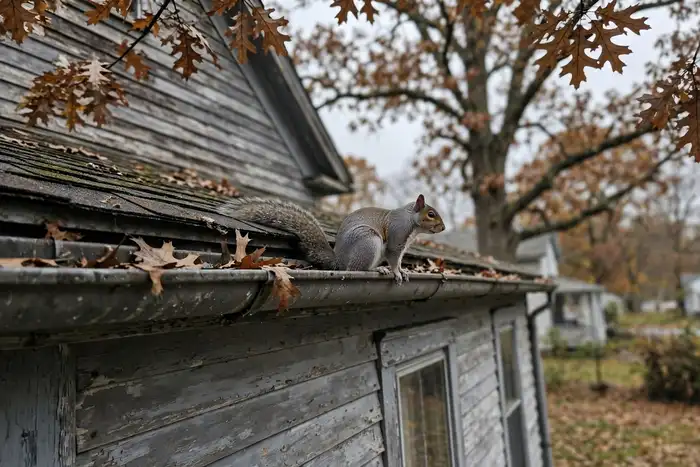
Gray squirrels work the older rooflines above Painesville's in-town streets each fall, slipping through soffit gaps that lake snow and ice widened, while flying squirrels use smaller openings after dark. Nesting shreds insulation and the gnawing reaches wiring. See our full Painesville squirrel removal guide →
🦝 Raccoons
The river feeds them and older chimneys and garage ceilings house them. A spring mother in an uncapped flue is a classic Painesville call. Ohio rules bar taking a raccoon elsewhere, so the job is exclusion first, every kit accounted for, and the latrine dealt with. See our full Painesville raccoon removal guide →
🦇 Bats
Big brown bats roost behind gable vents and loose trim on older Painesville houses, and some spend the winter asleep in the attic. State blackout dates decide when exclusion can run — April and early May, then August to mid-October are the lawful seasons. See our full Painesville bat removal guide →
🦨 Skunks
A raised front porch with tired skirting is the address a Painesville skunk picks first, with sheds and low decks as backups. Skunks are rabies vectors and Ohio does not allow them to be moved off a property, so quiet exclusion and buried screening do the work. See our full Painesville skunk removal guide →
🦫 Groundhogs
Groundhogs dig under porches, garage slabs and shed edges where in-town lots meet open or brushy ground, then sleep the winter away underground. Fresh dirt in spring means the burrow is awake and expanding again. See our full Painesville groundhog removal guide →
🐾 Opossums
Night wanderers off the river corridor, opossums bed down in garages left open at dusk, under porches and in window wells they cannot climb out of. Ohio law keeps a caught opossum on its own property, so closing the shelter is the lasting half of the job. See our full Painesville opossum removal guide →
🐿️ Chipmunks
Chipmunks tunnel tight against older foundations, front stoops and porch footings, carrying the soil away so neatly that the damage hides until a stoop edge starts to settle. Feeders mounted by the house keep them digging in exactly the wrong place. See our full Painesville chipmunk removal guide →
🐀 Rats, mice & voles
Norway rats along the river and in older housing, house mice pouring through pipe gaps at first frost, and voles tracing trails under lake snow that appear at melt — in Painesville each one points to a different part of the property. See our full Painesville rodent removal guide →
🐍 Snakes
Garter snakes in the garden, rat snakes in garages after mice, and heavy-bodied northern watersnakes near the Grand River. Nearly every Painesville snake is harmless; the useful call is a calm identification and, indoors, removal. See our full Painesville snake removal guide →
🪰 Dead animals
A smell that grows in one room often means an animal died in a wall, under a porch or down in the garage ceiling during the cold months and the thaw is announcing it. Locating and removing the source beats masking it, every time. See our full Painesville dead animal removal guide →
Animal-specific help in Painesville
Deep, local guides for the problems we get called about most — with our wildlife crew behind every one.
How to get help in Painesville
Tell us what you're hearing
Scratching in the attic, a snake by the porch, holes in the yard — call with your problem and your Painesville address.
We connect you locally
Call us and tell us about the job — we will confirm the local crew for your county before any work starts.
They solve it — for good
Inspection, humane removal, full exclusion and cleanup — handled by our wildlife crew, following Ohio rules.
Common wildlife removal questions in Painesville
Who do I call for wildlife removal in Painesville?+
Why do animals keep getting under my porch and into my foundation?+
Can bats be taken out of my attic in the middle of summer?+
Will you trap a raccoon and let it go out in the country?+
Does living near the Grand River mean more wildlife at my house?+
How much does wildlife removal cost in Painesville?+
Serving all of Lake County
Painesville is one part of Lake County. See wildlife removal in Lake County, OH for the county-wide picture — the animals we get called about most, and the other towns we cover.
One call to your Painesville wildlife crew
Whether it's squirrels in an older in-town attic or a raccoon in a new subdivision crawlspace, the fastest fix is our wildlife crew, who knows Lake County wildlife. Call us and tell us about the job — we will confirm the local crew for your county before any work starts.
- Local to Lake County. ODNR-compliant handling — call to ask about licensing and insurance.
- One company, one call. Call us and tell us about the job.
- Done right. Removal, exclusion and cleanup.