Bat Removal & Exclusion in Painesville, OH
Pepper-like droppings piling up beneath one spot on the siding, or a bat circling a bedroom at 2 a.m.? Painesville's older houses shelter big brown bat colonies in summer and sleeping bats in winter — and Ohio law fixes the dates when they can be moved out. Call us and tell us about the job — we will confirm the local crew for your county before any work starts.
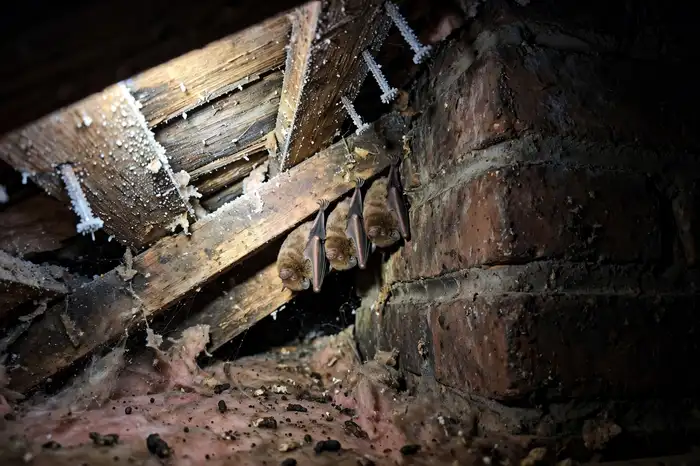
Bats in your Painesville home
The bat behind a Painesville gable vent is, in nearly every case, a big brown bat — a species well suited to this town. Older houses offer it tall, warm attics for a summer maternity colony and, in winter, quiet wall voids and attic corners cold and steady enough to sleep in until spring. Homeowners discover a colony by the droppings accumulating below an entry, brown staining around a vent, faint chirping from a wall on a warm evening, or a single bat that took a wrong turn into the living space.
Ohio regulates bat work more tightly than any other job on this page. Exclusion is the only lawful way to remove a colony, only a licensed operator may do it for hire, and the state's calendar — not the weather, not the homeowner's patience — decides when it may run. A crew that understands the calendar protects both the colony and the customer; a crew that ignores it can seal live bats into a house.
Two closed seasons, two open ones
The rule, in Ohio Administrative Code 1501:31-15-03(H)(5), closes bat exclusion from May 16 through July 31 whenever five or more bats are present, because that is when flightless pups are in the roost, and from October 15 through March 31, because bats may be hibernating in the building. Working inside either closed season takes prior written permission from the Chief of the ODNR Division of Wildlife. The open seasons are April 1 to May 15 and August 1 to October 15. A June discovery is therefore not a dead end — it is an inspection now and an exclusion scheduled for August, before the colony settles in for winter.
Winter bats are still in the house
Many people assume a bat colony leaves in autumn. Big brown bats frequently do the opposite: they stay, tucked singly or in small clusters into attic corners and wall voids, in hibernation. They are silent, they do not feed, and they are easy to miss on a casual look — which is exactly why the state closes winter exclusion. Sealing a Painesville house in January on the assumption that the bats have gone can trap animals that never left.
Entries on an older in-town house
A bat folds through a gap roughly the width of a fingertip. On older Painesville homes those gaps collect at gable vents with failed screens, at chimney flashing pried by ice, behind corner boards and window trim that have shrunk, and along the seam where a porch roof meets the house wall. Droppings on a porch floor, a walk or the ground directly under a gap mark the entries that are actually in use, and the crew works from that evidence rather than sealing the whole house at random.
Guano, indoor bats and sensible caution
Years of droppings under a roost are more than a smell; dried guano can harbor the fungus linked to histoplasmosis, so attic cleanup calls for proper protection and containment. Bats are also the wild animal most often confirmed with rabies in Ohio. That does not make an attic colony dangerous to live under — it makes direct contact the thing to avoid. A bat in a room where someone slept should never simply be shooed out a window; keep the room closed and ask your doctor or the county health department what to do, because testing the bat may matter.
How the exclusion itself runs
Inside an open window, the sequence is methodical: every gap on the house is sealed except the entries the colony is using, those entries receive one-way bat valves, and the bats leave at dusk to hunt and find they cannot return. After checks confirm the roost is empty, the valves come off and the final entries are sealed for good. On a many-gabled older house with several entries, expect the job to be measured in visits spread over days, not a single afternoon.
The two mistakes that make bat jobs worse
Caulking the entry the day you spot it is the first: with bats inside, they scatter into walls and rooms, or die where they cannot be reached. The second is reaching for mothballs, sprays or plug-in deterrents, none of which move a colony and some of which contaminate the attic. Inspect, respect the calendar, exclude one-way, then seal — that order is the whole craft.
Common bat questions in Painesville
How do bats get out of my Painesville attic, legally?+
Why is July too late and January too early?+
A bat was flying in my house last night — what should I do?+
How can I tell whether bats are using my house at all?+
How much does bat removal cost in Painesville?+
Other Painesville problems that come with bats
Our wildlife crew handles these closely related problems — the ones that most often turn up with a bat issue.
Got more than bats in Painesville?
On an older Painesville house, the opening a bat colony uses is seldom the only one ice and thaw have made in the roofline. See everything we handle locally on the Painesville wildlife removal hub, or jump to Ohio wildlife removal.
Serving all of Lake County
Painesville is one part of Lake County. See wildlife removal in Lake County, OH for the county-wide picture — the animals we get called about most, and the other towns we cover.
One call to your Painesville bat crew
A colony sealed in at the wrong moment means pups starving in summer or hibernating adults entombed in winter, and a colony ignored means droppings building in the attic year after year. Call us and tell us about the job — we will confirm the local crew for your county before any work starts.
- Local to Lake County. ODNR-compliant handling — call to ask about licensing and insurance.
- One-way valves, in the legal window. All gaps sealed except the active entries, bat valves fitted during April 1–May 15 or August 1–October 15, then permanent sealing once the colony is confirmed out.
- Done right. Removal, exclusion and cleanup.